Showing posts with label terra transport. Show all posts

Saturday, August 13, 2016

Lewisporte Train Park, Newfoundland

CN 6069 at the Lewisporte Train Park in Newfoundland
In July we paid a brief visit to the Lewisporte Train Park in Lewisporte, NL. I took a different route back from Twillingate via Lewisporte to take in this railway park, and I'm glad I did! My wife and kids were happy to spend a few extra minutes as we stopped at the nearby Tim Horton's in town for a snack.

Lewisporte is a bustling town of about 3,300 people. It was located at the end of the 9.4 mile Lewisporte Branch, built to provide a deepwater port for the Reid-Newfoundland Company's coastal boats. It was originally called Burnt Bay but was renamed Lewisporte after Lewis Miller, who was a Scottish lumber mogul. The branch became critically important during World War 2 with the rapid expansion of the Newfoundland Airport (now called Gander) and its importance for trans-Atlantic flights. Fuel for the important Gander airport was brought to Lewisporte by ship and travelled twice daily by "oil train" to the airport.

The branch connected to mile 244 of the main line at Notre Dame Junction.

TerraTransport
After the creation of Terra Transport, the subdivision was downgraded to a spur and eventually saw its last train in 1987 and was closed in 1988.

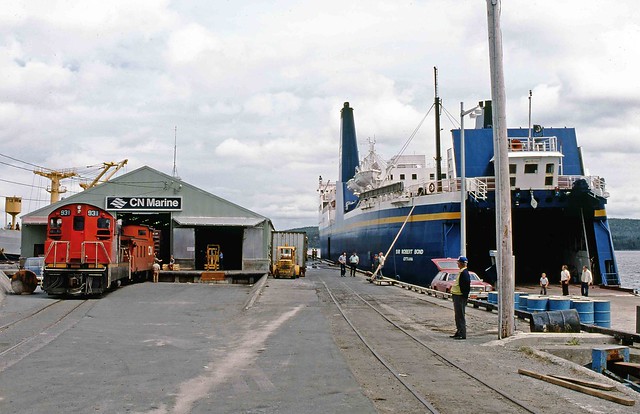
Here's a photo by James F. Primm II showing CN 931 working the CN Marine warehouse on the docks at Lewisporte.
CN NF210 #931 at Lewisporte NL, 1980
Lewisporte still hosts ferries to Labrador.

The train park is located right beside highway 340 and is very easy to find. There is a parking lot next to the train and a nice walking trail behind the display. The train station still exists in the town proper, but we did not visit it.

Snowplow

Snowplow CN 3462 in Lewisporte, NL
The display is headed up by the ubiquitous Newfoundland snowplow, CN 3462. This plow was built by National Steel Car in November 1953. It is unusual in that it has a lot of stenciling on it. Most display pieces lack most of the stenciling that the equipment had when in railway service.

CN 902

The locomotive CN 902 demonstrates this lack of stenciling.
NF110 locomotive CN 902 in Lewisporte
It's surprising that CN 902 doesn't even have the zebra or Terra Transport markings. The far side doesn't have a number at all and the window is boarded up. Note the lack of number boards, too. Perhaps this is undergoing restoration, as Brian Hiscock's photos from 2000 show it with a CN "noodle".

Unlike most of Newfoundland's branch lines, the Lewisporte Branch could operate the heavier NF110 and NF210 units (~100 tonne), because it had a minimum of 70 pound rails. Most branches could only support the lighter G8 (66 tonne) locomotives.

I liked how the garbage cans were railway themed!
Put your trash in the choo-choo bins

Coach CN 764

The sole passenger car is next.
CN 764 in Lewisporte
Coach CN 764 was built by the Canadian Car and Foundry company in June 1949 for the Newfoundland Railway as #47. I peeked in the windows and the seats are still inside.

Note that there would not be a passenger car on a plow train, as this is strictly against the rules. I understand it was commonly done during the Newfoundland Railway days but banned after Canadian National Railways took over the island's railway.

Caboose CN 6069 was built in January 1967 by National Steel Car.

The plow apparently makes a nice play structure!
Climbing the snowplow
(that's not my child on the plow)

The bold Terra Transport logo was evident on the passenger car.
TerraTransport logo
I'm almost done describing the Newfoundland railway sites that we visited. The last to come is Bonavista.

See also:

Wednesday, August 10, 2016

The Clarenville Train Station and Display, Newfoundland

Train station and railway display in Clarenville, NL
My family went to Newfoundland in July 2016 for their first visit to the Rock. I had been to Corner Brook very briefly but this was my first trip to the east end of the island. We landed in St. John's and drove up to Twillingate, and on the way we stopped in Whitbourne and then in Clarenville to catch the railway sights.

Clarenville is an important hub in the area, being the largest town in the area and a service centre for the Trinity-Bonavista peninsula. During the time of the railway, it was a station stop for trains, and the Bonavista branch started at Shoal Harbour, 1.1 miles railway west of the station.

After the railway officially closed on September 29, 1988, a few work trains passed through Clarenville to gather equipment and facilitate rail removal. The last train to enter Clarenville was in October 1990 with engine 914 leading a boxcar, coach and caboose.

NF110 #900 in Clarenville, Newfoundland
CN 900 was restored to its green and gold Canadian National livery and looks great. It was the first NF110 unit built by London's GMD plant.

I find it interesting that the Newfoundland locomotives all have a "skirt" along the side covering the wheels that mainland units seem to lack. I wonder why they had it?

Behind CN 900 is diner #176, built in 1958 for CN by National Steel Car. Apparently this was the last diner built in Canada for the CNR.
Dining car CN 176, Clarenville, Newfoundland
The elements are taking their toll on the roof paint.

Engine 900 and diner 176 were transported by road from the Railway Coastal Museum in St. John's to Clarenville in the summer of 2007. At the time #900 was in CN "zebra stripes" and the diner was in a two-tone blue colour scheme.

Bringing up the rear of this short train is bright red caboose CN/TT 6061.
Caboose CN 6061
There are a few other pieces of railway equipment. Oddly there is no snowplow, unlike almost every other railway display on Newfoundland, it seems!

Two former US locomotives are preserved on a second track.
Former US Army 7596, Newfoundland Hardwoods #31
30 tonne Plymouth locomotive #31 was built for the US Army as #7596 and worked at the base in Argentia, NL before going to Newfoundland Hardwoods.

Former US Navy 65-00236, Newfoundland Hardwoods #32
The other Plymouth locomotive is a 35 tonne unit, built for the US Navy in 1943. It also worked at Newfoundland Hardwoods before being donated to the museum.

There are three flatcars present, mostly ex Newfoundland Hardwoods cars.
Flatcar at Clarenville, Newfoundland
Speaking of Newfoundland Hardwoods, this was an interesting operation that had its roots in the construction of the Gander airport in the 1930s. The asphalt for the runways was landed in Clarenville at a facility next to the railway yard and shipped to the future Gander airport in tank cars. Over time the facility got into pressure treated lumber and became Newfoundland Hardwoods, a Crown corporation. The facility is now privately owned.
A "double gear grab winch", whatever that is

Newfoundland Hardwoods still had three locomotives in 1989, according to the Canadian Trackside Guide (CTG), even after CN ceased operation. The #30 listed in the 1989 CTG is the #32 shown above; #31 is the same, and the 1989 CTG lists a 14 tonne Plymouth locomotive #32... not sure what happened to that one.

Loco selfie!
I am reasonably sure that Newfoundland Hardwoods was the last operating railway on Newfoundland, with two diesel mechanical locomotives, sixteen flat cars and about 3 miles of track. It ceased operating in 2005. Please correct me if I am wrong!

I am glad that the museum was able to acquire the locomotives and a few flat cars. The equipment is owned by the Clarenville Heritage Society.

The station itself is owned by the Clarenville Shriners (shared with the Masons) and is a registered as a municipal heritage building. It was built in 1942 and is one of the few mainline railway stations remaining in Newfoundland.

For more information:


Wednesday, August 03, 2016

The Whitbourne Museum, Newfoundland

On our recent family vacation in Newfoundland, we saw the Railway Coastal Museum in St. John's and the Avondale Railway Museum. The first railway display we actually saw was the Whitbourne train station and display.

History

The town of Whitbourne has a special place in the history of Newfoundland's railway, as it was founded as part of the original railway construction on the island and became Newfoundland's first inland town.

Prior to the construction of the railway, there were very few inland roads on Newfoundland and communities were connected to each other by the sea. There was a great desire to diversify Newfoundland's economy beyond fishing, and therefore to develop the timber and mining resources in the interior of the island.

Whitbourne station/hotel, 1890
The initial railway construction on Newfoundland was undertaken by a New York-based group known as the Blackman Syndicate or the Blackman Company. The railway was to be built from St. John's to Hall's Bay. Construction commenced in 1881 and foundered by the end of 1883 as the syndicate ran out of money. By this time the railway had reached Harbour Grace Junction, which eventually became known as Whitbourne. One of the first permanent buildings in Whitbourne was a combination station/hotel built by a Colonel Davenport.

Whitbourne rapidly increased in importance as the first branch line was constructed to Placentia from Whitbourne in 1887. When the Reid Company took over the railway, it established its headquarters in Whitbourne and built car shops and other facilities there.

Whitbourne's railway significance declined after the Newfoundland Railway moved its headquarters to St. John's, but it remained an important junction until near the end of the railway when the branch to Placentia/Argentia was closed.


Today

Whitbourne train station and railway cars
The quiet town of Whitbourne has a railway station, along with a collection of rolling stock. The station houses the town hall as well as a small museum. The town is a few kilometres off the Trans-Canada Highway.

The station is a nice little building. I am not sure how old it is but it is clearly not the original station. It was closed up when we were there on a grey Sunday morning.

The rolling stock consists of the ubiquitous snowplow, an NF210 engine, an express baggage car, a coach and a caboose. They are not in great condition, as you will see.

Snowplow

Snowplow and other equipment in Whitbourne, NL
The snowplow is ex CN/TT 3459, built by National Steel Car (NSC) in 1953. Snow plows were very important on Newfoundland as the railway was plagued by significant drifts. At one time the railway had two rotary snow plows!

As an aside, people on Instagram seem to love snowplows. The above photo was one of my all-time highest rated images on Instagram.

TT 940

Terra Transport #940, Whitbourne
Terra Transport #940 was originally CN 940, built by GMD in February 1960 for Newfoundland's narrow gauge railway.

This locomotive is unfortunately exposed to the elements (and vandals) and its cab is not in good condition.
Cab of CN/TT 940
A real shame.

Only one of the display locomotives on Newfoundland still retains her diesel engine, CN 931 at Corner Brook. The hood doors were ajar on TT 940, showing the empty, graffiti-marred interior of the long hood.

38 of these NF210 locomotives were built, each with a 1200 horsepower prime mover. They were operated on the main line and on the Placentia branch, but were not permitted on the other branches due to the light rails still present.

Six are preserved on Newfoundland and eleven were sold to other countries. I hope a few still soldier on in narrow gauge service elsewhere!

Express Baggage

Express car 4147 / 1602 / 242
This unnumbered express car was built by the Canadian Car and Foundry company in 1943 as Newfoundland Railway #242. It was renumbered to CN 1602 and presumably continued to operate in passenger train service until it became CN Work Car 4147 in 1974. It continued as a work car until retirement in September 1989, almost a year after the closure of the railway on Newfoundland.

Coach

Ex Newfoundland Railways coach 33
This unnumbered coach was built by the Canadian Car and Foundry Company in 1943 as Newfoundland Railway #33. It had much the same history as the express car above. This car is really starting to show its age and the windows, although barred, are smashed in places.
*beep*

Caboose

Ex CN caboose 6053
This caboose was built for CN as #6053 by National Steel Car.

Summary

Terra Transport and me
Whitbourne has a long history with the Newfoundland Railway and its successors, CN and Terra Transport.

I hesitated to point out the condition of the display in Whitbourne. I know it is difficult to find dedicated volunteers and many railway museums struggle with funding and staffing. I hope that the town and interested persons can rally to maintain the station and rolling stock for many years to come.


See also:

Friday, February 05, 2016

The Corner Brook Railway Museum

Back in October 2015, I went to Corner Brook, Newfoundland for a short work stint. While there, I spent a bit of time at the railway museum in Corner Brook late one afternoon.

It was a pretty blustery day, and the museum was closed, but the grounds are open so I wandered around, enjoying my first second taste of narrow gauge equipment. (my first was at Exporail in Montreal)

The railway museum is located alongside Riverside Drive on the Newfoundland T'Railway, the portion of the Trans-Canada Trail that is built on the roadbed of the former Newfoundland Railway. Specifically it is on Station Road in Corner Brook, here. It is well maintained by the Railway Society of Newfoundland.

Corner Brook Railway Museum

You can see that one of the major features of the museum is steam engine 593, a Baldwin locomotive built in Philadelphia and delivered to St. John's in 1921 at a cost of $36,870. This locomotive was originally a passenger express engine and ended its long career as a yard switcher in Port aux Basques in 1957.

Newfoundland Railway Steam Engine 593
593 is at the head of a display passenger train that consists of:

  • ex CN 593, Baldwin 4-6-2, built 1921
  • ex CN 1598, Eastern Car box-baggage car, built 1954
  • ex CN 1600, Canadian Car and Foundry express car, built 1943
  • ex CN 758, Canadian Car and Foundry coach, built 1949
  • ex CN 175, Canadian Car and Foundry diner, built 1943 as a coach (lettered as "DINER 10")
  • Twillingate, National Steel Car sleeper built 1938

Twillingate sleeper in Corner Brook, NL

To be honest, I spent more time looking at the other train, the diesel-powered plow train. I am by far more interested in diesel locomotives than steam engines, which you probably know already if you are a long-time reader. Diesels FTW!

The plow train is a little shorter than the passenger train, but it has a nice variety of equipment.

Plow 3460 in Corner Brook, Newfoundland
The plow train consists of:

  • ex CN 3460, National Steel Car snowplow, built 1953
  • ex CN 931, General Motors Diesel NF210, built 1956
  • ex CN 15007, Eastern Car Company side dump car, built 1958
  • ex CN 6072, National Steel Car caboose, built 1967

CN 931 was definitely my main point of interest. It could use a little paint but it's looking pretty good.
CN 931, Corner Brook, Newfoundland
I had a peek into the cab through the windows. Maybe someday I'll be back in Corner Brook during the summer when the museum is open...

I was impressed at how well maintained the displays are. There is no graffiti and the walkways, steps and such are all in good order. Kudos to the Society for such a great job honouring the Newfoundland railway's past.

There's a museum building on site, the Rhoady J. Hickey building. Of course it was closed so I don't know what's inside. I imagine there are a number of artefacts on display.

There is a fair amount of track extending past the displayed rolling stock, coming to a switch and extending past that for a number of metres. It would be fun to run a velocipede up and down the track!

The "Newfie Bullet", the cross-island passenger train officially known as the Caribou by CN, was terminated in July 1969, a few years after the Trans-Canada Highway opened on the Island in 1965. The "bullet" was a bit of humour as the Caribou had a 23-hour schedule between Port aux Basques and St. John's, compared to the 12 hours a car could drive the same distance.

Terra Transport logo
CN took over the Newfoundland Railway after the province joined Canada in 1949. In the 1970s, CN began to rely more on trucks to haul cargo on Newfoundland, and in 1979 the Newfoundland rail operations were spun off into Terra Transport.

Terra Transport operated CN's freight operations, as well as the CN Roadcruiser bus operation and CN's trucking operation.

Newfoundland's branch lines were closed in 1984 and the railway itself was shut down in late 1988 with the last freights running through September, 1988.

Signs of the railway were evident in Corner Brook, with books and signs here and there throughout the town.

I found this switch stand beside a business in the town. The Newfoundlanders clearly take a lot of pride in their former railway. I wish I had seen it in operation but I had never been to Newfoundland before this visit.

I'll leave you with a few more images from the railway museum in Corner Brook.


Thanks for keeping the memory of the railway alive!

For more information: