Saturday, July 29, 2017

Three Passenger Trains in Northern Québec (Guest Post)

The following is a guest post by Al in Vancouver... enjoy!

In June and July of 2017, I had the opportunity to ride three passenger trains in northern Québec. This guest post will focus on overall impressions and tips for railfans.

Sept-Îles - Schefferville
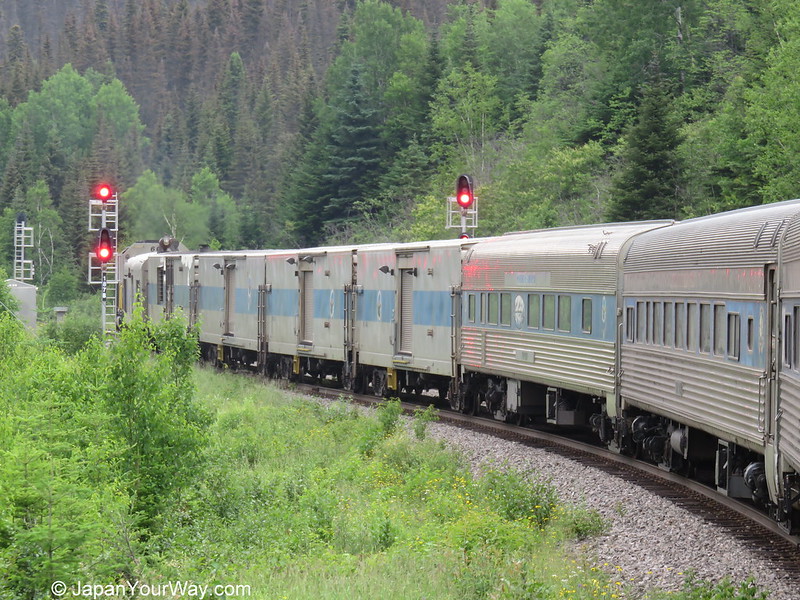
1-IMG_9369 This passenger service is operated by Tshiuetin Rail Transportation, owned by three first Nations in the region.  The head end crew and track between Sept-Îles and Emeril, Labrador are provided by the QNS and L Railway, a wholly owned subsidiary of the Iron Ore Company of Canada.

The train operates twice weekly.  As tickets are non-refundable and the person at the phone number listed on the website told me the train is never full, I decided to buy my ticket at the station in Sept-Îles the morning of departure.  I was surprised to learn they only accept cash (no credit or debit cards) at the station in Sept-Îles.  There is no ATM at the station.  After all passengers with tickets were boarded, I was allowed to buy my ticket and board.  Photo ID is required at boarding.  Seating is first come, first served.
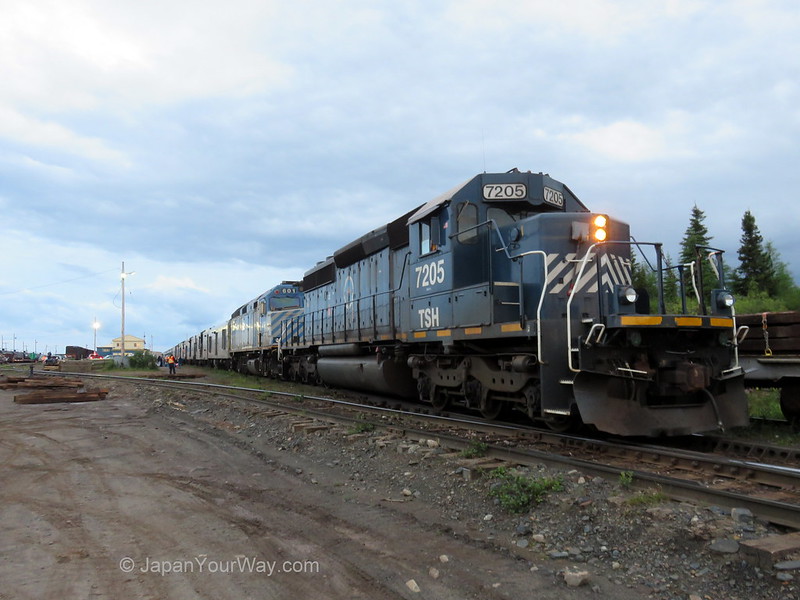
1-IMG_0084
I was surprised at the length of the train:  Two locos (TSH 7205, 601), baggage generator TSH 1423, four baggage (TSH 1422, 1401, 1455, 1445), cafeteria TSH 1000, three older coaches (TSN 1002, 1004, 1005) and two newer coaches (TSH 13518 and 13517).  I was directed to sit in an older coach with red seats (TSH 1004) which was also equipped with a projector and screen suspended between the luggage racks to show movies.  I sat far enough away from the movie equipment so that it would not obscure my view out the window.  A Québec tour group (tour conducted en français) occupied the first newer coach while the trailing coach was kept for employee use.  I estimate 50 to 60% of the seats were occupied.

None of the windows on the train were clean; disappointing as this affected the view.  Even if they were clean, I believe the age of the windows would still diminish the view.  Fortunately a photographer with the tour group was given supervised access to open the vestibule windows, and I was able to use this for photos soon after we left Sept-Îles.  The interior of the train was kept quite clean.

The first 100 miles north from Sept-Îles pass through beautiful scenery as the route climbs along the Moisie River.  Sit on the left (west side) of the train for the best view.  We had a few meets with QNSL iron ore and work trains.  Speeds are generally between 30 to 40 mph.
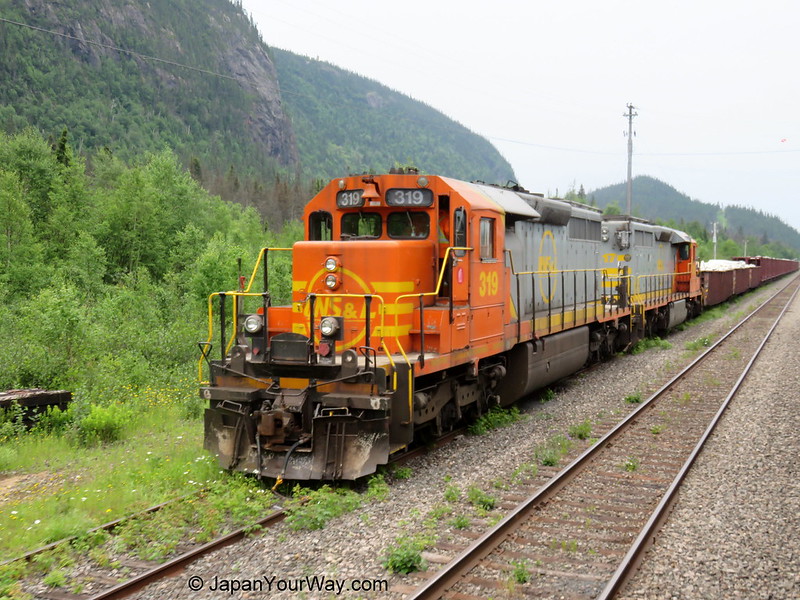
1-IMG_9436
It is interesting to watch the changes in scenery as the train climbs the Canadian Shield and gains latitude north through Labrador.  While the track is in good condition south of Emeril, there are sections north of Emeril that are rough and slow.

We arrived Schefferville around 20:30.  I did not have accommodation reserved but managed to arrange a clean, quiet and efficient room for $75 at a facility for workers named Bloc Orange.  From what I saw of the conventional motels, it is easy to pay over $200.  There is no road access to Schefferville, so things are expensive.  Your mobile phone will not work for voice or data unless you get a local SIM card.  Also note that WiFi gets very congested during the evenings due to high usage over limited bandwidth.

The road between the town of Schefferville and the train station is gravel.  If you decide to walk like I did, there is a good chance someone will stop and offer you a ride!  There is a taxi service in Schefferville, but there was a long wait once the train arrived.  I was also told the taxi is not open in time for the morning southbound departure.
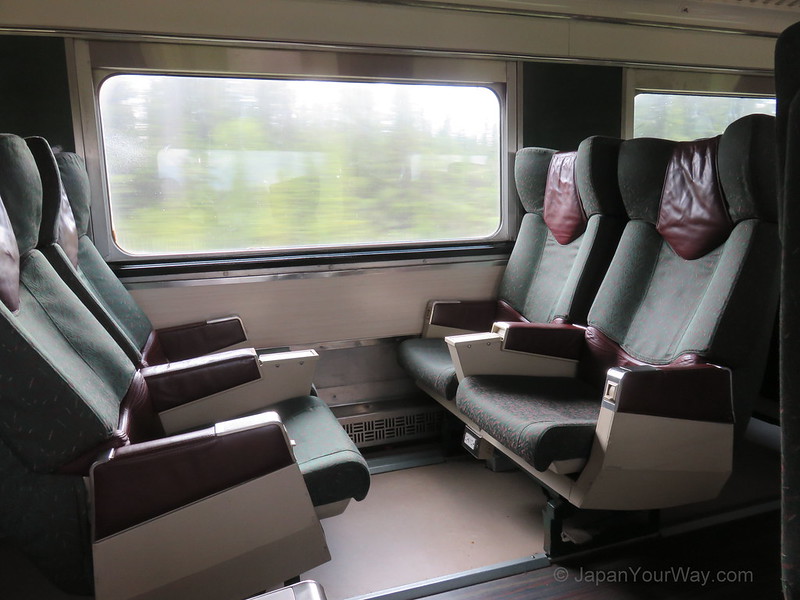
1-IMG_9927
The southbound trip the following morning was on the same equipment, except that locomotives TSH 601 and 701 were leading.  The station at Schefferville accepts credit and debit cards for tickets. Again, photo ID is required at boarding.  There was no tour group southbound and both of the newer coaches were kept for employee use.

We arrived Sept-Îles around 22:00.  The train was turned prior to the station stop.  Apparently it is not unusual for the train to arrive hours late due to meets and slow orders.

There is a good thread about the train on trainorders.com and a CBC documentary on YouTube.

Full photo album on Flickr

Senneterre to Montreal
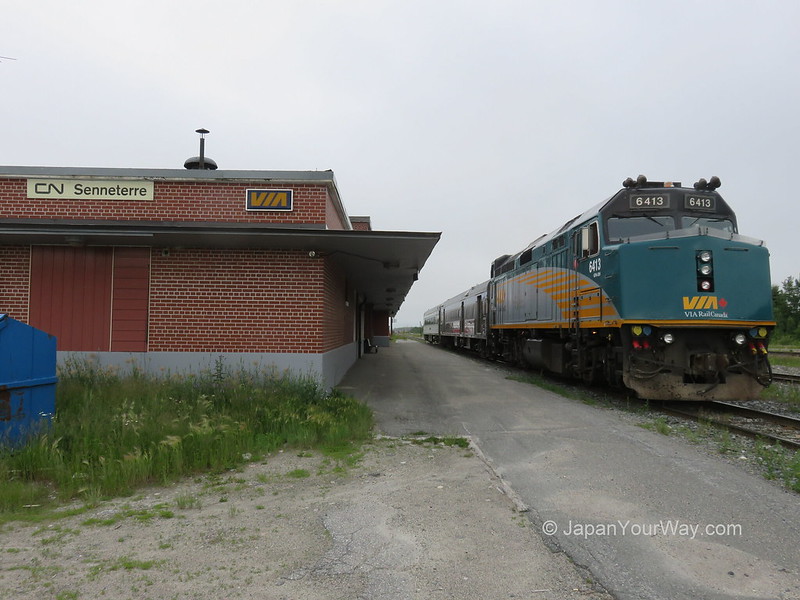
1-IMG_0321
VIA Rail operates this train, as well as the Jonquière train described below, over CN tracks.  Each train is operated with a single F40PH-2 loco, one 8600 series baggage car and one HEP2 coach. They operate three times a week.  Seat selection is not pre-assigned.

Due to limitations in my schedule, I chose to do this trip one-way from Senneterre to Montreal.  In retrospect, I would have done a return trip on this route, as the scenery is nice and because this train is always at the rear of the combined Senneterre and Jonquière train south of Hervey, providing access to a window facing out the rear of the train.

Note that not much is open in Senneterre before the train departs (even for the later Sunday departure), so bring food with you or buy it on board.

1-IMG_0380
The scenery is interesting with lots of forest, lakes, rivers and some hills.  As with the other routes, the northern portion of the route provides access to camps, cottages and settlements that do not have good road access.

We were two hours late arriving Hervey due to meets and slow orders.  We pulled into Hervey station for passengers, then reversed out to allow the train from Jonquière to get into the Hervey station ahead of us.  We then coupled to the rear of the train from Jonquière.
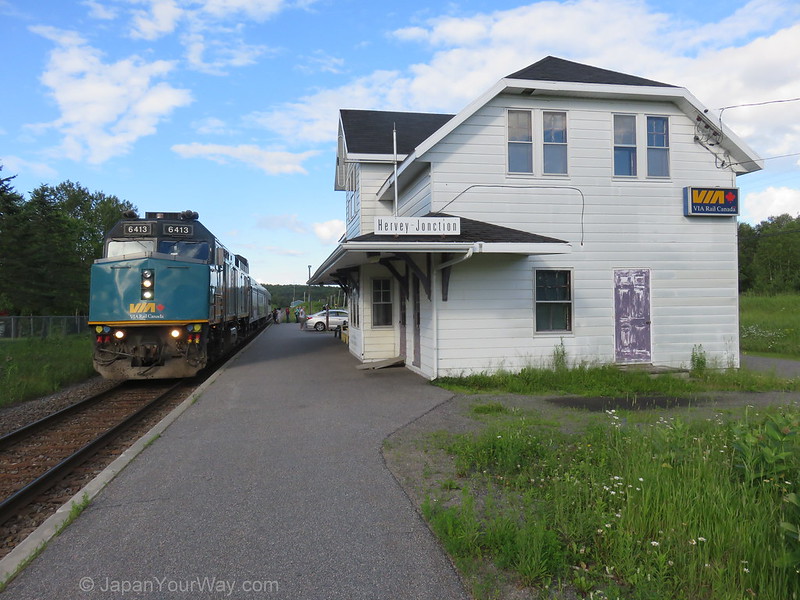
1-IMG_0848

The route from Hervey to Montreal is similar to the route between Québec City and Montreal with lots of rich farmland and stretches with good track speed.  There are some significant trestles on the Joliette subdivision (miles 50, 52, 58, 65 and 76), a tunnel at mile 51 and an interesting route through Shawinigan.

As we were still late approaching Montreal, the train stopped at Gare Sauvé for the crew to take a 20 minute rest break, allowing them to extend their operating day by 2 hours.  As the Jonquière train has a later start than the Senneterre train, the Jonquière crew is fresher and this is why the trains wait for each other in Hervey and are coupled with the Jonquière train and crew leading.  By the time we arrived Gare Centrale in downtown Montreal, we were two and a half hours late. Note this train does not use the Mont Royal tunnel, so it takes a while to route through the yard at Saint-Luc.  Most shops at Gare Centrale close at 21:00; fortunately a nearby Provigo supermarket was open til midnight.

I noticed a brochure at Senneterre station describing (en français) an outing using the train from Senneterre to Press, with a re-enactment of the last spike ceremony at Press followed by brunch and return to Senneterre by bus.  Remaining dates for 2017 are planned for August 6 and 20.  Info is available by emailing cde@ville.senneterre.qc.ca or calling +1-819-737-2296 extension 221.

The local tourist bureau can suggest activities in the region.  They can be contacted by emailing tourisme@ville.senneterre.qc.ca or phoning +1-888-437-2694 or +1-819-737-2694.

Full photo album on Flickr


Montreal - Jonquière

This train is assembled with the baggage car trailing the coach, i.e., locomotive followed by coach followed by baggage.  I was told this is to allow canoes to be loaded and unloaded using the rear door of the train from the baggage car.
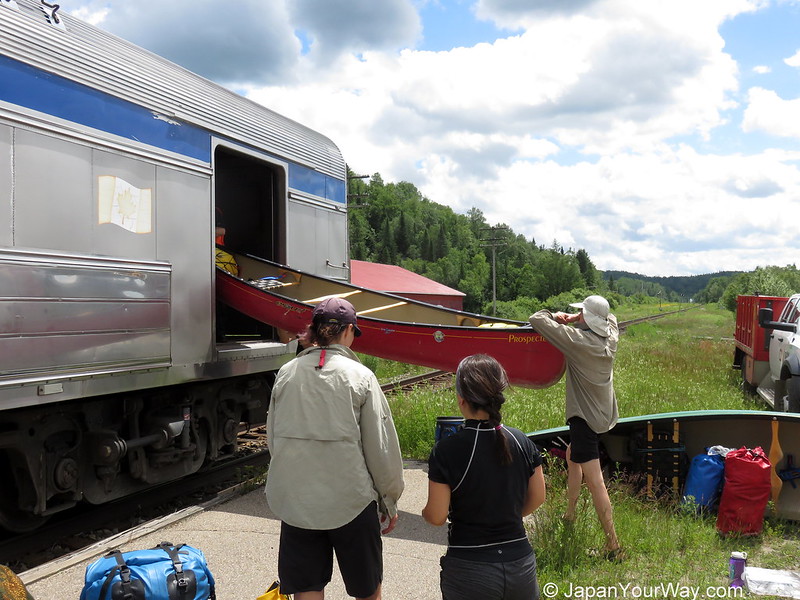
1-IMG_1136
I didn't see this door being used, but I can imagine a stop on a banked curve or conditions at the side requiring rear access.  Note that this arrangement prevents passengers from seeing out the rear of the train.
1-IMG_1035
Between Montreal and Hervey, the Senneterre train is coupled (elephant style) to the rear of the Jonquière train. For this portion of the route, please see my comments above.

Northeast of Hervey, the route follows the appropriately named Rivière-à-Pierre upstream.  The best views are on the north side of the train.  Many cyclists used the train, and at times the coach was around 90% full.  This is a very scenic region with infrastructure for tourists.  There was some freight traffic on the line with a few meets.  Forest product companies seem to be the primary customers.
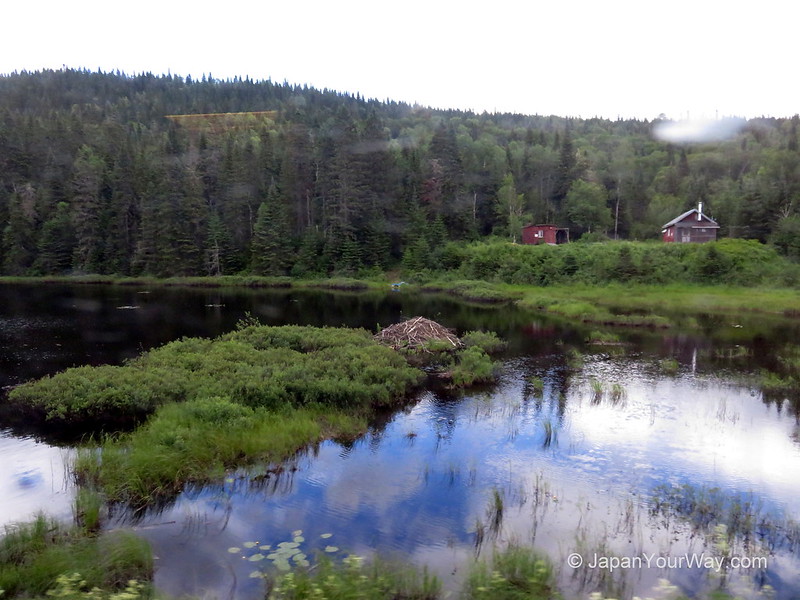
1-IMG_1177
The descent into the Saguenay region provides some nice views (again, the best view are on the north side) of Lac Saint-Jean, which is huge!

The terminus station in Jonquière is conveniently located at a transit hub, providing cheap transit options throughout the region.  I stayed overnight approximately 10km away in Chicoutimi and used transit both ways.

If you are a cyclist and not familiar with Québec's Route Verte and their 5000 km network of bike paths, check out this link.  More info about taking bikes on VIA trains is on VIA's website.

Full image album on Flickr

Final Comments

I thoroughly enjoyed all of these trains.  Although it is difficult to rank them, I have to say the trip to and from Schefferville provided the most memorable experience.  This is due to the different scenery and the QNS&L railway but also because most people operating and using the train were from First Nations.  I suggest that if you take this train, try to get to know some of them (the seats in the cafeteria car provide a good place to do this).  The person who picked me up on the way to the station in Schefferville made a lasting impression as he shared his background and stories with me.  The farther north you go, the more English is spoken, so language should not be a barrier.  Note that if I did not have access to open vestibule windows, it would have diminished the experience.  You might want to bring something to clean your window!  And you should be prepared for mosquitos.

The Québec tour group I encountered on the train from Sept-Îles also offer tours using the Senneterre and Jonquière trains.  While these appear to be conducted en français, the itineraries may offer some ideas.

I'd like to ride all of these trains in winter; perhaps April or May to allow for longer daylight, before leaves on trees along the line obscure the views.

I hope you get the chance to experience these trains!

Al is a railfan based in Vancouver.  He has ridden the rails on six continents and is a guide with JapanYourWay.com offering custom tours to Japan (a great destination for railfans!) and beyond.

Thursday, July 20, 2017

Sixty Million to Churchill?

Omnitrax held a press briefing on Tuesday, July 18 to present the results of the study that they commissioned to assess the flood damage to the rail line from Gillam to Churchill, Manitoba. The costs are.. high.

The Study

AECOM Canada, the engineering company that did the study, estimates that the line could be fixed in 60 days starting on September 1, for a cost starting at $13 million that could climb to $60 million. EDIT: Link to study

The study says there are 13 bridges, 68 culverts and 31 washout areas that need to be repaired on the Hudson Bay Railway's Herchmer Subdivision's 183.7 railway miles (294 km) between Gillam and Churchill.

Omnitrax has stated that they don't have the money to fix it, and have called the line "a public utility" and they "believe there is a role for the public to play" in fixing the line.

Government Response

So far government response continues to be muted. The provincial government indicated it is looking to the federal government to lead. Meanwhile, the federal government indicates that Omnitrax has an obligation to repair the line.

Reports say that Omnitrax has received $20 million from the federal government over the past 5 years and Manitoba has contributed "millions". AECOM said that Omnitrax has spent $60 million on the line since 2009 to improve conditions, although this Financial Post article seems to call that figure into question.

A Deadline

Omnitrax stated that it has to have funding in place by August 1 to begin planning for the work to commence in September, and be completed within 60 days before it becomes too cold to work.

What Now?

There's no doubt that Omnitrax can't afford to fix the line. They are privately held, so their financials aren't available, but the estimate I found says the company's gross income is around $90-100 million USD. $60 million would be a tremendous burden. I assume they have some insurance to cover losses like this but nobody outside Omnitrax seems to know much about that. Many people are insisting that Omnitrax is holding the town of Churchill hostage for public funds.

As I said at the end of my last update, I still think the best course of action is for Omnitrax to immediately proceed with the sale it already negotiated, and then the federal and provincial governments can step in to pay for the repairs. It's clear that the governments are loath to contribute money to a private company - understandably - so Omnitrax has to be removed from the situation.

I can't see why Omnitrax would want to hold on to the line, except perhaps to get the best price for it. I have no doubt they are universally hated in Churchill, especially when they boosted the price of gas by 30 percent briefly last night.

So sell it already and let's get on with fixing the rail line and restoring service.

Sunday, July 16, 2017

Railfanning and the Carman Fair

Rio Grande - really?
On Saturday July 15th our family traveled to Carman, Manitoba for the Carman County Fair. It was a lovely - if warm - day and we like going to these country fairs so the kids can ride on the midway rides without too much of a crowd.

The CEMR Carman Sub

We drove down on highway 3, paralleling the Central Manitoba Railway (CEMR) Carman subdivision for most of the trip. I noted cars at the Sanford grain elevator and some tank cars and a few ex Illinois Central ballast cars parked in Brunkild. At the Pioneer grain elevator outside Brunkild, there were some maintenance machines and an ex Amtrak ballast hopper working on the elevator tracks.

Carrying on down highway 3, the Sperling grain elevator was still gone (sigh) although there were tank cars stored in the village. The Homewood grain elevator is alive and well and the Carman warehouse had a lot of grain cars at it.

Stored potash cars and the fair
As we drove into Carman, I noted many potash cars stored in the town as well as a short CEMR train with two locomotives on it. I resolved to come back to that when we left.

The Fair

The fair was great - the kids had fun and my wife and I found the temperature and crowds quite tolerable. We ate supper there and the food prices were quite reasonable.

I saw one place advertising a schnitzel sandwich so I had to have that. It was greasy but tasty!

As you can see from the lead photo in this post, I couldn't help railfanning the toy train.

After we visited the petting zoo - very popular with the kids - we had ice cream and then hit the road. I decided to head back through Elm Creek / highway 2 to cover a different route.

CCGX 5202

On our way out, I stopped to photograph the CEMR train. It was not positioned for photography so I had to shoot a bit against the sun. Here's a photo I processed with HDR to get as much detail as I could.
CCGX 5202 and CEMR 5396 in Carman
The far locomotive is CEMR 5396, an ex CP SD40-2 that I have photographed many times. The near one, though, is new to me.

CCGX 5202 is an SD38AC originally built in 1971 for the Bessemer and Lake Erie Railroad as BLE 865. It was acquired by the Duluth, Missabe and Iron Range Railroad as DMIR 200 in early 1993 and retired in April 2008. It bounced around a couple of small companies and Cando Contracting acquired it in August 2015 (more info).

This loco has been painted in Cando's sharp "swoosh" scheme and looks quite nice. Note the "SD38AC" designation, the plaque "Rebuilt with pride by CEMR Winnipeg", and the Buzz Lightyear sticker.

That was nice to see. Hopefully I'll see it in better light soon.

Barnsley

On the way up highway 13 to Elm Creek, I stopped briefly to photograph the two lovely grain elevators in Barnsley. They looked very nice in the setting sun's light.
Barnsley Grain Elevators

Elm Creek Switching

As we approached Elm Creek, I could see the highway was blocked in the distance.. by grain cars! It turned out that the CPR was in town. I drove through town and found the head end at the wye.

Two of the new ECO units
The train had two of the rebuilt "ECO" units on it, CP 2238 and 2325. Again the sun was in the "wrong" spot so I did the best I could. I saw the conductor walking back to the locomotives, so I drove over the nearby crossing to avoid being trapped on the "wrong" side of the train.

The light was better on the other side..
CP in Elm Creek, Manitoba
If you squint you can see the Cargill unit about 2/3 of the way across the photo, near their grain elevator.

They started pulling, so I grabbed a photo I had been planning for a long time... the train by the giant fire hydrant.
CP 2238 and the giant fire hydrant in Elm Creek, MB
That hydrant is apparently the second largest in the world.

Homeward Bound

We headed home without waiting for the train, as it was getting late and I didn't want to push my luck with my family. We passed the lovely elevator in Culross - no cars - then Fannystelle - no cars - then Starbuck - cars - then back onto the Trans-Canada Highway and home.

This was essentially our route:

See Also


Saturday, July 15, 2017

10 Questions for Kevin Burkholder

This series is modeled after the "Interesting Railfan" series in Railroad magazine from years ago. I'm asking each railfan 10 questions, some standard and some customized for the particular person. I hope you enjoy it. (See all in the series)

I put 10 questions to Kevin Burkholder, who is what you might call a professional railfan. He runs Steel Wheels Photography.

1. Tell us a little bit about yourself.

I’m a retired flight paramedic, having served 22 years in that particular venue and more than 30 as a paramedic overall.  I reside in the quaint railroad town of Bellows Falls, Vermont, with my wife and soon-to-be 9 children…#9 is due in September.  To be fair, several of the children have graduated and moved on, but we have age range from 21 down to newborn in September, which will then put us at 5 boys and 4 girls.

We affectionately have nicknamed our brood ‘the Burky Bunch’.  Despite the family and the former medical career, through doing various work for the rail media industry since 1988,  I have established many strong contacts in the rail industry, not just with railroads but with various builders, paint contractors and rebuilders.

NS 6920 in Binghampton. Photo by Kevin Burkholder.

2. Why do you like trains?

I grew up on Railroad Street in Myerstown, Pennsylvania, with my great grandfather working as an electrician for the Reading Railroad.  Within eyesight of the Reading Railroad and then Conrail after that, my grandmother would walk me to the tracks to watch the trains go by.

My photographic interest was sparked and I received a 110 camera for my 8th birthday, for which I put to good use shooting the end of the diverse schemes and the beginning of Conrail.  My father would continue to nurture the desire for train photography and had a slide camera that he would take with us on trips to various rail hotspots of the time, including Potomac Yard and other now long-gone locations around the country and Canada.

I started shooting slides in 1980ish and stayed with that until 1999, when my conversion to digital began.

3. If you could railfan anywhere, anytime, where and when would it be?

Back in Australia, where the scenery is as diverse and unique as the rail equipment itself.  I wouldn’t be able to pick any one spot specifically as I love different angles and locations.

NOW – if I could take my current array of equipment back in time, it would be 1955 to the old Chesapeake and Ohio transitional era, where I would likely be in heaven 😊

4. What’s your favorite railway?

The kind that runs…  Actually I don’t have any one favorite railway as I am intrigued by all operations and all types of equipment.  I do tend to appreciate shortline operations a bit more with their typically older motive power, but love to see trains as a whole (just ask my wife)!

5. How did you decide to get into commercial photography full time?

With photography almost always being my ‘real’ job when compared to my 2 or 3 day-a-week paramedic jobs, I had built a strong and growing customer base that were seeking more time and work as the years progressed.

The air medical industry was making turns that I was no longer comfortable with, particularly in the lack of focused patient advocacy, so after consultation with my chief financial officer, aka my wife Tonya, we decided that the timing (2016) would be right to turn the photo business into my primary business.

I had amassed the equipment through time and the client/customer base was growing with such entities as Genesee and Wyoming having more spot or last-minute assignments.

6. Please describe your photography workflow.

Biggest part of the workflow is planning ahead.  This includes the right equipment for the right location for the right environment ALL the time.  There are times that I preplan a scenario and then map out 3 or 4 variants so that in the end, my plan is complete.

Once to the subject, either safety brief or get into position if from public venue and make sure (aka double check) equipment to make sure that all settings are where you want them to be.  If a marginal weather day with intermittent sun, I make sure that I have settings in my head as to what I’ll change if the weather does.  I shoot in ALL manual mode, never using auto anything except White Balance.

Through the millions of images I’ve taken, I’ve established in my head which ISO to use, what speed and aperture to set, all the while thinking about how I’ll do the final edit to supply the customer with the desired result.

I shoot all images in raw, not touching any jpg settings in my camera.

Once complete with the day, I download the imagery onto a couple hard drives to insure their integrity and then go about editing my selected images with Lightroom and resizing and sharpening in Photoshop.  Depending on my customer’s desire, extra editing may be required or even multiple days.

7. How do you develop a good working relationship with railways?

This one is a HUGE and loaded question.  It is not something that happens in a day, or two or even a month, it is a commitment and professionalism you show for an extended period of time.  It is paying attention to safety and knowing the rules of the railroad, essentially, which in turn promotes respect for them back to you.

It is supplying them with quality product that they can use in marketing and public relations every time, not just the occasional marginal image.  It is being able to produce their desired result, no matter what the conditions are, day, night, rain, snow, sleet or whatever, and producing it how they want it.

It is not just being a railfan and submitting your best picture for consideration…
CP Holiday Train, Plattsburgh, NY

8. What's the most important recommendation you would give someone who was interested in professional photography?

I would say it is having the right equipment, the right motivation, the right training and absolutely (reiterating a previous point) knowing what your customer wants in the end.  There is photojournalism, which I also do, but there is also marketing and PR photography, which often means manipulating an image beyond what is out of the camera and having great knowledge of various editing software that will allow the production of such work.

9. What's in your camera bag?

I’m a Nikon guy for decades now, so my current equipment is as follows:

  • Nikon bodies – D4s, D810 and D800;
  • Lens compilation is actually quite simple and I’ll explain one of the choices in a moment, but I have a 14-24 mm Nikkor f2.8; 24-70 mm Sigma f2.8; 70-200 mm f2.8 Nikkor; a 400 mm f2.8 Nikkor; and a 1.7x Nikon teleconverter.
  • In addition there are remote shutter releases, Pocket Wizard transceivers and batteries in there.
Now – that one Sigma lens in the bag – I had both the Nikkor and Sigma f2.8 lens and I put them head-to-head for comparison and in my case, the Sigma had just slightly higher quality in my images.

Was it an anomaly with the Nikkor lens?  Dunno, but I have stuck with the Sigma for that focal length and it is actually my go to lens for much of my work, especially the night photo work.
Genesee and Wyoming, Georgia

10. What projects do you have ongoing or planned?

I always have multiple projects and plans on the table – however right now the biggest project is keeping my super-hyper-active 2 year-old from injuring herself!  On the rail side, I have multiple TRAINS Magazine assignments in process with diverse writing and photography.

I am working on the annual Glory Days of the Railroad Festival for White River Jct., Vermont, (this year Sept 9-10) that I pull together all of the rail equipment for.  This is usually a rather stressful undertaking right up until the 11th hour when all of the equipment arrives on site.

Aside from that, I have been asked to participate in a charity event back in Australia that will be part of the Discovery Channel’s Railroads Australia series, as well as being invited back Down Under for a variety of other specialty/night photo work.

I had a chuckle recently when there was some jealous rumors floating about that said I had ‘terrorized’ Australia with the night photography.  Far from the slanderous accusations, so far that like I mentioned, another few trips are in the works at the cost of the railroads there getting me back there.

I love what I do and take on as much as possible, often being way in over my head, but after nearly drowning in a lake in minus 27 degree F temps, I feel like I can take it on and stay afloat.

Genesee and Wyoming, Millers Falls, Massachusetts
Thanks, Kevin! To see more of his work, visit his web site www.steelwheelsphotography.com, read his blog, follow him on Twitter, or see his thousands of photos on Railpictures.NET.


See all 10 Questions entries


Thursday, July 13, 2017

Three Tips for Careful Composition

At the Trevi Fountain in Rome
I consider myself a decent photographer. Over the years, I've learned to slow down and take some time to carefully "craft" a photo - if I have time. Sometimes the trains don't wait and you have to shoot quickly, but sometimes... you have the time to do it right.

The two basic elements of a photograph are exposure and composition. I'll write about exposure another time but I wanted to talk a bit about how you can tweak your composition to get better photos.

These are examples of what you can do with composition to improve your photos... maybe not dramatically, but improve them a little bit. It's the details that matter and they all add up.

I'll discuss three things to think about while composing a photo:

  • Watch the edges
  • Move your feet
  • No touching!

Watch the Edges

Ehh, all right, I guess
Here's a half decent photo of a telegraph pole along the CN main line. It's OK, but that wire along the bottom edge... it's distracting. What happens if we crop a bit?

Better!
Just getting rid of that little distraction improves the photo. It'll never be an award winner but it's not bad.

Always watch the edges of your photos for little distracting elements that creep into the photo. Branches, wires, posts... these little pests don't belong in your photo if they are not the main subject.

Move Your Feet

Wide open prairie... not bad!
I was out at Meadows, Manitoba and decided to photograph this road heading off into the distance. I think it's a good photo, but... that pole shadow across the road...

I walked forward a few steps, and voila!
Wide open prairie and no shadow!
Better? I think so. The photo is essentially the same but I eliminated the distracting shadow by moving my feet. I could have zoomed in a bit instead, but that would have changed the composition. By walking a few steps, I end up with the same wide open shot without the shadow.

If I was really picky, I would consider editing out that one tree in the middle of the horizon. It's another detail that I might not want in the shot.
Now, no tree
Sweet.

No Touching!

Try to keep the object of the photo from touching or obscuring other things in the photo. For example, check out these two photos, taken seconds apart.
Locomotive not obscuring the signal

Touching!
See how the locomotive in the second shot obscures the signal? I think the first is a better photo because you can see the whole signal tower. In the second photo you don't see the lower red indication.

It's subtle, but it makes a difference.

Another example. I spent about a minute composing the photo below.
St. Paul's Anglican Church, and fence
I wanted the focus to be on the fence, but not obscure the steeple. I also wanted the cross on top of the steeple to be isolated and not touch anything. It took a bit of maneuvering and careful positioning but I am very pleased with the result.

Details Matter

I hope those three elements of composition will help you improve your photography. Remember to watch the edges for distractions, move your feet to get only what you want in the photo, and keep elements from touching in the photo for maximum effect.

See Also

Saturday, July 01, 2017

150 Canadian Railfans That Inspire Me


In celebration of today, Canada's 150th birthday, I've assembled a list of 150 Canadian rail fans that inspire me.

These people are or were photographers, authors, activists, preservationists, modelers, historians, business people, or some combination of the above. Some even work with the railways. Most are alive today but unfortunately some have passed on.

They are on this list because I have been impressed and/or inspired by their work. This is by no means an exhaustive list of all Canadian railfans, nor the 150 "best", whatever that means. I've tried to only include Canadians, even though there are some American and other photographers / authors / etc. who have done important work on Canadian railways. Today is Canada's day.

It's a list of 150 people that came to mind when I started thinking about Canada's 150th a few weeks ago. I'm sure as soon as I click publish, I'll think of others that should have been on the list, and I'm sure there are many very inspiring Canadian rail fans that I have never met or heard of. C'est la vie.

Without further ado...
  • Fred Angus 
  • Matt Arnott 
  • Rob Arsenault 
  • Justin Babcock 
  • Bernard Babin 
  • William Baird 
  • Brian Barchard 
  • Luke Bellefleur 
  • Anthony Bernard Prince
  • Michael Berry 
  • Pierre Berton 
  • Martin Boston 
  • Tom Box 
  • Bill Brillinger 
  • Jim Brown 
  • Ron Brown 
  • Tim Burridge 
  • Jon Calon 
  • Carroll Cameron 
  • Andy Cassidy 
  • Andrew Castle 
  • Clayton Chaloner 
  • Bruce Chapman 
  • Ken Chivers 
  • Colin Churcher 
  • Chris City 
  • Samuel Clark 
  • Art Clowes 
  • David Collenette 
  • Dan Conlin 
  • Charles Cooper 
  • Raymond Corley 
  • Michael Cormier 
  • Doug Courtney 
  • Glenn Courtney 
  • Peter Cox 
  • Ian Cranstone 
  • Romet CZ Vilenski
  • Steve Dickie 
  • Dave Dineen 
  • Dan Dl'Uo 
  • Geoff Doane 
  • Chris Doering 
  • Luc Doiron 
  • Duncan du Fresne
  • Nick Eh 
  • Bob Fallowfield 
  • Pierre Fournier 
  • Francois Gagné Audet
  • David Gagnon 
  • Eric Gagnon 
  • Patrick Gagnon 
  • Marcus Garnet 
  • Kevin Gaudet 
  • Brian Gilhuly 
  • Ken Goslett 
  • Peter Gough 
  • Harry Gow 
  • Allan Graham 
  • David Guay 
  • Bruce Harvey 
  • Tim Hayman 
  • Fred Headon 
  • Joshua Hoffarth 
  • Nicolas Houde 
  • Steve Hunter 
  • Jack Hykaway 
  • Manny Jacob 
  • Philip Jago 
  • Scott Jay 
  • David Jeanes 
  • Francois Jolin 
  • Ken King 
  • John Knowles 
  • Peter Lacey 
  • Matthieu Lachance 
  • Matt Landry 
  • Barbara Lange 
  • Owen Laukkanen 
  • Omer Lavallee 
  • Will Lawrence 
  • Gary Lee 
  • Jimmy LeFrense 
  • Wendell Lemon 
  • Bill Linley 
  • John Longhurst 
  • Steve Lucas 
  • Ken MacDonald 
  • Louis MacIsaac 
  • Taylor Main 
  • Trevor Marshall 
  • David McCormack 
  • Ken McCutcheon 
  • Greg McDonnell 
  • Joe McMillan 
  • Chris Mears 
  • Steve Meredith 
  • David Morris 
  • Raymond Morrissette 
  • Douglas N.W. Smith
  • Gary Ness 
  • David Othen 
  • Pat Othen 
  • Jason Paul Sailer
  • Ron Pelletier 
  • Lorne Perry 
  • Mark Perry 
  • John Peter Cowan
  • Kenneth Pieroway 
  • Duane Porter 
  • Ted Rafuse 
  • Isaac Raymond 
  • Ron Ritchie 
  • C. Robert Craig
  • Earl Roberts 
  • Mike Robin 
  • Jody Robinson 
  • Matthew Robson 
  • Phil Ross 
  • Mark Rushton 
  • Mark Sampson 
  • Brian Schuff 
  • Jason Shron 
  • Trevor Sokolan 
  • Andre St-Amant 
  • Adam Steele 
  • Sean Steele 
  • Conrad Steeves 
  • Brett Stevens 
  • Tim Stevens 
  • Ken Storey 
  • Hugues St-Pierre 
  • David Stremes 
  • Lawrence A. Stuckey
  • John Sutherland 
  • Stafford Swain 
  • Bill Taylor 
  • Lorence Toutant 
  • Blake Trafford 
  • Michel Tremblay 
  • Robert Turner 
  • Morgan Turney 
  • Stephen Vallis 
  • Malcolm Vant 
  • Christian Vazzaz 
  • Caleb Wentzell 
  • Mike White 
  • Douglas Wilson 
  • Ian Wilson 
  • Michael @ Beachburg Sub blog (sorry, don't know your last name!)
To everyone on the list, and those who I accidentally omitted, thank you for inspiring me to continue photographing trains, writing about trains, and supporting trains where I can. You've inspired me and others more than you know.


Aside: Eric Gagnon compiled a list of 150 Great Things about Canadian Railways. I purposely didn't look at it until I finished compiling my list. Now I see at least 7 people in common between our lists!
My daughter...
quite a while ago
I've finally stopped calling this day Dominion Day... it's only taken me a 35 years. The last Dominion Day (July 1, 1982) was very memorable for an impressionable teenager, so it stuck with me. But it's (finally) time to move on.

Happy Canada Day, everyone. Maybe I'll see you trackside some day.

Other Canada Day posts: