Showing posts with label 6416. Show all posts

Friday, August 24, 2012

Some Recent Canadians

Here's a few Canadians I have seen recently. Here's a challenge for you. Tell me which photos I've processed with HDR.

Let's start with July 26. I was out at Carman Junction in Winnipeg to shoot VIA 1. Here's the head end as they start to round the bend.
VIA 6411 in Winnipeg

The same train, just a few seconds later after it has mostly rounded the bend...
VIA 6411 in Winnipeg

No going away shot here as it was out of focus.

Skip ahead to August 11. This is just past Shaftesbury Boulevard, about a mile east of Carman Junction. Note how brown the grass was... we haven't had a lot of rain in August.
VIA 6416 in Winnipeg

Here's the going-away shot.
VIA Rail Canadian in Winnipeg

And the video...


And now, August 16, at St. James Junction. I was sitting in my car, reading a book, and I was so engrossed in it that I almost missed the Canadian going by!
VIA 6438 in Winnipeg

Going away.
VIA's Canadian in Winnipeg

Here's the video of the August 16 Canadian, complete with wind noise and the bang-bang sound of the wheels going over the CN-CP diamond.

Here's a bonus train, CN 786 coming into Winnipeg on July 26 with a long string of potash cars... perhaps going to Saint John?
CN 2403 leads train 786 into Winnipeg

So... what photos did I use HDR on?

Sunday, December 25, 2011

Tuesday, November 22, 2011

Single Image HDR

I mentioned HDR a while ago. HDR stands for High Dynamic Range and is basically a way of processing digital images to include more details in a photo than your camera is normally capable of taking with a single image. Traditionally, an HDR photo consists of several images taken at different exposure settings and merged together with a software program such as Photomatix.

You can take these different exposures automatically or manually.  My T1i allows me to shoot three images, one "normal", one under-exposed and one over-exposed, by a menu setting and then clicking the shutter button three times in a row. Preferably you have the camera on a tripod so the scene doesn't change between clicks.

The reason HDR works is because different details are recorded when you change the exposure. When you over-expose an image, you brighten up the shadows and reveal details that aren't there at a "default" exposure. When you under-expose an image, you preserve details that might otherwise be blown out at the normal exposure and rendered as simply white pixels. The software merges them together in a process called "tone mapping" that takes all the images and renders them into one image.

HDR is kind of a love it or hate it thing with photographers. Many photographers love the marvelously detailed photos it produces. Many others hate the "fake" look that many HDR photos have, either intentionally or otherwise. Personally, I like "natural" HDR photos but I really dislike the luminous, false-looking photos that some people produce.

Here's what I consider realistic HDR. Click on the image for a larger view.

Now this one is what I consider UNrealistic HDR. It's pretty but it does not look real to me.

You may know that many cameras can shoot in "RAW" mode, meaning they capture the raw output from the camera's sensor into a file. A camera that shoots only JPG or TIF photos takes the raw output and applies exposure, white balance and other settings to the raw output, saves the JPG or TIF and then throws the raw output away. This saves space but some detail is lost. I shoot RAW photos these days and process them into JPGs before publishing them here. Almost everybody who does HDR work does it with RAW files.

There is a version called "single image HDR" that does HDR processing on a single RAW camera image. How does that work? You basically copy the same image three or four times, then tell your favourite HDR program that they are separate images taken at different exposures. Theoretically it is good for photos like I take, where you cannot take multiple exposures of the same scene because the train isn't holding still for you! I thought I'd give it a try with a few images.

I took this image of VIA 6416 I shot a few days ago.
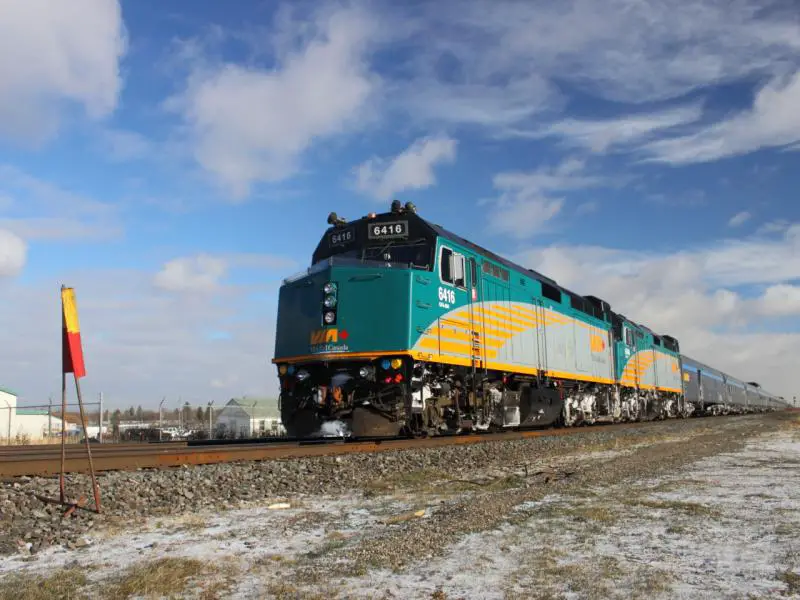
VIA 6416 in Winnipeg
I ran it through Photomatix as a single image HDR and came up with this.
VIA 6416 as HDR in Winnipeg, MB
I see a lot more detail on the engine itself, as the shadows are reduced significantly. I also see some improvement in cloud detail and colour, but I think the engine itself shows the most improvement. What do you think?

You can see from the watermark that I haven't paid for Photomatix yet. ;)

Here's another from the same blog post. CP 9109 and CP 5764 were heading south on the La Riviere subdivision just outside La Salle, Manitoba. I tweaked this image as much as I could to show some detail on the undersides. Since I was shooting toward the sun, the sky in the top left was blown out and there was a lot of contrast in the shot.
CP 5764 near La Salle MB
Here's the Photomatix treatment.
CP 5764 near La Salle MB
I think the second image is much better. There is a lot more detail in the clouds and the shadows are significantly less. However, the second image seems a bit unreal to me. There is a Luminosity setting in Photomatix, and I cranked it up a bit for this one to see what it would do.

I'm going to try the "blah" images from last week and see how they turn out. I'll let you know.

What's your impression of HDR processing? Do you like it? Hate it? Don't see much point to it?

Sunday, November 20, 2011

Bright Sun Shiny Day

VIA 6444 in Winnipeg


I can see clearly now the rain is gone 
I can see all obstacles in my way 
Gone are the dark clouds that had me down 
It's gonna be a bright sun shiny day  - "I Can See Clearly Now", Johnny Nash


Thursday noon was a very bright, sun shiny day as you can see. I went out to shoot the Canadian and was pleased by the nice weather. First up was train 314, heading east on the north track.
CN 2264 in Winnipeg

Note the flag at the end of the bridge, visible in front of the junction between the two engines. There was a crew working on St. James Junction a little ways east of me, on the south track.

Soon after 314 passed my location, I saw VIA's headlights come around the corner at Portage Junction in the distance. They rolled past St. James Junction then switched over to the north track just before my location. VIA 6416 and 6444 were the power for this ordinary Canadian. I was standing on the slope leading down to route 90, trying to get a more ground-level shot than the usual height.
VIA 6416 in Winnipeg

A passenger in one of the coaches gave me a wave as they rolled on by. Or maybe she didn't want her picture taken. I'll assume it was a wave. :)
Waving Passenger

A train is visible in the distance here... CN 192, in fact.
VIA Rail's Canadian

This was the first time I'd seen train 192. I believe it is an extra train from Prince Rupert that runs on occasion to supplement CN 198. CN 8954 and another engine were on the head end, and CN 2263 was pushing on the very end.
CN 8954 in Winnipeg

Here we look over the engineer's shoulder at the signals protecting St. James Junction.
CN 8954 and Signals at St. James Junction in Winnipeg

The signals on the south track (right of picture) are easy. Red over red is covered by rule 439, absolute stop.

The signals for train 192 are on the north track (left of picture). The closest signal is yellow over yellow, rule 409, clear to slow. "Proceed, approaching next signal at SLOW speed." The next signal that 192 will face is red over green, rule 431, slow to clear, "Proceed, SLOW speed passing signal and through turnouts."

This tells us that 192 was going to shift over to the south track, and the confirmation of that is barely visible on the right edge of the photo, just above one of the CN trucks - a green over red indication on the south track, rule 405, "Clear signal, proceed" while the corresponding signals on the north track are red over red.

EDIT: Corrected first signal description, thank you Jeff!

Sunday, July 10, 2005

VIA 15 at McGivney

On Sunday July 10, David Morris and I went up to McGivney to catch the #15 Ocean. It's detouring via the Napadogan subdivision because of a derailment on the NBEC/CFMG in Trois-Pistoles. We figured it would arrive any time after 19:00.

At 18:55 I was surprised to see a hirail pickup truck approaching from the west. It was followed by two tampers, 656-29 and 621-00. The two tampers were stowed in the storage siding as we watched.


I spoke with the foreman, explaining why we were there and asking when he thought the Ocean would be by. He called the RTC and the RTC said he expected #15 to be at Bantalor in 5 minutes (this was 19:05).

The bugs had a feast while we waited...

The Ocean shot past at 19:30 with 6416 leading a Renaissance consist with (I think) Evangeline Park on the tail end. One of the two engines was smoking quite a bit! I got some video and a few snaps.