Showing posts with label camera. Show all posts

Thursday, August 30, 2018

Review: EW-83J Lens Hood Clone

EW-83J lens hood on my Canon lens
Lens hoods are a useful accessory for your camera. They serve a couple of purposes - keeping side light from reflecting off your lens and causing problems, and protecting the end of the lens. Normally when you buy a lens, it comes with a cap but no hood. Mid to high end lenses, like my Canon 70-200mm f/4 L lens, often come with a lens hood. However, my 17-55mm f/2.8 lens did not come with a hood.

You can buy one from Canon, but it's around $75 Canadian, which is ridiculous for a piece of plastic. So several manufacturers have made similar hoods for the same lens. I bought the BlueBeach version of the EW-83J.

At the time of writing, it's $12 Canadian, which is much more reasonable for a shaped piece of plastic. Shipping is extra, of course, unless you add enough to your order to get free shipping.

Please note: if you buy anything from the Amazon links in this post, I receive a small percentage of anything you buy as a commission, at no extra cost to you.

EW-83J lens hood
The hood comes in a plastic bag - actually one bag inside another, for some reason - and is just the hood with no instructions. Here are my instructions.


  1. Take it out of the bags.
  2. Screw it onto the end of your lens.
  3. Twist it until it doesn't obscure your photo.
  4. Go take some photos.
It's pretty simple.

Some Amazon reviewers have complained that it doesn't fit quite right, and they had to trim it a bit with a hobby knife to make it fit. I found it was a snug fit on my lens - which is good - and so far it has stayed on and done its job. I've been using it for a few weeks now.

To be honest, it fits just as well as the Canon lens hood that came with my 70-200mm lens. That Canon hood sometimes doesn't thread right on the first try, so I have to back it out and try again. Not a big deal, as you normally aren't slapping a hood on in a hurry.

EW-83J lens hood on the Canon 17-55mm lens
It has kind of a petal shape. Make sure you orient it right so that it doesn't block anything in your view. If you have it 90 degrees out of whack, it will cause a little vignetting, just like the "real" Canon hood does.

I'm very satisfied with my lens hood. If you need a hood for your Canon 17-55mm EF-S f/2.8 lens, you might want to buy this one!

You can browse all lens hoods on Amazon, but I really recommend that you search for your particular lens to find a hood made specifically for it. You want a good fit, and read the reviews to ensure people are happy with it. In the end, it's just a piece of plastic, so all that can really go wrong is that it doesn't fit right.

Good shooting!
Ready to photograph!
See all my reviews

Wednesday, May 09, 2018

Canon 77D - First Thoughts

The Canon 77D camera
I bought a new camera body a while ago - a Canon 77D. Since I bought my previous body in June 2010, it was time for an upgrade.

In this article, I'll go through my reasons for upgrading, my camera selection process, general comments about the camera and my experience with low light photography with the 77D.

Why Upgrade?

Night photo with Canon 77D
My Canon T1i was and is a great camera. I've taken close to 60,000 photos with it, and I still use it on occasion for video or as a second camera. In fact, I just used it to shoot a half marathon.

However, it had a few weaknesses that were really bugging me. The biggest one was that it had poor low light performance.

When it's dark, you have only three ways to get a decent exposure for a photo:
  1. Open the aperture up (limited by your lens);
  2. Slow the shutter speed (need a tripod and a stationary subject); and/or
  3. Increase the ISO (increases digital noise).
The problem with the T1i is that above ISO 400, it got very noisy and was pretty much unusable above ISO 800. This meant that I couldn't take star photos, especially not Milky Way photos. Also, sports photography in dim rinks weren't really successful.

My Canon T1i didn't have a flip out LCD screen either. Beyond the obvious selfie potential, I could see that as being useful for composing shots when the camera was on the ground or other positions where I can't look through the viewfinder.

Choosing a Model

Top view of Canon 77D
I had decided to continue with a Canon body. If I was starting fresh, I'd pick a mirrorless camera instead of an SLR, but I have a big investment in good glass (lenses) so I am sticking with Canon.

I didn't want a full-frame SLR, because one of my two good lens isn't compatible and I had already decided that it was unnecessary for my needs. I had been lusting after a Canon 7D Mk II for a while, but after a little research, I found that the Canon 80D was a better camera for a lower price!

A little more investigation showed me that there were three very similar cameras in Canon's lineup:
  1. Canon T7i, consumer grade
  2. Canon 77D, prosumer grade
  3. Canon 80D, semi-professional grade
Here's a table comparing those three camera bodies, along with my old T1i on the left.


Canon T1i Canon T7i Canon 77D Canon 80D
Megapixels 15 24 24 24
Max ISO 3,200 25,600 25,600 16,000
Focus Points 9 45 45 45
LCD Fixed 3" Flip-out 3" Flip-out 3" Flip-out 3"
Frames/second 3.4 6 6 7
Video 1920x1080, 20 fps 1920x1080, 60 fps 1920x1080, 60 fps 1920x1080, 60 fps
Other features - - Built-in interval and bulb timers; top LCD panel Weather sealing; pentaprism viewfinder
Price Discontinued $ $$ $$$
Amazon Buy on Amazon Buy on Amazon Buy on Amazon

You can see there are more similarities than differences between the three "7" cameras. I didn't want the T7i because I wanted a higher-end body to resist weather. The 80D seems like the superior camera but its ISO performance isn't as strong as the T7i or the 77D, because it has an older processor in the camera.

I went to Henry's and asked to look at the 77D and 80D. I held them for a few minutes then bought the 77D.

General Comments

Controls on the Canon 77D
So far I've taken a little over 3,000 photos with the 77D and I am very impressed with it. It operates very much like the T1i, being another Canon product, but it has some definite improvements.

The focusing performance seems better on the 77D, presumably due to the dual-pixel technology that these cameras have. I rarely have a focus miss now, something that I had fairly frequently when using my 70-200mm lens in lower light. I'm also impressed by how well it focuses in lower light, where my T1i would hunt and not focus.

One small thing is that the shutter sound is much quieter on the 77D. My T1i's shutter was super noisy, loud enough that it would sometimes turn heads if I took a photo in a quiet room. The 77D is by no means silent but the shutter isn't very loud.

A few controls have moved - notably, the power switch - but in general, it wasn't a big learning curve for me to move to this camera. I like that there is a separate button to change the ISO. I wish there was a button to change the focus type between "one shot" and "AI Servo".

The 77D has a touch screen. To be honest, I have not used this at all. I've locked it out for the moment, as I am afraid I am going to touch it and change settings that I don't mean to change. Maybe I should try enabling it, as I could change the focus type pretty quickly using the touch screen.

This camera has wireless (wifi and Bluetooth). I've used the app on my phone to receive photos from the camera, but I haven't played with it much. I think it will be more useful as a remote trigger for the camera. More to come.

Low Light Performance

Ooooh, stars!
Here's the important part. I bought the 77D primarily to get better low light performance, and it delivers. I'm very impressed by how much better it is in low light, both when shooting at a low ISO and also how well it performs when I shoot at ISO 1600 or higher.

Here's a photo at a ridiculous ISO 25600 - something I would never ever attempt with the T1i. In fact, you couldn't even select it on the T1i.
ISO 25600 photo with Canon 77D
There's some quality issues, but it is still quite usable at such a high ISO. I was also shooting from across the rink!

In case you're wondering what's going on here, this was a little game they were playing in the stands during a curling competition in Portage la Prairie. The person who could get the most tissues out of the box won a prize.

Here's a more reasonable ISO - ISO 1600. My friend Jason Paul Sailer is giving the wave to a train at sunrise.
ISO 1600 photo of a train with Canon 77D
I'm very happy with the quality of this photo.

Another ISO 1600 photo - curler Kaitlyn Lawes' intensity is apparent as she is delivering a shot at the Canadian Mixed Doubles Curling Trials in Portage la Prairie, Manitoba.
Kaitlyn Lawes throwing a curling stone
I am super happy with the low light performance of this camera.

Summary

I love my new camera! The Canon 77D has met my expectations for low light performance and I've been impressed by its focusing capability and picture quality. I have very few complaints.

I was not compensated in any way to write this article. I just want to share my experience with the camera!

Sunday, February 12, 2017

AmazonBasics DSLR and Laptop Backpack Review

I've had a sling-type camera bag for a while, but I wanted to get a larger bag that also included a spot for a laptop. A few blogs had mentioned the Amazon Basics DSLR and Laptop Backpack so I decided to give it a shot.

I lucked into a little sale and got it for $45.99 (Canadian) with free shipping. It arrived quickly and I took a little video while I unboxed it.
The backpack has three compartments - a slot for a laptop up to 17" in size, the main compartment with sections for camera bodies and lenses, and a smaller accessory compartment with pockets and slots for cables, pens, etc.

The Camera Compartment

The main compartment has dividers that you can move to fit your own equipment. I would say that you could easily fit two complete cameras in here.

In my backpack, I've put my camera, with my two main lenses (and my "nifty fifty"), a flash, battery charger, rain cover, and a few other doodads. There is room for more.

I can fit my camera with a telephoto lens on it very comfortably in here.

I think I will be fiddling around with the compartments a little more to get just what I want. I may wish to have the camera closer to the top so I can just unzip the top and slip the camera out, rather than having to open the compartment fully to get the camera out.

The Laptop Compartment

There's not a lot to say about the laptop part. Most laptops will fit here no problem at all. I have two laptops, a giant 17" Dell workstation and a smaller 14" laptop. Needless to say, the 14" computer fits in with no issues. The Dell, however... it's a tight fit. The zippers do close but just barely.

You should keep in mind that my 17" Dell is a large laptop and most people comment on its size when they first see it. There's a tasteless joke in here somewhere.

Here's a photo of my smaller laptop in the bag.

I'm confident that the vast majority of laptops will fit in this bag.

The Front Compartment

Front compartment
The front compartment is for all the miscellaneous doo-dads that you carry around. Laptop charger, cables, pens, business cards, breath mints, whatever you normally carry along when travelling.

The compartment zips open about 60% of the way. The rest forms a deep pocket to retain larger items.

You can see from the photo that half of the compartment is a large mesh bag, closed with a zipper. I plan to use that for passports, boarding passes and other documentation that I don't want to lose.

The other half has a pouch with a number of small pockets for pens and small items, as well as a clip thingie to attach keys or carabiners to. I would use this to attach the little key generator devices I have to carry around for customers' VPNs.


Other Features

The backpack has straps on the outside for securing a tripod to the backpack. I tried this for a little while and it does work, but I generally don't carry a tripod around and I found the tripod was banging into things as I wore the backpack. To me this isn't a very useful feature but "your mileage may vary".

The backpack comes with a rain cover bag. I haven't had the opportunity to use it yet but it's nice to have. I pretty sure the backpack is not waterproof so you would want to use the bag in heavy rain. I know I have used the integrated rain cover on my Lowepro SlingShot a few times.

Wearing the Backpack

Of course I had to try the backpack on to see how it feels. It has the normal backpack shoulder straps and also has straps to go around the waist.
Wearing the backpack
I don't think I will wear the waist straps.

It's comfortable enough and you can see the shoulder straps are nice and broad so it shouldn't dig into my shoulders.

Dislikes

I can't say I have any real dislikes for the backpack, other than it is different than my Lowepro SlingShot 102AW. I am used to wearing the SlingShot and being able to slide it around to the front and get my camera out fast. With a backpack, you have to actually take the pack off and set it down somewhere before you can take the camera out.

I really see different uses for my backpack and my sling pack. The backpack is for travelling and for having on the passenger seat next to me while driving. I think that is an excellent use for it as everything will be accessible. The sling pack is good for being a tourist - to have the camera easily accessible - but not good for carrying a lot of stuff.

Summary

This backpack does exactly what it promises to do - carry a DSLR and a laptop in a backpack. The price is great and it is a good basic backpack for carrying your computer and camera around. I'm happy with my purchase.

Buy the DSLR / Laptop Backpack

(The Amazon links are affiliate links, meaning that I receive a small commission if you follow the link and purchase something on Amazon, at no additional cost to you. I was not compensated for this review in any way, nor did anyone ask me to review the backpack. I just wanted to share my experience.)

Friday, November 27, 2015

Black Friday

Normally I don't pay any attention to Black Friday* but this year was different. Since I'm on the prowl for a new lens, I wanted to see if it would go on sale today.

It had been listed for $969.99 on Henry's, which is about $80 off their normal price. I wasn't excited about that price so I was holding out for better. I had pretty much resigned myself to trying the Boxing Day sales, but maybe, just maybe Black Friday would come through.

Just before midnight I checked the Henry's web site again.

Another $120 off! (With tax it's $960.49, free shipping)

I didn't wait very long before clicking BUY NOW on that one! The confirmation email came quickly and now I just have to wait for it to ship. I should have it before Christmas...

If you look for the lens on Photoprice.ca you'll see links to other retailers who are selling the lens for the same price. I saw that Canon itself was selling for that price, as was Best Buy and a few other places. I want to support Canadian companies so I chose Henry's, also because they have a store in Winnipeg. Sadly it was web-only so I couldn't get it direct from the local store.


By the way, if you live in the US and are interested in Lightroom and/or Photoshop, this is a steal! The Adobe Creative Cloud Photography plan (Photoshop CC + Lightroom) is on sale for USD $6.99/month... this normally costs $9.99/month so it's 30% off. Snap it up, as this doesn't go on sale often! (that's an affiliate link, where I earn a small commission for anything you buy while you're on Amazon, at no additional cost to you)

* Black Friday is a recent North American tradition of sale prices and ridiculous shopping crowds, which apparently originated in Philadelphia in the 1950s but only became widespread in the late 1980s. I like that it has become more and more an "online" thing.

Sunday, November 08, 2015

Choosing a New Lens

Choosing a New Lens

I'm on the hunt for a new lens for my camera. Currently have three lenses for my Canon T1i:
  • My baby, a Canon 70-200mm f/4 IS lens
  • The kit lens, a Canon 18-55mm f/4-5.6 IS lens
  • The "nifty fifty", a Canon 50mm f/1.8 lens

My Baby

I love the Canon EF 70-200mm f/4 L IS USM lens. It's expensive but man, is it sharp! I bought it in September 2013* and I use it extensively. I use it probably more than I even should, because it is so much better than the 18-55mm lens.

The Nifty Fifty

I bought the "nifty fifty" (Canon EF 50mm f/1.8 lens) back in early 2011. It's a sharp, fast lens but I don't tend to use it very much for railfanning. The problem is that it is a prime lens, not a zoom, so it is not very useful for photographing moving objects. If it was a prime 24mm lens (or wider) it would be more useful. I tend to use the 50mm lens in low light situations because of its wide aperture (lets in more light) and sharpness.

I recommend that everyone have a "nifty fifty" - they are sharp, fast lenses and very inexpensive.

The Kit Lens

That leads us to the 18-55mm lens. It's an OK lens, but it is definitely not sharp. "Kit" lenses tend to be fair quality lenses but you generally want to upgrade from them (they're called kit lenses because they come in the kit you buy with your camera body).

So... what lens to buy? One big problem is that there are so many choices. Canon has 81 lenses in its current lineup! This doesn't even count the third-party lenses from Sigma, Tamron or Tokina...

Narrowing the Focus

It's important to narrow this field down by deciding precisely what you want. My 18-55mm replacement is intended to be a walk-about lens that I will use for photographing moving trains as well as everyday tourist / pictures-of-kids photography. Here's what I want:
  • A similar focal range: 18-55mm, maybe 16mm at the low end but not more than 70mm at the high end. The focal length can't be longer than 18mm or it's not wide enough.
  • An aperture of f/2.8 or f/4 at the highest.
  • It has to be sharp.
  • It has to zoom... not a prime.
  • Image stabilization / vibration reduction is very important.

The Contenders

Armed with this list, I went out and did a lot of searching to find what lenses were available. In the end, I found 8 lenses. I built an Excel spreadsheet to list the important attributes of these lenses, then read the online reviews and assigned a "desirability index" to each and sorted them. Here are the results:

All prices are Canadian and are store prices at time of writing.

Analysis

The top two lenses are the Canon EF-S 17-55mm f/2.8 IS USM Lens and the Sigma 17-50mm f/2.8 EX DC OS HSM FLD Lens. Both are very good lenses. I really want the Canon but the Sigma is $300 cheaper!

The Sigma 210101 18-35mm F1.8 DC HSM Lens is an excellent lens, by all accounts. I would rate it higher but it has no image stabilization and the focal range is not quite as high as I'd like. That f/1.8 aperture is very tempting, though!

Note that for these third-party lenses like Sigma, it's important to ensure you have the right lens mount. Since I shoot Canon, I've linked to the Canon versions of the lenses. They make lenses for Nikon and Sony as well, so don't buy the wrong lens.

Next Steps

The next step is to go to a camera store and try the Canon and Sigma lenses out. Ideally the store would have both and I could shoot them both and compare the images at home. I know I can't take the lenses with me so that will have to do. I know my heart wants the Canon lens but I have to give the Sigma a good look.

After that it's a question of accumulating enough funds to buy the new lens! Maybe if I sell a few more calendars...

Thanks for reading! Are you in the market for a new lens? Or a new camera?

* The reason why I know that I bought my 70-200mm lens in September 2013 is thanks to Lightroom. It was a simple matter to search by metadata and look for all photos I took with that lens.

The first photo I took with a 70-200mm lens was a pan shot of a passing vehicle to test it out.

Please note that some of the links in this article are affiliate links, meaning that I earn a small commission when you buy something after following the link, at no additional cost to you.

Thursday, July 28, 2011

A Polarizer Comparison

I shot the Canadian today at noon. It had two unrefurbished units, now a rarity, with a dead-heading diner (Emerald).
VIA 6428 in Winnipeg

I had the circular polarizer on my camera while I was shooting. Just for kicks, I decided to take it off and shoot the last few cars without it for comparison.

Here's the last car I shot with the polarizer ON, Bliss Manor.
Bliss Manor in Winnipeg

Here is Elgin Manor without the polarizer.
Elgin Manor in Winnipeg

Neither picture was processed in any way except to crop to size, and both were sharpened to the same degree.

You can see how the sky is darker with the polarizer, and some cloud detail is visible that is washed out without the polarizer.

What do you think? Is the difference significant enough?

Tuesday, January 18, 2011

A Tale of Two Lenses

When I bought my Canon T1i, it came with the "kit" lens, the Canon EF-S 18-55mm lens. As kit lenses go, it's not bad but I always figured I could do better.

That's the thing about SLRs - there is always a better lens out there, if you are willing to spend the money. The thing I always wondered was whether the difference would be noticeable.

I did some research recently and decided that I would like to purchase the Canon EF 50mm f/1.8 II lens. It has good reviews and is known to be a fast lens with good optics.

I went on Kijiji and found one for sale here in Winnipeg for about $30 off retail, and less than 6 months old. Lenses don't depreciate much so this was a pretty good deal. The seller was also selling a battery so I figured I'd get that too... always good to have a spare.

We met at the Forks and I had a look at the lens. It's tiny! I was satisfied with it so we exchanged cash and I went on my way. On the way out, I noticed that VIA 693 was backing into the station at 16:30, "only" about 6 hours late!

I headed over to CN Subway, and on the way shot CN 111 rolling past Canwest Park with CN 8932 and CN 2307 on the head end. This was a grab shot.
CN 8932 in Winnipeg at Canwest Park
As I went down toward Osborne I saw CN 8948 was the DPU unit in CN 111. I also saw an eastbound with CN 2663 and CN 2651 on the north track going by CN 111.

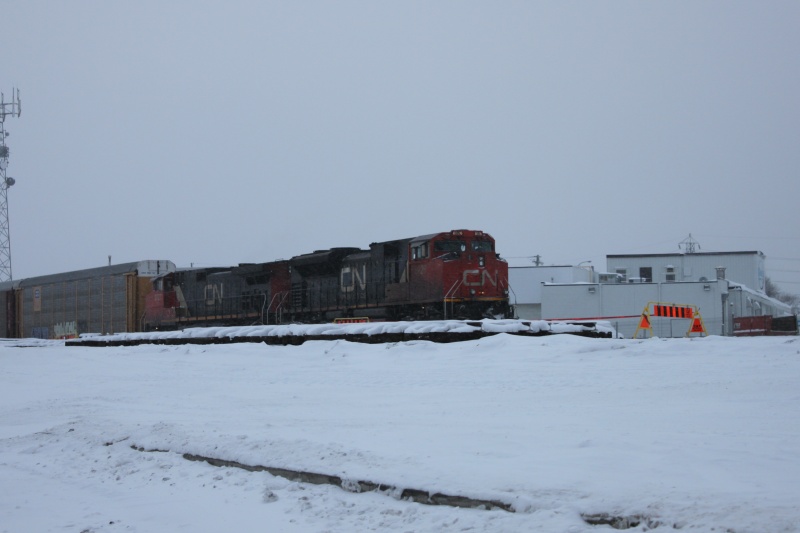
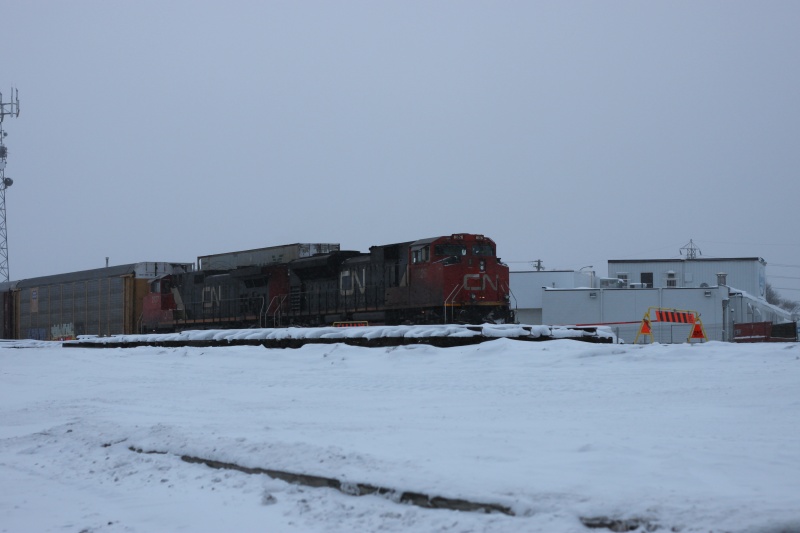
At Subway, there was an eastbound train waiting to head out. I think it was either 302 or 306. As an experiment, I decided to shoot it with both the 18-55mm lens and the 50mm lens. At first glance, the pictures look pretty much the same.
CN 8826 with 18-55mm lens
CN 8826 with 50mm lens
The top one was taken with the 18-55mm zoom lens, and the bottom with the 50mm lens. No editing was done on the images other than to crop the 18-55mm shot a bit and resize the images.

However, the devil is in the details. I shot both in shutter priority mode (1/200s) and the EXIF details show a little difference. For the 18-55mm lens, the camera used an exposure of f/5.6 and ISO 200. The 50mm lens earned an exposure of f/4.5 with ISO 100, showing the greater light sensitivity of the 50mm lens.

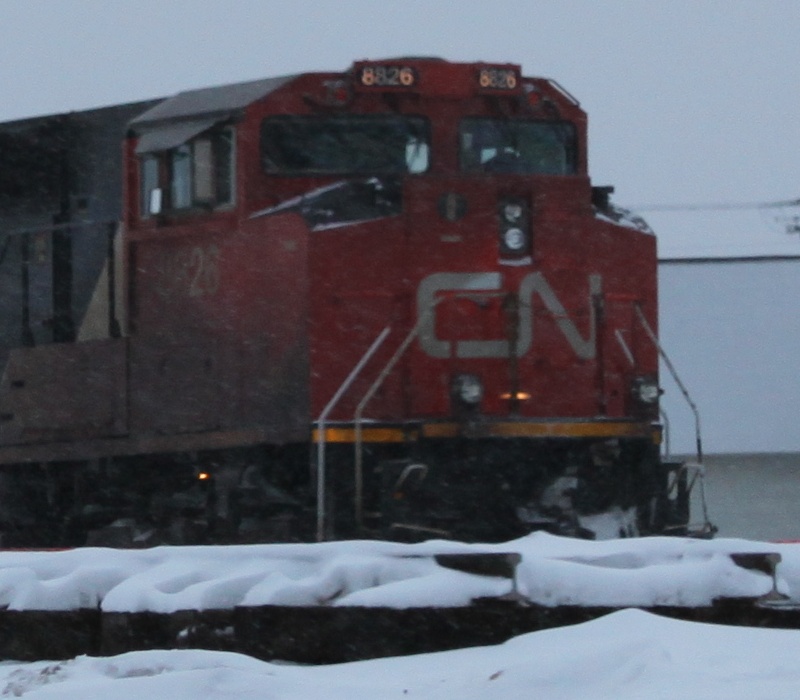
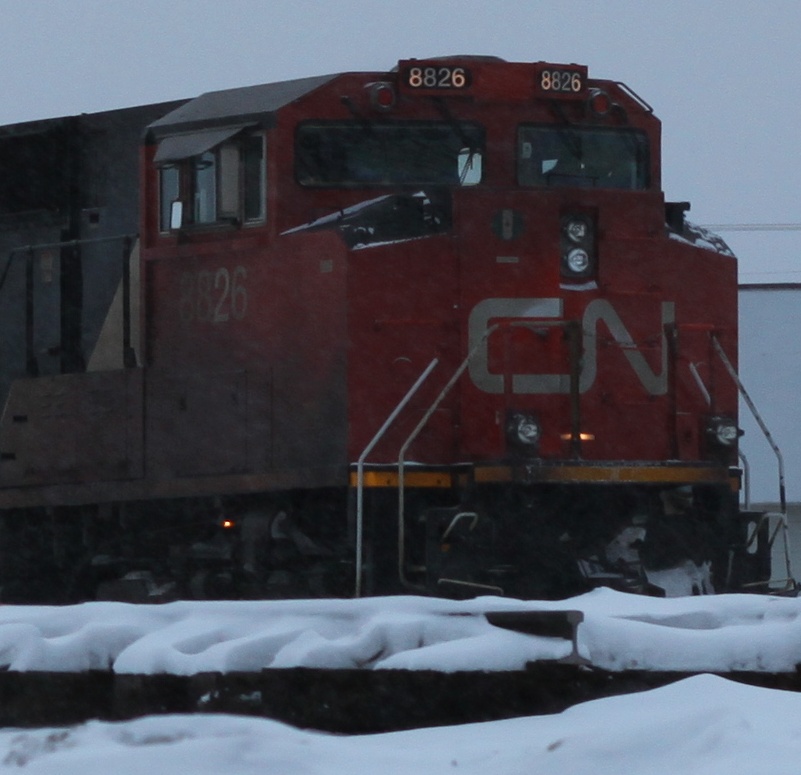
If you look closely at the images, the difference in detail is quite apparent.
CN 8826 with 18-55mm lens
CN 8826 with 50mm lens
Again, the top one was taken with the 18-55mm zoom lens, and the bottom with the 50mm lens, with no editing. You can see that the 50mm lens was quite a bit sharper when the image is magnified.

This is definitely a better lens than the 18-55mm lens. I don't think I will be using the 50mm exclusively, of course, since it doesn't have any zoom and is therefore less versatile than the zoom lens. However, I think for "whole train" shots the 50mm lens may become my preferred lens. Stay tuned.

Monday, June 07, 2010

Focus... Focus!!!

My first outing shooting trains with my Canon T1i was a disappointment, I'm afraid.

My youngest son and I drove up to Wilkes Avenue to catch the departing Hudson Bay (VIA 693) Sunday at noon. As it happens, a CN freight was heading west first. I think it was CN 781 but I'm not sure. I pointed the camera and started shooting...
CN 5676 in Winnipeg
All very nice until you expand the image and notice that it is blurred.

I was shooting in full auto and the flash popped up when I was shooting. I think it was firing the flash while I was shooting and expecting that to make a difference. The manual says it will attempt to illuminate backlit subjects.

I didn't notice that it was blurred, because it looked fine in the viewfinder. The Hudson Bay came along and I shot it too... also blurred.
VIA 6451 and the Hudson Bay

VIA's Hudson Bay
Needless to say, I was disappointed when I loaded the images on my computer.

On our way up Wilkes, we saw CN 7238 and slug 200 stopped at the former Winnipeg Intermodal Terminal and shot them. These turned out fine, because the train wasn't moving.
CN 7238 and slug CN 200 in Winnipeg
There is a sports mode on the camera and I think I will try that next time. I really hope it brings better results. It's a learning experience!

Canon T1i - First Impressions

My Canon T1i arrived Thursday. We were putting our new lawn in this weekend so I haven't had much of a chance to play with it yet (except to take some photos of our progress) but here are my first impressions.

The camera feels lighter than I expected. I guess I am thinking back to the days of my old Minolta Maxxum 5000i (body selling for $30!). I am impressed by how light it feels.

The next thing I noticed is how large and bright the LCD screen on the back is. It is at least three times the area of my Canon S3. It sure makes chimping much easier. My wife was very disappointed to learn that you don't get a live preview of the shot on the LCD, though. She's used to that from the S3, together with the flip-out LCD. Time will tell if that bothers me. I don't think it will, because I typically shoot looking through the viewfinder anyway.

Taking a picture in full auto mode is about as easy as you might think. The nine focus points are clear in the viewfinder and it is very helpful to know what point(s) the camera wants to use for focus. The shutter release is smooth and it feels like a serious camera. I don't know how to explain it better than that.

The autofocus is noticeably faster than the S3, especially in low light. The T1i doesn't waste time hunting for focus; it seems almost instant. I pointed it at a stippled white ceiling in low light, and the T1i had no trouble focusing on that. The S3 would have hunted for focus and given up in the same situation.

I haven't tried the video at all. For now I'm going to stick to stills. The T1i is capable of "full" 1080p video (1920x1080 pixels) but only at 20 frames per second. I think for train shooting that is going to be insufficient, so I will likely use 720p video (1280x720) at 30fps. The S3 shot at 640x480 so this is still a big improvement.

Those are my first impressions. I have a lot of training to do to get used to the camera and its features and drawbacks. But it's a start.

Sunday, May 30, 2010

The Waiting Game

I've taken the plunge. I cashed in some Air Miles and now I'm waiting for this baby to arrive.

I can't wait.

Thursday, April 29, 2010

Decisions, Decisions Round 2

I think I've just about decided which camera to get. As you may recall, I was considering the Canon XSi versus the Nikon D5000. Many of you commented, and I really appreciate the feedback. Some liked the Canon, some the Nikon, and there were a couple of other recommendations: the Fuji S100fs and the Olympus E620.

Since my last post, I've decided that I do want video on the camera, so that rules out the Olympus. The Fuji has video but it is pretty low-resolution. Now I'm comparing the Canon T1i versus the Nikon D5000, a worthy match-up.

Comparison

I think in the end, I like Canon and that's what is going to tip the scales for me. Unless something else comes along shortly, my mind is made up. Now I just have to figure out the best way to finance it! :)

Friday, April 23, 2010

Decisions, Decisions

I'm nearing a decision on replacing my venerable Canon S3 IS camera with a digital SLR camera. Right now I'm torn between two cameras.


The Canon XSi looks like a really nice camera. But... the Nikon D5000 seems to be just as good as the Canon, plus it does video.

If you compare side-by-side, you can see the Nikon has a slight edge. The sensor is a bit bigger, it can do ISO 3200, the screen can flip and tilt, and as I mentioned it does video.

My heart is with Canon but the Nikon seems better... for $150 more. What to do???

Wednesday, December 27, 2006

Comments on Canon S3 IS

I purchased my Canon S3 IS camera back in September and I've thoroughly enjoyed using it. It's fast and easy to use and the pictures it takes are a few steps above the old 3-megapixel Fuji point-and-shoot I was using. The image stabilization allows me to shoot hand-held in situations I'd never dream of shooting before, and I can tweak the camera to get shots I couldn't do before.

I stumbled across a site with S3 tips: Bagelturf. I can't tell who the blogger actually is but he has a Mac and he has an S3 like I do. Check out his tips on things like focusing on tricky subjects and focus bracketing are especially good.

Monday, June 26, 2006

Digital SLR conundrum

I've been looking at digital SLR cameras for a while now. I've narrowed my choices down to the Olympus E-Volt E-500 and the Canon EOS Digital Rebel XT. Both are 8 megapixel SLRs, both fine cameras as far as I can see. I think the Canon body is slightly better in terms of capabilities, but the Olympus kit comes with two lenses instead of the one Canon lens. Decisions, decisions.

I'm still accumulating the cash so it will be a while before I make the jump. I currently shoot with a point-and-shoot Fuji Finepix A210 and it is terrible for shooting moving objects (like, um, trains). The 1/2 to 3/4 second delay between pressing the shutter button and it actually taking a picture make it impossible to compose a good shot of a moving object.

Does anyone have any recommendations on a digital SLR in the $800-$1100 range? Don't even both mentioning something like a Nikon D200 to me - it's way out of my price range.