Just for something a little different, let's look at some of the cars found on CN 2329 East, spotted on September 13, 2018.
CN 2329
By the name I've given the train, obviously CN 2329 was on the head end. 2329 is a GE ES44DC locomotive, built in mid 2010.
I first spotted this locomotive on train 404 on April 4, 2011 (see "404 on 4/04"), several hundred feet further east from the photo above. The second time I spotted 2329 was on October 9, 2012, pretty much at the exact same location. I might take a lot of photos in the same area... what do you think?
There was another locomotive on the train. You'll see it soon...
MGLX 625056
MGLX 625056 in Winnipeg
The first freight car I photographed was this Saskatchewan! car now owned by MobilGrain, MBLX 625056. The taggers have been all over this car, unfortunately. I always liked the green SK cars.
GTW 138205
Long live the Grand Trunk
The next car I photographed was heavily weathered GTW 138205, sporting the giant white "GT". It even has its multicolour ACI label visible to the right of the "T". I can't quite read the built date but it looks like "11-76", which is comparable to the dates on other GTW cars like this that I have photographed. 40+ years of working... too bad rail cars don't get a pension when they are retired.
CN 395299
Faded glory
Next up is highly faded CN 395299, with its Canadian Wheat Board logo and lettering barely visible. I remember it being almost pink in colour to my eye. Another car on borrowed time...
CGEX 1085
Cargill's CGEX 1085
I see a lot of Cargill grain cars. CGEX 1085 here is one of the common types, but I also see a lot of Cargill cars with external, vertical ribs. The reporting marks tend to be CGAX, CGEX or CGOX. I don't know if there is any reason for the difference in reporting marks.
You'll see another Cargill car shortly.
EFNX 160760
A truly boring car
I took a photo of EFNX 160760 not because there was anything interesting about it, but because it is a prime example of today's truly boring rail cars. This 5200 cubic foot car was built in September 2016 and is one of many cars in Element Financial's fleet of rail cars available for lease.
In "days of yore", railroads owned a lot of rolling stock. Not any more. I believe the majority of today's rail cars are owned by lessors like Element who lease them out to customers. It probably makes a lot of financial sense for the railroads to be out of the lease market, but I miss the corporate logos on rail cars. This car is truly and literally the beige among the rapidly disappearing GT blue, the UP yellow, and the rainbow Canadian grain car fleet.
CNA 385112 looks like a pretty ordinary 4740 cubic foot rail car, with external ribs, built in March 1972 and still sporting its ACI label. However... what's that in the top left of the car?
Aha! Cargill!
This was a Cargill car! Also note that it used to be NAHX 5xxx3 before CN acquired it.
These little details keep me watching the train after the locomotive(s) go by.
The FURX Cars
FURX FTW
I saw a string of these gray FURX cars on the train next. You can see they are three bay open top hopper cars, 2400 cubic feet. I can see external controls to open the doors, so they must be pneumatically controlled. I see the pistons to operate the doors and there are nozzles on the cars labelled "AIR". It's weird how the middle door is "C" and the "A" and "B" doors are on the ends.
The real "win" on the train for me was this pair of 86 foot boxcars, with the PHRX reporting mark. The PHRX reporting mark is owned by Premier Horticulture Ltd., a company founded in 1923 around sphagnum peat moss. Their head office is in Rivière-du-Loup (Québec).
I remember seeing 86 foot boxcars on the New Brunswick East Coast Railway in northern New Brunswick. There is a lot of peat moss on the Acadian peninsula, and in fact the former Caraquet and Gulf Shore Railway (and later CN Caraquet subdivision) hauled a lot of peat moss.
Note the CN Aboriginal Affairs logo that these new locomotives wear. I love how there are labels with tiny letters along the frame edge... someone is very optimistic that these will be readable! My guess is that they will become covered in grime and be unreadable within a month.
Canadian Grain Cars
A rainbow
There was a rainbow of Canadian grain cars near the tail end of the train to finish things off.
I hope you enjoyed this little rolling stock review. Let me know what you think in the comments!
This is a guest post by photographer Ken McCutcheon. He participated in my 10 Questions series a while ago. Recently he shared a pair of emails and I asked permission to share them with you as a guest post.
Last week on Thursday and Friday [June 16-17] the Great Western Railway ran a couple of interesting trains.
Colour Me Green
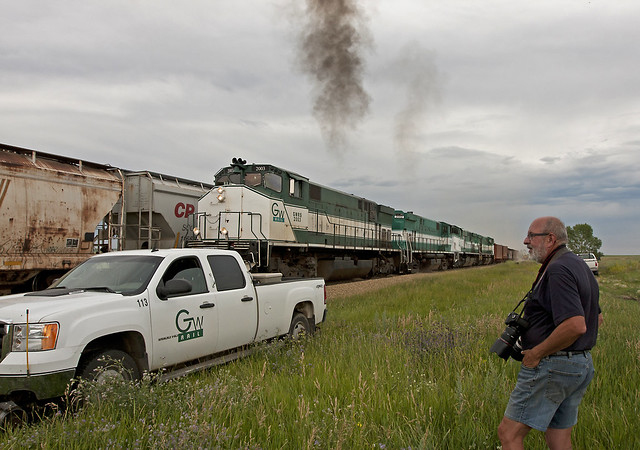
GWRS 2000 and 2001 prepare to leave Shaunavon, SK. Ken McCutcheon photo.
The yard is full of stored empty tank cars.
Thursday's movement from Shaunavon, Saskatchewan to Assiniboia, SK featured MLW M420's 2000 and 2001.
I had made a comment on Facebook regarding this train. Next thing I know, Trevor Sokolan was on his way down from Edmonton to photographically record
the event.
There was really nothing out of the ordinary with this operation other than: GWR have the M420's for sale. There were two operating Alcos this day. How much longer will they be in service?
So there was an urgency to have one more experience with the M420's.
Approaching Admiral, SK - Ken McCutcheon photo
After driving through a monsoon enroute from Assiniboia to Shaunavon early Thursday morning, I hooked up with Trevor, chatted and waited for the "chase" to begin.
During this time a minivan with Ontario plates rolled up with a couple more railfans. Ted and Robin from Cobourg, Ontario just happened to be in southern Saskatchewan and on the GWR this day. I'd say they were blessed.
At 1015 Thursday June 16th the chase was on.
Approaching Pontiex, SK. Ken McCutcheon photo.
Trevor Sokolan shared a photo of the units switching the Admiral elevator here.
Colour Me Orange
Leaving Rockglen, SK. Ken McCutcheon photo.
On day two, GWR ran a potash car storage train down the Fife Lake Sub to Coronach. (The Fife Lake subdivision is used mainly now for storage of railway equipment)
Under a clear dome the two B40-8's 563 and 575 (handled 67 empty potash cars going into storage. Once again the four photographers had a great day of chasing.
I found out the following Monday that the locomotive engineer for both these trips, Doug Knuff, had pulled the pin.......retiring from the GWR.
Doug was a gentleman and a blessing. He was always friendly, with a wave from the cab; he shared whatever information I requested; and he will be sorely missed.
All the best, Doug, in your retirement and THANK YOU for the memories. Be blessed and enjoy your free time away from the railway.
Ken McCutcheon
Approaching Scout Lake. Ken McCutcheon photo.
Thanks for the post, Ken! Here's a photo of Ken enjoying the GWR's Alcos in July 2015, by Trevor Sokolan.
Local railfan Jack Hykaway shared this great railfan adventure. Follow Jack on YouTube! He included so much content and so many photos that I have broken it into two parts (Link to part 1)
VIA 2 Arrives
A backlit VIA 2 rolls into Melville six hours behind schedule
Melville is a crew change point for VIA and for most CN trains, and when a fresh VIA crew showed up at the station, I knew the train must be close. I asked the engineer what time the train would be due in the station, “It shouldn’t be long now, the train is very close” he replied.
The engineer waited on the platform with myself and the retired CN employee. He informed us that he would have the pedal to the metal for the trip to Winnipeg and that we would only be meeting three westbounds on the trip to Union Station.
Finally, at 6:30, the distinct sound of a VIA horn shattered the silence. The train crawled into Melville station, running six hours behind schedule. I was anxious to get on and relax for the ride to Winnipeg.
I was welcomed onboard by the Service Manager, and he showed me to a free seat. I didn’t spend a minute in my coach seat. Instead, I made a bee-line up to the dome car. It was completely empty, which gave me the opportunity to grab the best seat available.
VIA No. 2 departing Melville
At 6:40, the two F40PH-3 locomotives rumbled to life, and with a jolt, the train started rolling forward. The locomotives hustled the long train out of the yard and onto the mainline. The wind was behind the train and with 6,000 horses on the head-end, we were doing good track speed in no time flat.
Outside of Melville, we met an intermodal, led by a CN SD70M-2 and an IC Deathstar SD70
By the time we reached Cana, we were doing 80 MPH with nothing but clear signals stretching to the horizon. We maintained the aggressive pace through Waldron, Bangor, Atwater, and Zeneta, but we slowed for the sharp curves near Yarbo and Gerald.
Both F40s belch fumes as they spring along the mainline near Yarbo, SK at 80 MPH
The Mosaic K2 Potash Mine near Gerald, SK
Large potash mines dominate the landscape in this region. Mosaic has two huge mines near Yarbo, on the North and South sides of CN’s mainline. Since Melville, a few other passengers joined me in the dome, and they were admiring the impressive mines. A VIA crewmember was quick to inform the passengers over the PA system that what they were looking at was a potash mine.
VIA No. 2 about to cross the impressive trestle near Gerald, SK
After crossing the impressive trestle at Gerald, the engineer opened the taps on the F40s and we were making good time again by the time we reached Spy Hill, SK. As we crossed into Manitoba, the train began its descent into the Assiniboine River Valley, which meant we could no longer keep our fast pace.
A wide shot of the interior of the dome in the skyline car
This is the most scenic part of the seven-hour journey. The tracks cling to the side of the valley wall as they descend towards St Lazare, MB. Three quarters of the way down, a spur branches off to the south of the mainline. This line swings back into Saskatchewan to connect the Potash Corp potash mine at Rocanville, SK with CN’s mainline. At St. Lazare, VIA 2 crossed the Assiniboine River on a through truss bridge, then the train tilted around a broad corner and followed the meandering course of the Assiniboine River on the valley floor.
The train flies through the through truss bridge near St Lazare, MB
Immediately after crossing the bridge, VIA No. 2 passes through St Lazare proper, and swings around a corner as it passes through town
A scenic highlight on the trip and a favourite railfanning spot among prairie railfans is the impressive trestle at Uno, MB. At approximately 1,500 feet long, it feels as if the train is floating in mid-air while crossing the impressive structure. Passengers sitting behind me in the dome scrambled to grab photos of the spectacular views down the valley at this location.
The power passes the station sign at Uno, MB.
In a few minutes the train will be high above the valley floor on the impressive Uno trestle.
As we left the Assiniboine River Valley behind, passengers filed out of the dome car, leaving only me and a few others to enjoy the views. At Arrow River, the sun’s position made for an interesting shot as the train swung around the broad curves.
The sun reflects off of the shiny roofs of VIA’s classic Budd equipment
as the train passes through Arrow River, MB
As the track straightened out for the run to Rivers, the engineer let the horses run on the two F40s once more.
VIA 2 exits the Assiniboine River Valley near Miniota, MB.
The train is passing under an old wooden bridge just outside of town
The train brakes were applied when we encountered a Diverging-to-Stop signal at the west end of Myra Siding. It was a perfect meet with a westbound freight – neither train had to stop.
VIA 2 met CN 2239 at Myra Siding as it headed west with a long string of manifest freight in tow.
VIA 2 got back onto the mainline and the train drifted into its station stop in Rivers, MB just as the sun was falling behind the horizon.
VIA 2 gets clearance, and proceeds out onto the mainline following a meet at Myra
Sunset in the Skyline
The train was only stopped in Rivers for a few minutes before we departed for Winnipeg in the fading light.
Departing Rivers, MB with darkness quickly falling
There was still enough light outside to make out the overpasses at Grants and at Moffat – both of which are popular railfanning locations, but there were no railfans waiting on us tonight.
Darkness fell by the time we reached Harte, and the train pierced through the night for the rest of its trip to Winnipeg.
Rounding the curve at Grants Cut. Note the Panorama Car a few cars back in the consist
We made good time to Portage La Prairie thanks to recent track work at Firdale. At PlaP, we stopped for ten minutes to let a handful of passengers disembark. From there, there was nothing but double track between us and Union Station, except for a few hundred yards of single track at Nattress, where the mainline crosses the Assiniboine River again. The engineer skillfully guided the train through the fog at a blistering 80 MPH along this double track superhighway. We cruised by two stopped intermodal trains waiting for us to clear the single track at Nattress, then we were the only train on the line until we reached Winnipeg.
LED signals light up the night as the train speeds towards Winnipeg
It wasn’t long before locations familiar to me, such as Calrin and Diamond, flashed by the windows in the darkened dome. We rounded the curve at Portage Junction at about 12:50 AM.
The train finally pulled through the train shed at Union Station in Winnipeg at 1:00 AM, only five and a half hours after leaving Melville.
Number 2 would be cleaned and serviced in Winnipeg in just half an hour. Re-boarding for the trip through Ontario would commence at 1:45, and departure would be somewhere around 2:00, putting the train a mere two hours behind schedule – not bad for a train that rolled into Melville six hours late!
Local railfan Jack Hykaway shared this great railfan adventure. Follow Jack on YouTube! He included so much content and so many photos that I have broken it into two parts.
A Prairie Railfanning Adventure
My family and I headed west through the prairies this past weekend to visit family in Saskatchewan. Our bags were packed and we were out of the house by 8:00 on Friday morning, a little earlier than we would've normally left for this trans-prairie trip. We left with time to spare because somehow I had managed to convince my parents and sister to stop at a well-known railfanning location for a picnic lunch. We made terrible time through rush-hour traffic in the city, then on the highway, construction along the TCH slowed us even more. Construction was constant - huge stretches of highway were being redone, so the normal four-lane 110 KM/H speed limit was reduced to 80, and in some places to as low as 60, and traffic marched westward in a single-file line.
It was almost 11:30 AM by the time we finally reached Brandon, which is normally only a two hour drive from Winnipeg. CN's main line from Winnipeg to PlaP was bustling with activity, but as we sped under the main line at Brandon North, all was quiet. About an hour later, we arrived at my picnic spot, near Arrow River, MB, just as an eastbound was passing through. That construction along the TCH had cost me a train! We lugged our cooler up the hill anyways, and my parents and sister sat down for some lunch while I set up my tripod and hoped to catch another train at this scenic spot.
I was halfway through my chicken sandwich when my dad pointed at the horizon. “Is that a train?” I jumped up and turned my attention to the eastern horizon – sure enough, a flickering light was cresting the hill in the distance. I got ready to capture the train coming past the grain elevator at Quadra, a mile or two away from where I was set up.
CN 347 glides past the Grain Elevator near Arrow River, MB.
The train turned out to be CN 347, with two SD70M-2s easing a solid block of empty centerbeam flatcars through the sweeping curves at Arrow River. This was the only train I saw during my short time trackside.
We were running tight for time, as we still had many hours of driving ahead of us. After packing up and picking off several wood ticks, we continued west to our destination, Wynyard, SK.
Saturday
Saturday morning, I joined my family on an adventure to downtown Wynyard to visit Home Hardware. They don't have any Home Hardware stores in Winnipeg and mom wanted to check out their cool spinning mops and other handy gadgets. Dad was interested in the comfy Adirondack chairs they had in stock, and my sister and I were passing the time trying on some very stylish sunglasses.
We walked along the tracks on the way to the store, so I snapped a few photos of the small CP yard and station in Wynyard.
CP’s yard in Wynyard, SK. A third GP20C-ECO is hiding behind the two others on a farther track
The old CP station in Wynyard sits boarded up
The yard looks healthy, contrary to what we're seeing here in Winnipeg. A few dozen tanks and hoppers sit in the yard while a trio of GP20C-ECO units sit just beyond the cars. CP also built a new yard office in town, and it seems crews have been busy along the Sutherland Sub just west of town. A new crossing, a pair of crossovers and two ribbon-rail mainlines stretch to the horizon out of the west end of town.
Later on that afternoon I had some free time, so I went back down to the tracks to see what I could see. A CP truck was waiting by the station so I figured a train must be close, as most trains stop to change crews here. I was right - in a few moments a light crested the hill and CP 298 rolled into town.
CEFX 1046 leads CP train 298 out of the yard at Wynyard, SK
CEFX 1046 was in charge of train 298 this day. The train did some switching out of the east end of the yard before it continued east. Jack posted a video:
As the train completed its switching and started to depart, my dad and I drove out of town a few miles and searched for a photogenic spot. We checked out a spot in the hamlet of Mozart, but the light wasn't quite right there, and it wasn’t the shot I was after, so we headed back to the highway and we continued east. The pit-stop at Mozart almost cost me the train, as when we arrived at my chosen spot, the train was only a mile or so behind us and it was doing good track speed. We drove down a sandy grid road for a quarter-mile, and I sprung out of the car to set up. The wind was really howling in this part of the prairie, so I used the car as a wind-block to capture a stable shot of the train streaking through the green farmland.
CEFX 1046 has the short manifest train rolling through the prairies at track speed
A CP toaster brought up the rear of CP 298, and if you look closely directly above the hopper car in front of the DPU, you can barely make out the large grain elevator in Wadena, SK, about 13 miles to the north.
A CP Toaster is shoving hard on the rear end of CP 298
Dad and I were back in Wynyard in time for dinner, and I went to bed satisfied with the shots I had taken.
Sunday
VIA’s cookie-cutter station building
sits beside the impressive CN station,
currently being restored
We headed back toward Winnipeg on Sunday morning, but the railfanning was far from over. My parents agreed to drop me off in Melville so I could catch VIA 2 and take the train back to the city.
I was on the platform at 12:30 PM, which is the train's regular arrival time for Melville.
Unsurprisingly, it was running late. A quick call to VIA's 1-800 number revealed that No. 2 was running a couple hours behind schedule and was estimated in the station at 4:00 PM. A three-and-a-half-hour wait wasn't so bad - CN kept me entertained with train after train through town.
A dash of blue is trailing three CN units
on a westbound Intermodal train.
This train is slowing for a crew
change at the west end of the yard
It was bittersweet seeing those trains, as it was likely that most would end up delaying VIA 2 even further. One train pulled into town from the east and sat on the track nearest to the station for over two hours. A retired CN employee was waiting to catch the VIA with me at the station, and we were discussing different theories as to why the train had been sitting in town for so long. As it was nearing 4:00 PM, the freight train was still blocking the track closest to the station. This is the only track VIA can use to pick up/drop off passengers in Melville – passengers aren’t allowed to cross the tracks here to board the train due to safety concerns.
CN 2500, a C44-9WL is accelerating out of Melville Yard with a long intermodal train in tow
The freight train refused to move, and other trains were going around it on the siding. I called the VIA hotline again, and found out my train had been delayed until 5:30 due to the freight traffic. I conveyed the bad news to my fellow passenger, and I decided to grab some supper at the CO-OP nearby and go for a stroll to see the sights in downtown Melville.
A pair of AC units led a manifest freight into Melville on the mainline. This train was sitting on the mainline for two hours before continuing west.
When I returned to the station with some supper and a few snacks for the train ride, the hiss of air brakes releasing was a welcomed sound. The AC units on the head end of the massive freight train pulled the slack from between the cars, and with a bang, the train was on the move again.
It was nearing 5:30, and even with the track cleared, there was still no sign of VIA. At a quarter to six, I called one last time, and they claimed that VIA No. 2 was still scheduled to arrive at 5:30 in Melville – that shows just how much the folks working at VIA’s call centres know.
Will VIA 2 finally arrive? Was Jack stranded in Melville for days? Find out next time in the exciting conclusion to Jack's Prairie railfanning adventure! Read part 2!
Railroad magazine used to have a regular feature highlighting an "Interesting Railfan". I thought I would run a similar series with some railfans who have agreed to participate. I'm asking each railfan 10 questions, some standard and some customized for the particular person. I hope you enjoy it. (See all in the series)
Mark (L) with his father at the
Grey Cup Train, 2012
Mark Zulkoskey is a railfan living in Prince Albert, Saskatchewan. We've never met but I've enjoyed and envied his photos on Saskatchewan Railways. He graciously agreed to answer my 10 questions.
1. Tell us a little bit about yourself.
I’m a registered social worker living in the Central Saskatchewan city of Prince Albert, which also conveniently, was my place of birth. I always vowed to move but the prairie has oddly grown on me. I work as a Cognitive Disability Consultant for two health regions which has the added bonus of a lot of travel. I married the lady who has tolerated my obsession with trains for the last five years this summer. Of course we married at the Wetaskiwin Railway Museum and believe or not it was her idea and not mine! The running joke that day was that I preferred to ride with the engineer in the RS23 rather than with my bride. I have a 6 year old step son who I have worked to indoctrinate into the world of rail.
I quickly mention a funny story that proves my relationship with my wife is destined to last. Back in 2012 we were enroute to Saskatoon for her birthday supper. My wife’s birthday is in late March and we tend to get our worst blizzards then. I decided it would be a good idea to photograph some trains first. I roared down a back road, bouncing on the snow drifts until we were stuck. Two stuck tow trucks and six hours later we were out. Strangely enough it provided some good bonding time. Frankly if she didn’t leave me for that injustice, I don’t think she will now…
The Hudson Bay Railway, The Pas, MB, 2014
2. Why do you like trains?
My father used me as his launch pad into trains and I guess I followed suit. Much of my early childhood consisted of chasing CN GMD1s and CPR RS23s out to the local pulp mill or off onto the 60lb branchlines that surrounded my hometown. I started shooting trains with a bright blue Fisher Price camera that took 110 film. Summer day trips to all corners of Saskatchewan cemented my love in the prairie hinterland, rail and grain elevators. My father often said he would use me, with my little train hat plopped onto my head, to gain access to rail yards and to get the occasional ride. My first ride was on a pair of GMD1s and one of my fondest moments of my childhood.
I was bullied in grade 6 and some of that came out of my interest in trains. I stopped railfanning almost overnight, but the call of the haunting whistle late at midnight called me back. When I turned twenty I returned to my early love, perhaps for the nostalgia but also inadvertently because my new found appreciation of our vanishing grain elevators coincided with railroad branchlines. It has all been downhill since then.
3. Where’s your favourite place to railfan?
Alaska Rail north bound empty coal train
in Chugach State Park, Alaska
This past summer I had the opportunity to railfan Alaska Rail on my honeymoon. The rail carved through the mountains, presenting spectacular photographic opportunities.
And yet at the end of the day I still find myself traipsing through farmer’s fields, flying down dusty back roads and returning to the same small town motels of Saskatchewan.
The prairies are a photographic challenge. Bald prairie challenges the photographic eye and forces me to reevaluate my shots. The rail network of Saskatchewan also continues to be rather extensive. The vast array of shortlines helps keep some diversity in my shots and it isn’t uncommon to photograph four or five railways in one day. A few places of notable mention are the hills east of Biggar, the badlands near Eastend, the CNR bridge in Prince Albert and the CPR line to Nipawin.
Carlton Trail GP10s, summer 2015. Note 1004 & 1064 have since been retired.
4. If you could railfan anywhere, anytime, where and when would it be?
Definitely sometime in the 1960s or 1970s anywhere in North America. For me this was the golden age of rail and the pathetic demise of Alco. Canadian rail would still be slugging along with CLC locos and MLW would still be churning out smoke spewing locos. I’d love to shoot Southern Ontario or my mother’s home town in Northern Ontario on the ONR. Plus the convenience of passenger travel wouldn’t hinder my ability to reach many communities across the country.
5. What’s your favourite railway?
CN has been the stalwart railway of choice recently given their frequency and array of motive power; but I don’t think I’d classify them as a favorite. Great Western’s colourful power, M420s and the rolling hills of the south would probably throw them into the ring of favorite railways. Rather than quantifying a favorite list, I’d probably opt to shoot the shortlines that dot the prairies.
CN east of Biggar, SK in 2014
6. What do you use to edit your photos?
Typically Lightroom 4 or Photomatix Pro 5 if I’m shooting in HDR. I used to manipulate with Photoshop for fun occasionally but I haven’t had the time for that in a few years. I’ve gradually upgraded my gear over the last few years and I really started focusing on post production when I started shooting RAW in 2013.
7. What do you aspire to be shooting in five years?
I really want to focus on capturing the prairie spirit in my pictures over the next few years. I want to capture that elusive dream in my shots, the dream that so many immigrants had as they settled on the prairies (think Hearts Hill or Bents, SK). The prairie spirit is alive and well in so many communities today, through the local co-op branches to the cooperative programs that have kept the rail lines busy with producer cars. That’s what I want to be shooting. Of course I want to continue to travel and while my family will be growing in the next few years, I hope to make it out to the Maritimes, Quebec and the Rockies.
8. Where do you share your photos?
Typically on Facebook book through my Saskatchewan Railways page or on RailsMBSK.
9. What projects do you have on the go?
My father and I are in the process of building a switching layout for future hobby shows. The rest of my stuff is gathering dust until I can move into a larger home. I’m currently working on painting and decaling my HBR GP40-2(W).
CTRW 2015, Mark's third GP10 for Carlton Trail
I’m buying a new camera in the spring, so I’m looking forward for a few photo runs this summer in Saskatchewan and Alberta and perhaps Manitoba. My long term photography project is to photograph every remaining grain elevator in Saskatchewan. This began in 2009 on a road trip to North Battleford. I was stopped in Leask and noticed the two lonely elevators. I remembered long trips to Alberta as a child, watching the rows of colourful elevators pass me by and how so many have now turned to dust. I started with a point and shoot and the magic of Google Maps and slowly made progress. Of course my perfectionism has caused me to do more than the one re-shoot. As of Jan 1, 2016 I have photographed 482 Sask elevators in 364 communities across the vapid prairie. I now only have 12 elevators left on my list to photograph!
10. Go Riders?
Actually I’m not much of a football fan and I’m sure that will raise the eyebrows of a few Sask railfans. I’m more of a hockey guy, so go WHL Prince Albert Raiders! (at least they're green - Steve)