Showing posts with label guest post. Show all posts

Saturday, July 29, 2017

Three Passenger Trains in Northern Québec (Guest Post)

The following is a guest post by Al in Vancouver... enjoy!

In June and July of 2017, I had the opportunity to ride three passenger trains in northern Québec. This guest post will focus on overall impressions and tips for railfans.

Sept-Îles - Schefferville
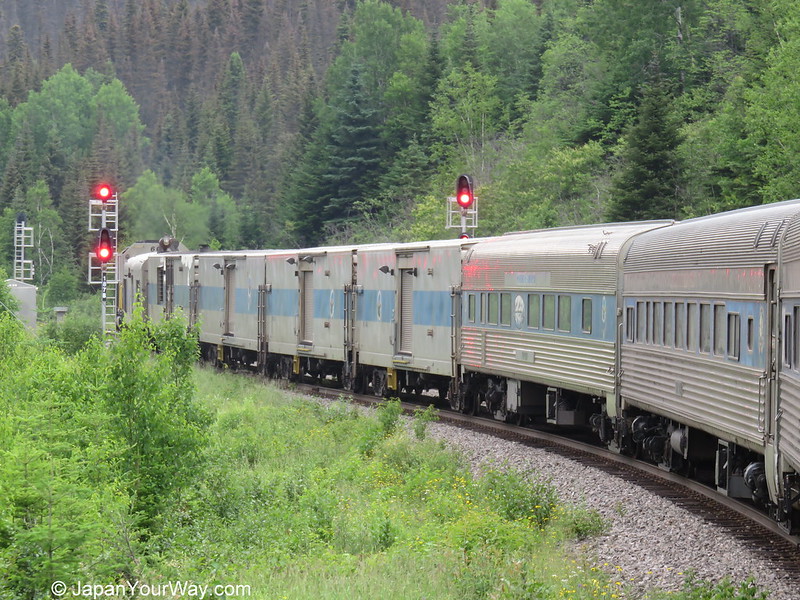
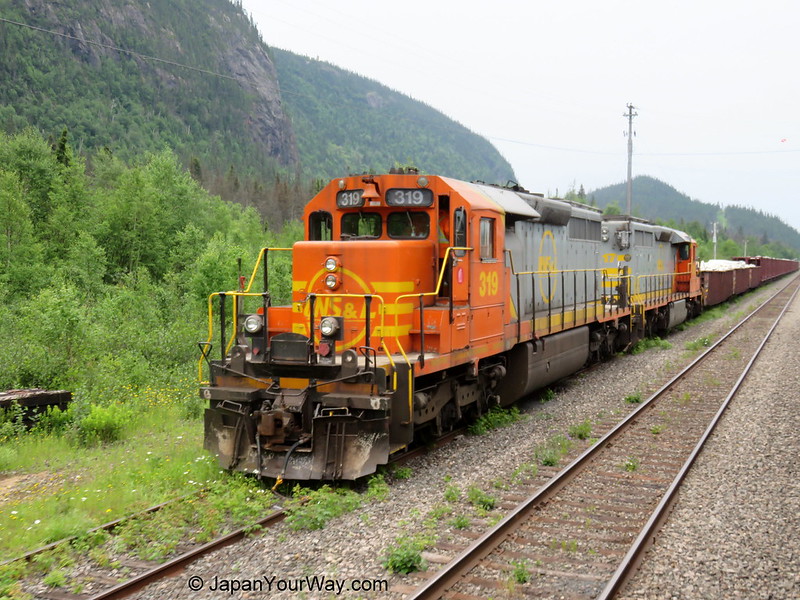
1-IMG_9369 This passenger service is operated by Tshiuetin Rail Transportation, owned by three first Nations in the region.  The head end crew and track between Sept-Îles and Emeril, Labrador are provided by the QNS and L Railway, a wholly owned subsidiary of the Iron Ore Company of Canada.

The train operates twice weekly.  As tickets are non-refundable and the person at the phone number listed on the website told me the train is never full, I decided to buy my ticket at the station in Sept-Îles the morning of departure.  I was surprised to learn they only accept cash (no credit or debit cards) at the station in Sept-Îles.  There is no ATM at the station.  After all passengers with tickets were boarded, I was allowed to buy my ticket and board.  Photo ID is required at boarding.  Seating is first come, first served.
1-IMG_0084
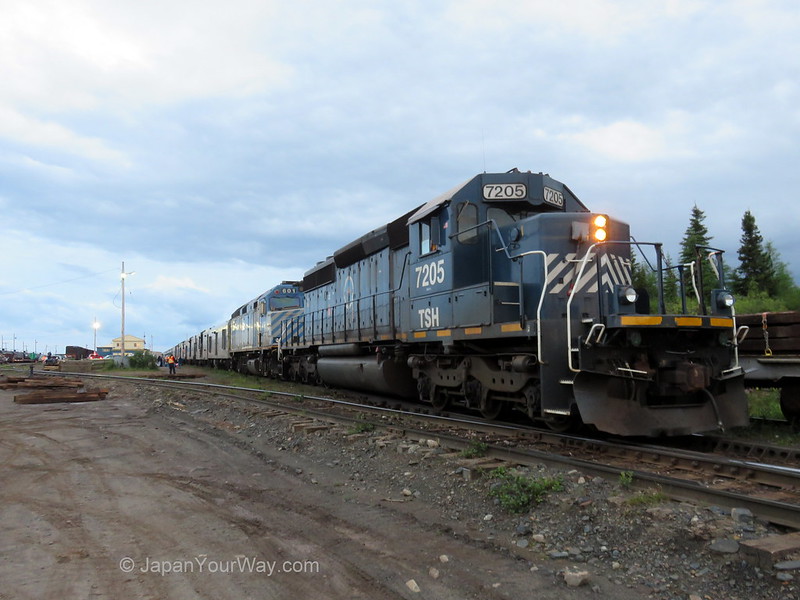
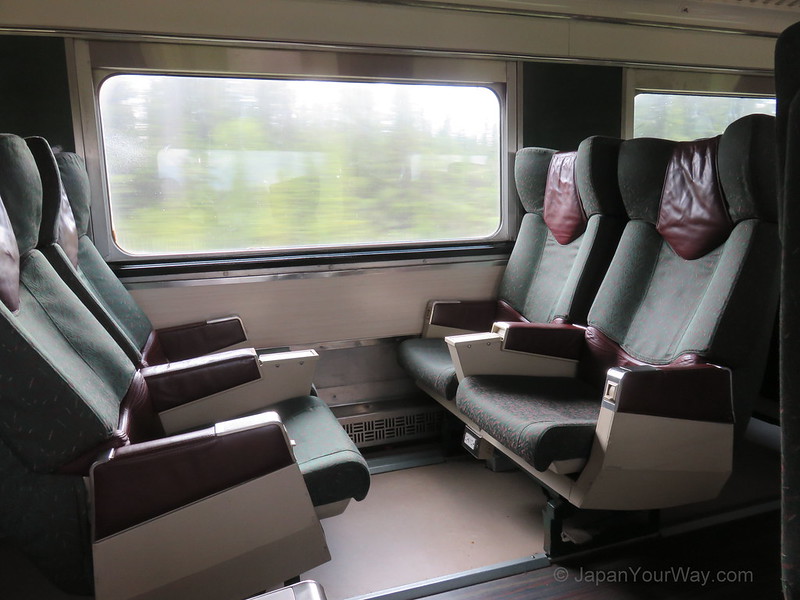
I was surprised at the length of the train:  Two locos (TSH 7205, 601), baggage generator TSH 1423, four baggage (TSH 1422, 1401, 1455, 1445), cafeteria TSH 1000, three older coaches (TSN 1002, 1004, 1005) and two newer coaches (TSH 13518 and 13517).  I was directed to sit in an older coach with red seats (TSH 1004) which was also equipped with a projector and screen suspended between the luggage racks to show movies.  I sat far enough away from the movie equipment so that it would not obscure my view out the window.  A Québec tour group (tour conducted en français) occupied the first newer coach while the trailing coach was kept for employee use.  I estimate 50 to 60% of the seats were occupied.

None of the windows on the train were clean; disappointing as this affected the view.  Even if they were clean, I believe the age of the windows would still diminish the view.  Fortunately a photographer with the tour group was given supervised access to open the vestibule windows, and I was able to use this for photos soon after we left Sept-Îles.  The interior of the train was kept quite clean.

The first 100 miles north from Sept-Îles pass through beautiful scenery as the route climbs along the Moisie River.  Sit on the left (west side) of the train for the best view.  We had a few meets with QNSL iron ore and work trains.  Speeds are generally between 30 to 40 mph.
1-IMG_9436
It is interesting to watch the changes in scenery as the train climbs the Canadian Shield and gains latitude north through Labrador.  While the track is in good condition south of Emeril, there are sections north of Emeril that are rough and slow.

We arrived Schefferville around 20:30.  I did not have accommodation reserved but managed to arrange a clean, quiet and efficient room for $75 at a facility for workers named Bloc Orange.  From what I saw of the conventional motels, it is easy to pay over $200.  There is no road access to Schefferville, so things are expensive.  Your mobile phone will not work for voice or data unless you get a local SIM card.  Also note that WiFi gets very congested during the evenings due to high usage over limited bandwidth.

The road between the town of Schefferville and the train station is gravel.  If you decide to walk like I did, there is a good chance someone will stop and offer you a ride!  There is a taxi service in Schefferville, but there was a long wait once the train arrived.  I was also told the taxi is not open in time for the morning southbound departure.
1-IMG_9927
The southbound trip the following morning was on the same equipment, except that locomotives TSH 601 and 701 were leading.  The station at Schefferville accepts credit and debit cards for tickets. Again, photo ID is required at boarding.  There was no tour group southbound and both of the newer coaches were kept for employee use.

We arrived Sept-Îles around 22:00.  The train was turned prior to the station stop.  Apparently it is not unusual for the train to arrive hours late due to meets and slow orders.

There is a good thread about the train on trainorders.com and a CBC documentary on YouTube.

Full photo album on Flickr

Senneterre to Montreal
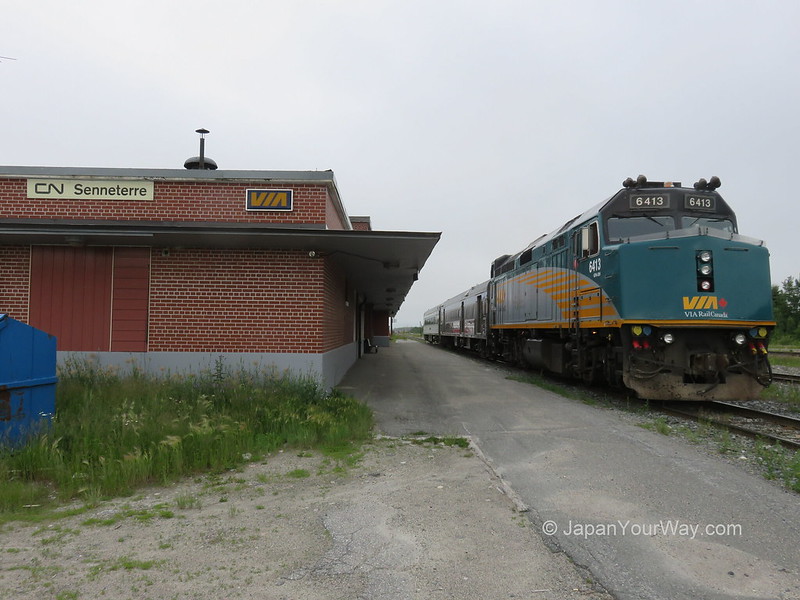
1-IMG_0321
VIA Rail operates this train, as well as the Jonquière train described below, over CN tracks.  Each train is operated with a single F40PH-2 loco, one 8600 series baggage car and one HEP2 coach. They operate three times a week.  Seat selection is not pre-assigned.

Due to limitations in my schedule, I chose to do this trip one-way from Senneterre to Montreal.  In retrospect, I would have done a return trip on this route, as the scenery is nice and because this train is always at the rear of the combined Senneterre and Jonquière train south of Hervey, providing access to a window facing out the rear of the train.

Note that not much is open in Senneterre before the train departs (even for the later Sunday departure), so bring food with you or buy it on board.

1-IMG_0380
The scenery is interesting with lots of forest, lakes, rivers and some hills.  As with the other routes, the northern portion of the route provides access to camps, cottages and settlements that do not have good road access.

We were two hours late arriving Hervey due to meets and slow orders.  We pulled into Hervey station for passengers, then reversed out to allow the train from Jonquière to get into the Hervey station ahead of us.  We then coupled to the rear of the train from Jonquière.
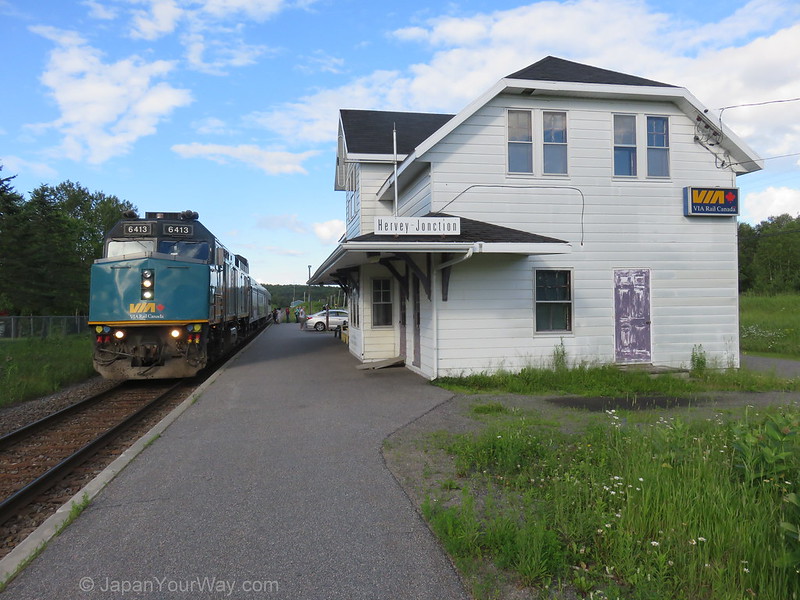
1-IMG_0848

The route from Hervey to Montreal is similar to the route between Québec City and Montreal with lots of rich farmland and stretches with good track speed.  There are some significant trestles on the Joliette subdivision (miles 50, 52, 58, 65 and 76), a tunnel at mile 51 and an interesting route through Shawinigan.

As we were still late approaching Montreal, the train stopped at Gare Sauvé for the crew to take a 20 minute rest break, allowing them to extend their operating day by 2 hours.  As the Jonquière train has a later start than the Senneterre train, the Jonquière crew is fresher and this is why the trains wait for each other in Hervey and are coupled with the Jonquière train and crew leading.  By the time we arrived Gare Centrale in downtown Montreal, we were two and a half hours late. Note this train does not use the Mont Royal tunnel, so it takes a while to route through the yard at Saint-Luc.  Most shops at Gare Centrale close at 21:00; fortunately a nearby Provigo supermarket was open til midnight.

I noticed a brochure at Senneterre station describing (en français) an outing using the train from Senneterre to Press, with a re-enactment of the last spike ceremony at Press followed by brunch and return to Senneterre by bus.  Remaining dates for 2017 are planned for August 6 and 20.  Info is available by emailing cde@ville.senneterre.qc.ca or calling +1-819-737-2296 extension 221.

The local tourist bureau can suggest activities in the region.  They can be contacted by emailing tourisme@ville.senneterre.qc.ca or phoning +1-888-437-2694 or +1-819-737-2694.

Full photo album on Flickr


Montreal - Jonquière

This train is assembled with the baggage car trailing the coach, i.e., locomotive followed by coach followed by baggage.  I was told this is to allow canoes to be loaded and unloaded using the rear door of the train from the baggage car.
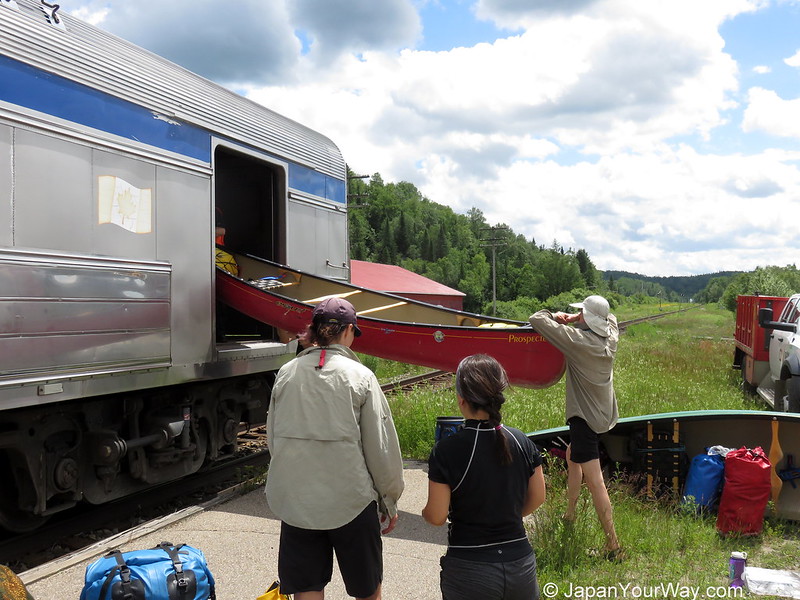
1-IMG_1136
I didn't see this door being used, but I can imagine a stop on a banked curve or conditions at the side requiring rear access.  Note that this arrangement prevents passengers from seeing out the rear of the train.
1-IMG_1035
Between Montreal and Hervey, the Senneterre train is coupled (elephant style) to the rear of the Jonquière train. For this portion of the route, please see my comments above.

Northeast of Hervey, the route follows the appropriately named Rivière-à-Pierre upstream.  The best views are on the north side of the train.  Many cyclists used the train, and at times the coach was around 90% full.  This is a very scenic region with infrastructure for tourists.  There was some freight traffic on the line with a few meets.  Forest product companies seem to be the primary customers.
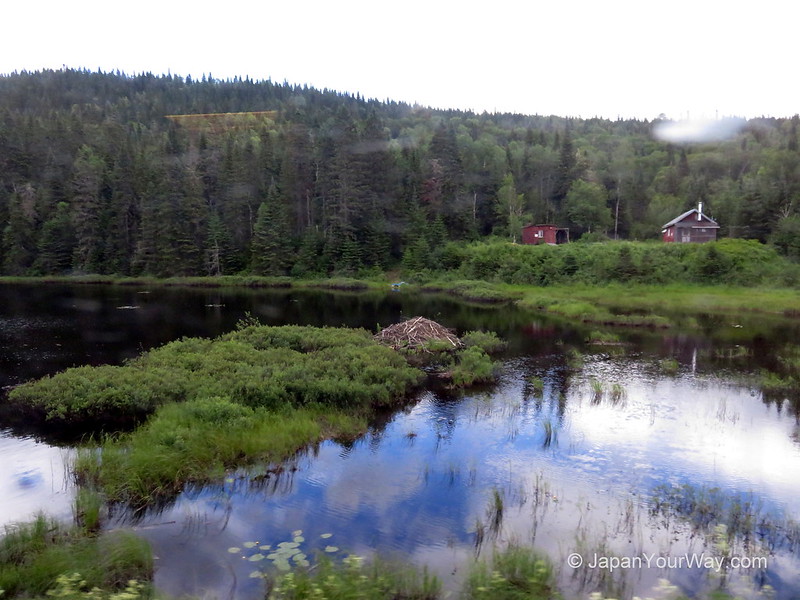
1-IMG_1177
The descent into the Saguenay region provides some nice views (again, the best view are on the north side) of Lac Saint-Jean, which is huge!

The terminus station in Jonquière is conveniently located at a transit hub, providing cheap transit options throughout the region.  I stayed overnight approximately 10km away in Chicoutimi and used transit both ways.

If you are a cyclist and not familiar with Québec's Route Verte and their 5000 km network of bike paths, check out this link.  More info about taking bikes on VIA trains is on VIA's website.

Full image album on Flickr

Final Comments

I thoroughly enjoyed all of these trains.  Although it is difficult to rank them, I have to say the trip to and from Schefferville provided the most memorable experience.  This is due to the different scenery and the QNS&L railway but also because most people operating and using the train were from First Nations.  I suggest that if you take this train, try to get to know some of them (the seats in the cafeteria car provide a good place to do this).  The person who picked me up on the way to the station in Schefferville made a lasting impression as he shared his background and stories with me.  The farther north you go, the more English is spoken, so language should not be a barrier.  Note that if I did not have access to open vestibule windows, it would have diminished the experience.  You might want to bring something to clean your window!  And you should be prepared for mosquitos.

The Québec tour group I encountered on the train from Sept-Îles also offer tours using the Senneterre and Jonquière trains.  While these appear to be conducted en français, the itineraries may offer some ideas.

I'd like to ride all of these trains in winter; perhaps April or May to allow for longer daylight, before leaves on trees along the line obscure the views.

I hope you get the chance to experience these trains!

Al is a railfan based in Vancouver.  He has ridden the rails on six continents and is a guide with JapanYourWay.com offering custom tours to Japan (a great destination for railfans!) and beyond.

Monday, July 11, 2016

Spring Break Railfanning (Guest Post)

This is another guest post by Taylor Woolston... another Winnipeg railfanning tour by bicycle!

On Wednesday March 30th, 2016, it was the third day of Spring Break, and I decided that I would go and railfan the BNSF Manitoba Railway for a bit. BNSF Manitoba is a is a shortline that owns a few miles of tracks in Winnipeg.

They bring cars to and from CP's Westview Yard at "Garbage Hill", and CN's Fort Rouge Yard, and they also serve a few industries, including ADM, which is right beside their engine house. They usually start their operations at around 10 AM.

After waking up and having breakfast, I packed up my equipment and rode off on my bike towards the BNSF. Being around an hour early, I decided to make a stop at St James Junction, which is a short hop from the BNSF. Here, the CN Rivers Subdivision crosses the CP La Rivere Subdivision. When I got to the junction, I noticed something north of the diamond on the La Riviere Subdivision, but I couldn't figure out what it was; however, it was coming my way. Before it could cross, it had to wait for a couple of CN trains to cross the diamond.
Right after the second CN train crossed, the thing on the CP La Riviere Subdivision crossed over, heading south. It turns out it was some kind of self-propelled rail crane, with a couple of flatbeds surrounding it, CP in front and SOO behind.

Once it passed by, I made my way over to Grant Avenue to get set up for BNSF. As I rode past the ADM area, I noticed that they were already active, moving tanks around. I got to Grant Avenue, set up, and waited. Then I noticed something to the north, there was a CP train coming!


As CP came closer and closer, and the BNSF was finishing up and getting ready to go, I wondered which one would pass by first.

In the end, BNSF passed by first with BNSF 1523 (GP28-2) and 7 tanks in tow.

I was very relieved to see that their caboose, BN 12580, was on the tail end to "complete" the train.

The BNSF freight met the CP train a little bit north of here, and just a few minutes later, CP passed by with CP 2304 and 2211 (both GP20C-ECO's) hauling a relatively long train south. This was most likely the train that goes to the Altona, MB area.

Once it finally passed, I packed up and biked north. I crossed the combined rail and foot bridge (which is very useful, and you can get very close to the action!) across the Assiniboine River, looking for a spot to try. After a few minutes, I realized that the BNSF was approaching! I decided to bike back across the bridge, and set up near Wellington Crescent. A couple minutes later, they came into view with the caboose leading mostly tanks heading south.

Immediately after they passed, I packed up and gave chase, which is not easy on a bike! Slowly, bit by bit, I passed them, and I was able to beat them to Taylor Avenue.

I noticed that their signal onto the CN Rivers Subdivision showed Slow-to-Stop (Red over Flashing Yellow), which indicated that they would probably be stopping at Waverley Street, so I gave chase again. Sure enough, BNSF stopped short of Waverley Street. After a little while, a westbound CN train roared past. Once that train passed, BNSF got clearance to Fort Rouge Yard, and they passed by.

After that, I decided to head back north to Wellington Crescent and look around for a shot there. After waiting for awhile for BNSF to return, I could hear some horn blowing coming from the north. It sounded like it was coming from the St James Industrial area.

After thinking for a bit, I decided to take a risk and abandon the BNSF, and ride up north to see if there was anything going on. I went up to Saskatchewan Avenue, which parallels a CP spur that serves a few industries. There is also the ex-CN Oak Point Subdivision, which CP uses a few miles of to serve a few industries.

Most of the CN Oak Point Subdivision was abandoned in 1996, but a few miles in the city survived, which CP now uses as a spur. I didn't see anything at all going on, then I noticed that the switch that leads to the Oak Point was set to go to the former branch line. With the track layout, I knew instantly that there must be something up there!

I rode up a few streets, until reaching the area where King Edward Street (Route 90) crosses under Oak Point and the CP Carberry Subdivision. From there, I was able to see a CP locomotive doing some switching near Brookside Blvd, which is where the track ends.

After awhile, they appeared to be done switching and were heading away from the industries, so I decided to ride away and set up somewhere. While coming up here, I noticed a small wooden bridge where the track crosses over Omands Creek and I decided that I would set up there. When I arrived, they were in view, but still a fair distance away from me. Eventually, they very slowly passed me with CP 4428 (GP38-2) pulling 3 cars at around 5 MPH.

When they passed, I immediately packed up and chased them back to Saskatchewan Ave, where a curve takes them off the Oak Point Spur, and back onto CP's main lead for the area. The CP crew stopped before coming around the curve, which helped allow me to get set up again. After a couple minutes, they came around the curve. Once they came off, they threw the switch back and pushed the cars back towards a siding.

Afterwards, I decided to head home. I rode south down Empress Street, when I heard a train horn. From the north. You might think it was just the local freight I just saw, but the horn was completely different, it was a horn only used on GP20C-ECO's. At Omands Creek, I took a look, and sure enough a train was coming south on the CP La Riviere Subdivision. I setup on a nearby foot bridge, and captured CP 2317 (GP20C-ECO) and 3068 (GP38-2) leading a local made up of hoppers and a few tanks.

That was the end of a great day of railfanning, made up of lots of branchline action, some caboose action, and even a little mainline action!

Thanks for the guest post, Taylor! You can see Taylor's other guest post here and please go visit his YouTube channel.

Tuesday, July 05, 2016

Two Trains Over Two Subdivisions (Guest Post)

This is a guest post by photographer Ken McCutcheon. He participated in my 10 Questions series a while ago. Recently he shared a pair of emails and I asked permission to share them with you as a guest post.

Last week on Thursday and Friday [June 16-17]  the Great Western Railway ran a couple of interesting trains.

Colour Me Green

GWRS 2000 and 2001 prepare to leave Shaunavon, SK. Ken McCutcheon photo.
The yard is full of stored empty tank cars.
Thursday's movement from Shaunavon, Saskatchewan to Assiniboia, SK featured MLW M420's 2000 and 2001.

I had made a comment on Facebook regarding this train. Next thing I know, Trevor Sokolan was on his way down from Edmonton to photographically record
the event.

There was really nothing out of the ordinary with this operation other than: GWR have the M420's for sale. There were two operating Alcos this day. How much longer will they be in service?

So there was an urgency to have one more experience with the M420's.
Approaching Admiral, SK - Ken McCutcheon photo
After driving through a monsoon enroute from Assiniboia to Shaunavon early Thursday morning, I hooked up with Trevor, chatted and waited for the "chase" to begin.

During this time a minivan with Ontario plates rolled up with a couple more railfans. Ted and Robin from Cobourg, Ontario just happened to be in southern Saskatchewan and on the GWR this day. I'd say they were blessed.

At 1015 Thursday June 16th the chase was on.
Approaching Pontiex, SK. Ken McCutcheon photo.
Trevor Sokolan shared a photo of the units switching the Admiral elevator here.


Colour Me Orange

Leaving Rockglen, SK. Ken McCutcheon photo.
On day two, GWR ran a potash car storage train down the Fife Lake Sub to Coronach. (The Fife Lake subdivision is used mainly now for storage of railway equipment)

Under a clear dome the two B40-8's 563 and 575 (handled 67 empty potash cars going into storage. Once again the four photographers had a great day of chasing.

Approaching Lisieux. Ken McCutcheon photo.
Trevor Sokolan shared a photo near Bexkill, SK.

For me the chase was bittersweet.

I found out the following Monday that the locomotive engineer for both these trips, Doug Knuff, had pulled the pin.......retiring from the GWR.

Doug was a gentleman and a blessing.  He was always friendly, with a wave from the cab; he shared whatever information I requested; and he will be sorely missed.

All the best, Doug, in your retirement and THANK YOU for the memories. Be blessed and enjoy your free time away from the railway.

Ken McCutcheon

Approaching Scout Lake. Ken McCutcheon photo.
Thanks for the post, Ken!

Here's a photo of Ken enjoying the GWR's Alcos in July 2015, by Trevor Sokolan.
Even the Locals Get in on the Action!

Further reading:

Sunday, June 05, 2016

The Greater Winnipeg Railfanning Adventure (Guest Post)

Local railfan Taylor Woolston provided this narrative of a recent railfan adventure he had in the greater Winnipeg area... via bicycle!


Railfanning can sometimes be boring, with a lack of good or interesting power, and sometimes a lack of trains in general. Hoping that my luck might change for the better, I went railfanning on Monday, May 30th 2016. OH BOY. In my opinion, this was one of my best railfanning days ever from an overall point of view (Not just because of 1 train). Let's start from the beginning.

Every second school day, I switch between half days and full days. Today was a half day and I hadn't railfanned for awhile, so I decided to bring my railfanning equipment to school and go out right after school at lunch. I decided to head northeast, into the St Boniface area of Winnipeg.

I checked out the Greater Winnipeg Water District (GWWD) rail yard along Dawson Road, and noticed that the gate for the road into the yard by Messier Street was open. With that, I thought there might be a possibility of seeing the GWWD operating. They have 2 MLW RS23's, and seeing them operate is always a treat, but they aren't easy to catch.

After checking out the yard, I continued on and ended up going to an area where the GWWD crosses CN's "X Tracks", which takes trains in and out of CN's big and busy Symington Yard with 3 tracks to work with. The GWWD crossing creates a triple diamond across CN's tracks. There is a hill that parallels CN's tracks, which is where I set up.

After waiting for a while, CN 347 showed up and crawled out of the yard on track X3 and stopped short of the diamonds. Their power was CN 8921 (SD70M-2) and 2408 (C40-8M).


Shortly after, a GP38-Slug-Slug-GP38 set pulled across the diamond with a string of cars and stopped, then pushed hard back into Symington and disappeared.


After waiting for a while, a CN van (no, not like a caboose) came up to the head end and dropped off the conductor. Shortly after, CN 347 took off heading west.

After they passed, I waited for a while with nothing going on. Suddenly, I got word that the Central Manitoba Railway (CEMR) wanted to enter Symington. I decided, with almost no chance of seeing the GWWD, to ride up to Dugald Road, where an overpass crosses over the CN X tracks, to make absolutely sure that no other trains block my view of CEMR, and to get a different perspective.

I packed up, rode up to the nearby street, Lagimodiere Blvd, and went towards the overpass. However as I crossed the GWWD, I saw something that made me slam on the brakes..... TRAIN! A GWWD train returning from the Deacon Water Treatment Plant!

I turned around and went back to the triple diamond and set up faster than a cheetah on steroids! (are there railfan cheetahs? - Ed)


Unsurprisingly, they had to stop before crossing over CN. I decided to go back onto the hill and set up there.

As I was doing so, I heard something - the unmistakable sound of a GP9RM working hard. At first I thought it was the CEMR train, but it turns out it was a CN local bringing some cars into Symington. CN 281 (Yard Slug) and 7214 (GP9RM) led the freight into the yard.


Just a few minutes after the local cleared, the GWWD got their signal crawled across the diamond towards their yard with 3 tanks in tow. The unit they were using today was #202.


The last time I saw this operation, I learned that they drop off the tanks from Deacon onto their interchange track with CN, and pick up ones that CN has left for them. Knowing this, and the fact that they don't exactly go very fast through here, I decided to wait a few minutes for CEMR to hopefully arrive.

Sure enough, a few minutes later the CEMR train rolled into Symington with CEMR 4002 and 4000 (a pair of GP9RM's) in charge.


After the CEMR roared past, I started what should have been an easy chase of the GWWD, but my rear tire picked the perfect time to burst on me, meaning I was now stuck on foot, rolling my bike around. I zigzagged through a couple of side streets before getting to where the GWWD crosses Dugald Road, with a couple minutes to spare.

After having dropped off the tanks from Deacon and picking up the tanks from CN, they now had 5 tanks with them, and brought them towards the yard. In order to get the tanks into the yard correctly, they have to stop short of the yard, and use a siding to run the locomotive to the other side of the cars.


Without even fully retracting the tripod, I ran with the bike as quickly as possible to where the GWWD crosses Dawson Road and Messier Street. The Dawson Road crossing is incredibly shallow, with the rails being in the road for almost 54 metres (176.5'). Compare that to the Messier Street crossing, where the rails are in the road for only 15 metres (50').

By the time I got to the crossings, covered in sweat as it was a hot day, they had coupled the locomotive to the other side, and the conductor was walking up towards the road to manually activate the crossing, protect it and ride the tanks into the yard.


As the conductor rode across, he asked me how I was doing, and I gave him a big thumbs up! Once they dropped the tanks in the yard, the conductor deactivated the crossing, and they ran the unit back to the engine house, ending another hard day of work.


Once I was done worrying about the GWWD, I now had to worry about getting home. I was around 5 km (3.1 miles) away from home, and was on foot with a bike in bad order, and that's just the direct distance. I have a cellphone, so I could have called my dad to get the car bike rack out and give me a lift, but I decided to brave it out and go home on foot.

As I crossed the nearby CP Emerson Subdivision, I saw a northbound freight coming, and it was not far away at all! I had just a minute or two for setting up a shot. It wasn't very good, but oh well.

It was a fairly standard freight with nothing special on it.... until the end that is. On the end, there was a HERZOG tie train attached. The head-end of it was HZGX 187.


Once it very slowly crawled past, I made my way home after a great day of railfanning, even with the epic tire failure.


Thanks for the great guest post, Taylor! He also recorded video of many of these trains:


I encourage you visit Taylor's YouTube channel and subscribe!

Sunday, November 16, 2014

Thoughts on the Sanford Grain Elevator

I put a call out for guest posts on my mailing list, and Glen aka "The Busman" offered up his post on the Sanford grain elevator. I appreciated that, but since it's not a new post, I decided to quote from it and offer up my own commentary and photos in addition to Glen's.

Glen lives near Sanford and observed the sad state of Sanford's single grain elevator back in the spring of 2011.
I was driving aimlessly around our town today, small little town that it is, when I looked at our lone grain elevator and saw what sad shape it is in. Did this just happen over the winter, or has it been like this for years. Like this elevator aged 30 years overnight. Yet I see it everyday! Sort of like seeing a friend that you haven't seen in ages and your first glance makes you do a double take, " Man has that guy gotten older or what.?"
He wrote a great post on it showing the deterioration of the exterior of the elevator, plus a few glimpses of the interior as it was open to the elements.

Well, I'm not one to refuse an open door invitation as it were, so a quick look over the shoulder, all's clear, and in I went. Spooky is the first thing that comes to mind. Even though it is daylight and bright sunshine outside....eery shadows and diffused sunlight combine to set the stage for a Stephen King Horror flick. Old grain lying about, spider webs hung just right, real good movie scene props in here.
There are some great interior views on his blog. I found it very interesting that the elevator has two elevating legs.
Glen's photo

The Sanford elevator was built by the Manitoba Pool in 1948.

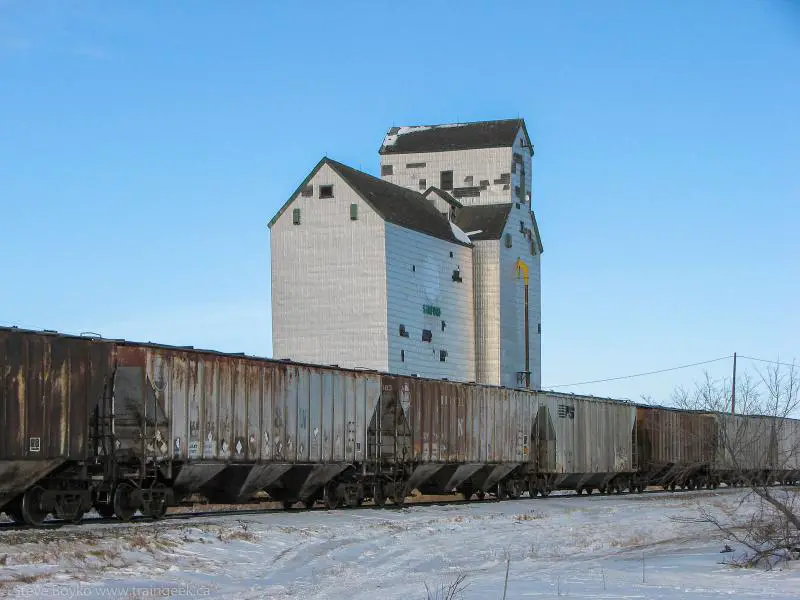
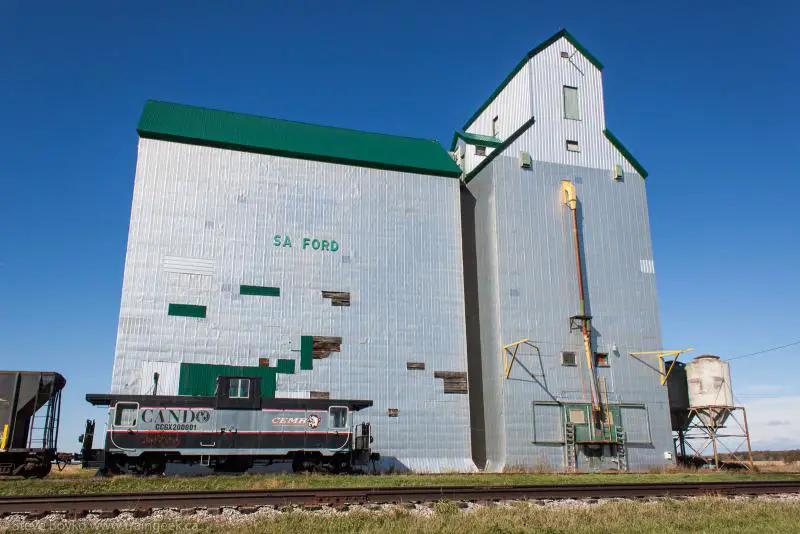
I photographed the elevator for the first time in January 2010 when chasing a CEMR train. At the time I didn't realize there was an elevator in Sanford so I shot the train north of Sanford. After seeing the elevator in the distance, I rushed to Sanford and photographed the train by the elevator.

You can see that a lot of the aluminum siding was missing at that time.

Fast forward to 2014... Glen emailed me to warn me that the elevator might be torn down, so I drove out to take my photos when I could.

This side didn't look so bad...

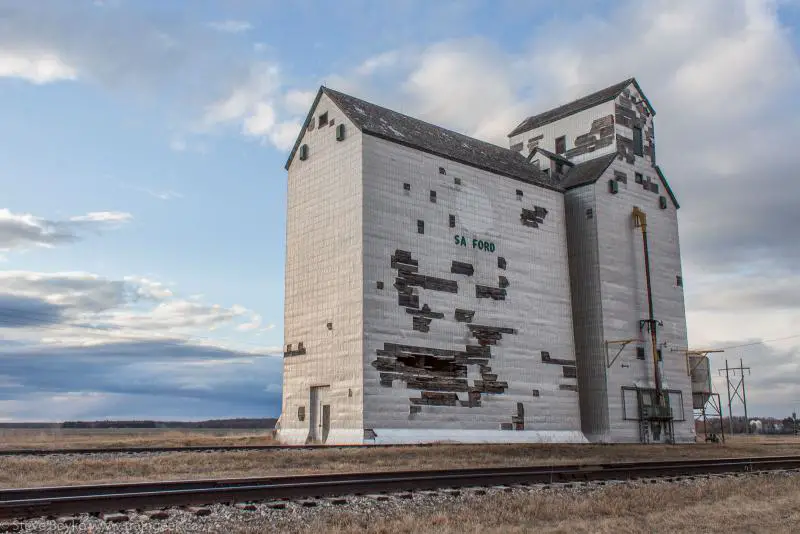
Check out the other side, though.

That's quite a large hole in the annex. Also note how much more of the siding had fallen off in the 4 years since I last photographed it.

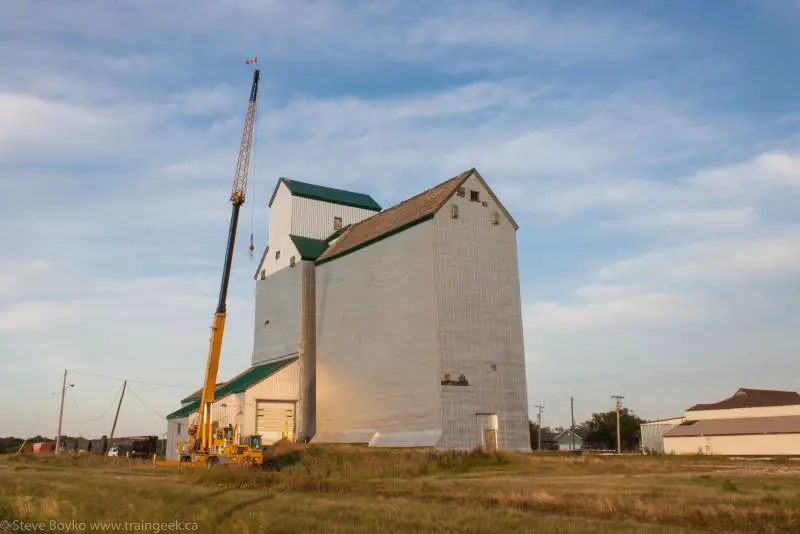
Glen contacted me later to say that the elevator was being repaired, not torn down! I was so glad to hear that. I took the kids out and we had a look at the work in progress. Glen updated his post as well to show the work.


You might recall I chased a CEMR train to Sanford at the end of last month.

In these days of elevators being torn down (Carey came down recently, and the elevator row in Warner AB was reduced by two last week) it is gratifying to see some elevators are being maintained and repaired.

I'll let Glen have the last word. Thanks for the article, Glen! Please go read his blog at flatlandersramblings.blogspot.ca - it's good!
Word has it they are returning next year to complete the work and rebuild a gaping structural hole on the east side and then re skin as well. Someone suggested they should turn this elevator into a museum and community space, similar to what they did to the elevator in the town of Plum Coulee in southern Manitoba. Either way, I'm glad the elevator will continue to stand guard over our little town for years to come.