Showing posts with label quebec. Show all posts

Saturday, July 29, 2017

Three Passenger Trains in Northern Québec (Guest Post)

The following is a guest post by Al in Vancouver... enjoy!

In June and July of 2017, I had the opportunity to ride three passenger trains in northern Québec. This guest post will focus on overall impressions and tips for railfans.

Sept-Îles - Schefferville
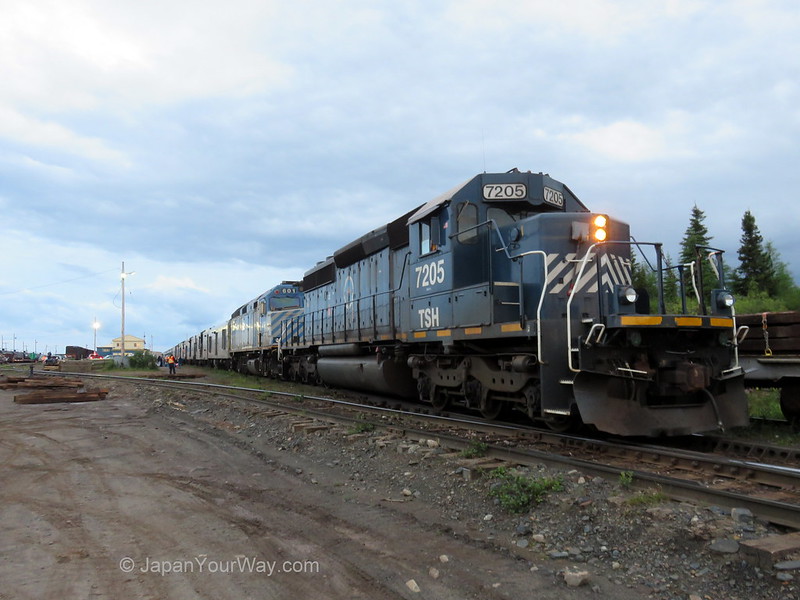
1-IMG_9369 This passenger service is operated by Tshiuetin Rail Transportation, owned by three first Nations in the region.  The head end crew and track between Sept-Îles and Emeril, Labrador are provided by the QNS and L Railway, a wholly owned subsidiary of the Iron Ore Company of Canada.

The train operates twice weekly.  As tickets are non-refundable and the person at the phone number listed on the website told me the train is never full, I decided to buy my ticket at the station in Sept-Îles the morning of departure.  I was surprised to learn they only accept cash (no credit or debit cards) at the station in Sept-Îles.  There is no ATM at the station.  After all passengers with tickets were boarded, I was allowed to buy my ticket and board.  Photo ID is required at boarding.  Seating is first come, first served.
1-IMG_0084
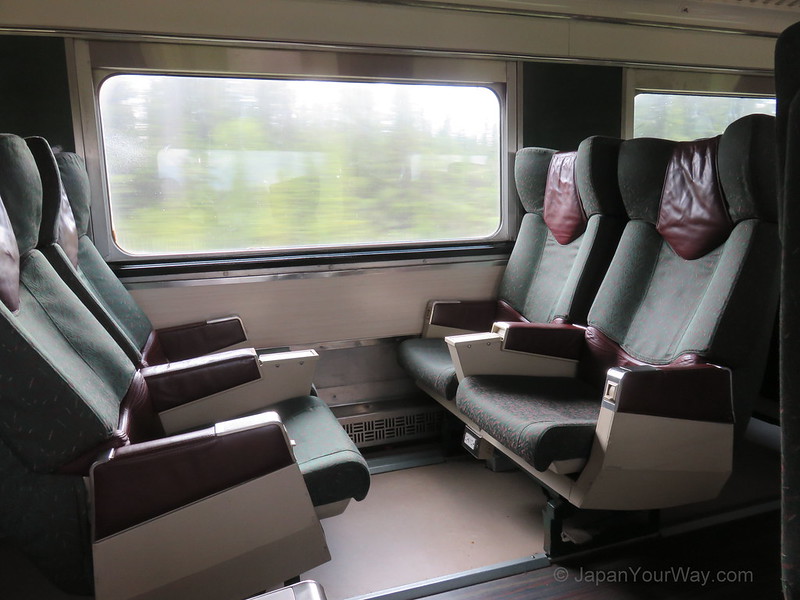
I was surprised at the length of the train:  Two locos (TSH 7205, 601), baggage generator TSH 1423, four baggage (TSH 1422, 1401, 1455, 1445), cafeteria TSH 1000, three older coaches (TSN 1002, 1004, 1005) and two newer coaches (TSH 13518 and 13517).  I was directed to sit in an older coach with red seats (TSH 1004) which was also equipped with a projector and screen suspended between the luggage racks to show movies.  I sat far enough away from the movie equipment so that it would not obscure my view out the window.  A Québec tour group (tour conducted en français) occupied the first newer coach while the trailing coach was kept for employee use.  I estimate 50 to 60% of the seats were occupied.

None of the windows on the train were clean; disappointing as this affected the view.  Even if they were clean, I believe the age of the windows would still diminish the view.  Fortunately a photographer with the tour group was given supervised access to open the vestibule windows, and I was able to use this for photos soon after we left Sept-Îles.  The interior of the train was kept quite clean.

The first 100 miles north from Sept-Îles pass through beautiful scenery as the route climbs along the Moisie River.  Sit on the left (west side) of the train for the best view.  We had a few meets with QNSL iron ore and work trains.  Speeds are generally between 30 to 40 mph.
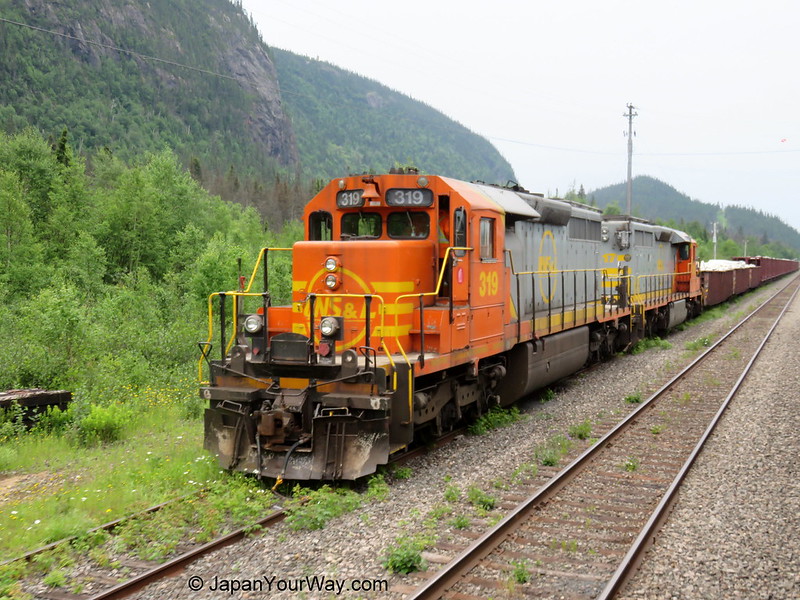
1-IMG_9436
It is interesting to watch the changes in scenery as the train climbs the Canadian Shield and gains latitude north through Labrador.  While the track is in good condition south of Emeril, there are sections north of Emeril that are rough and slow.

We arrived Schefferville around 20:30.  I did not have accommodation reserved but managed to arrange a clean, quiet and efficient room for $75 at a facility for workers named Bloc Orange.  From what I saw of the conventional motels, it is easy to pay over $200.  There is no road access to Schefferville, so things are expensive.  Your mobile phone will not work for voice or data unless you get a local SIM card.  Also note that WiFi gets very congested during the evenings due to high usage over limited bandwidth.

The road between the town of Schefferville and the train station is gravel.  If you decide to walk like I did, there is a good chance someone will stop and offer you a ride!  There is a taxi service in Schefferville, but there was a long wait once the train arrived.  I was also told the taxi is not open in time for the morning southbound departure.
1-IMG_9927
The southbound trip the following morning was on the same equipment, except that locomotives TSH 601 and 701 were leading.  The station at Schefferville accepts credit and debit cards for tickets. Again, photo ID is required at boarding.  There was no tour group southbound and both of the newer coaches were kept for employee use.

We arrived Sept-Îles around 22:00.  The train was turned prior to the station stop.  Apparently it is not unusual for the train to arrive hours late due to meets and slow orders.

There is a good thread about the train on trainorders.com and a CBC documentary on YouTube.

Full photo album on Flickr

Senneterre to Montreal
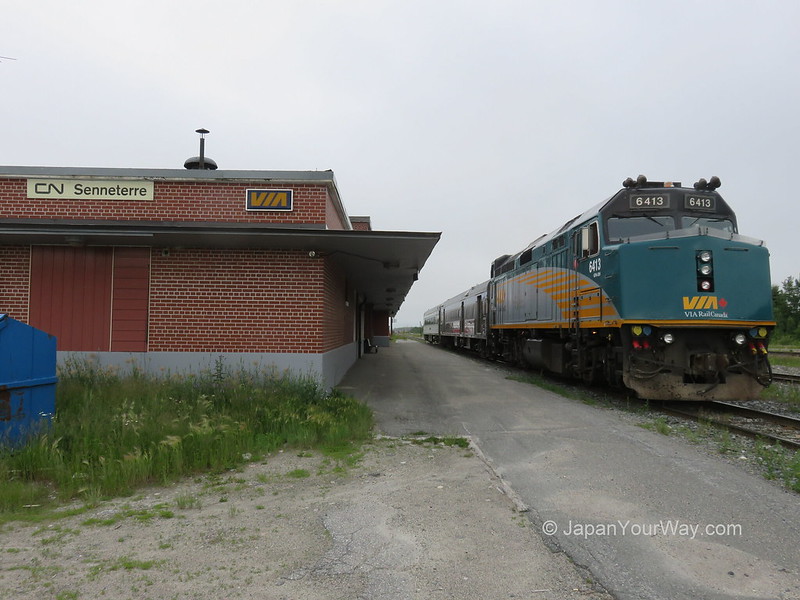
1-IMG_0321
VIA Rail operates this train, as well as the Jonquière train described below, over CN tracks.  Each train is operated with a single F40PH-2 loco, one 8600 series baggage car and one HEP2 coach. They operate three times a week.  Seat selection is not pre-assigned.

Due to limitations in my schedule, I chose to do this trip one-way from Senneterre to Montreal.  In retrospect, I would have done a return trip on this route, as the scenery is nice and because this train is always at the rear of the combined Senneterre and Jonquière train south of Hervey, providing access to a window facing out the rear of the train.

Note that not much is open in Senneterre before the train departs (even for the later Sunday departure), so bring food with you or buy it on board.

1-IMG_0380
The scenery is interesting with lots of forest, lakes, rivers and some hills.  As with the other routes, the northern portion of the route provides access to camps, cottages and settlements that do not have good road access.

We were two hours late arriving Hervey due to meets and slow orders.  We pulled into Hervey station for passengers, then reversed out to allow the train from Jonquière to get into the Hervey station ahead of us.  We then coupled to the rear of the train from Jonquière.
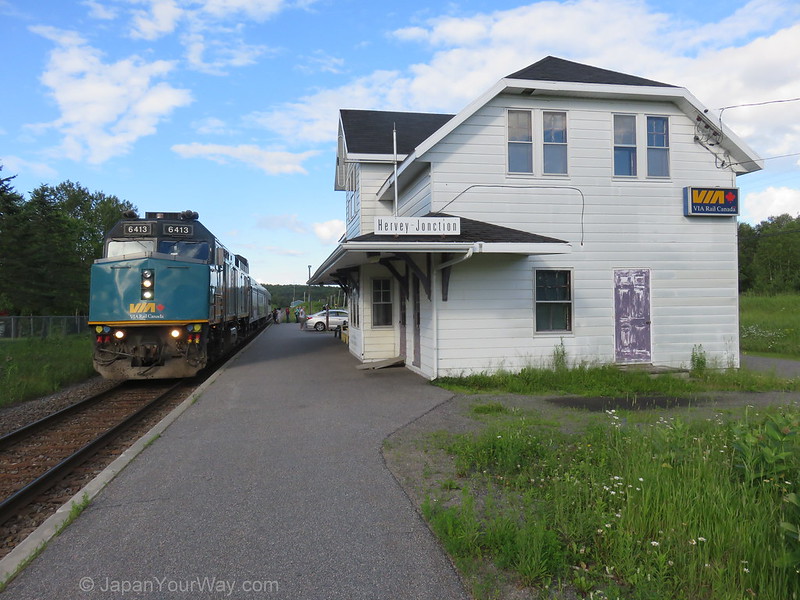
1-IMG_0848

The route from Hervey to Montreal is similar to the route between Québec City and Montreal with lots of rich farmland and stretches with good track speed.  There are some significant trestles on the Joliette subdivision (miles 50, 52, 58, 65 and 76), a tunnel at mile 51 and an interesting route through Shawinigan.

As we were still late approaching Montreal, the train stopped at Gare Sauvé for the crew to take a 20 minute rest break, allowing them to extend their operating day by 2 hours.  As the Jonquière train has a later start than the Senneterre train, the Jonquière crew is fresher and this is why the trains wait for each other in Hervey and are coupled with the Jonquière train and crew leading.  By the time we arrived Gare Centrale in downtown Montreal, we were two and a half hours late. Note this train does not use the Mont Royal tunnel, so it takes a while to route through the yard at Saint-Luc.  Most shops at Gare Centrale close at 21:00; fortunately a nearby Provigo supermarket was open til midnight.

I noticed a brochure at Senneterre station describing (en français) an outing using the train from Senneterre to Press, with a re-enactment of the last spike ceremony at Press followed by brunch and return to Senneterre by bus.  Remaining dates for 2017 are planned for August 6 and 20.  Info is available by emailing cde@ville.senneterre.qc.ca or calling +1-819-737-2296 extension 221.

The local tourist bureau can suggest activities in the region.  They can be contacted by emailing tourisme@ville.senneterre.qc.ca or phoning +1-888-437-2694 or +1-819-737-2694.

Full photo album on Flickr


Montreal - Jonquière

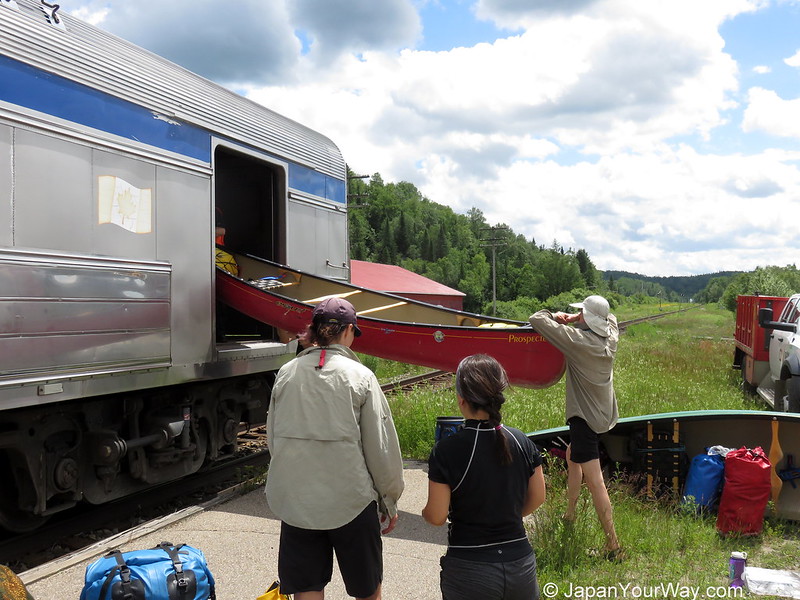
This train is assembled with the baggage car trailing the coach, i.e., locomotive followed by coach followed by baggage.  I was told this is to allow canoes to be loaded and unloaded using the rear door of the train from the baggage car.
1-IMG_1136
I didn't see this door being used, but I can imagine a stop on a banked curve or conditions at the side requiring rear access.  Note that this arrangement prevents passengers from seeing out the rear of the train.
1-IMG_1035
Between Montreal and Hervey, the Senneterre train is coupled (elephant style) to the rear of the Jonquière train. For this portion of the route, please see my comments above.

Northeast of Hervey, the route follows the appropriately named Rivière-à-Pierre upstream.  The best views are on the north side of the train.  Many cyclists used the train, and at times the coach was around 90% full.  This is a very scenic region with infrastructure for tourists.  There was some freight traffic on the line with a few meets.  Forest product companies seem to be the primary customers.
1-IMG_1177
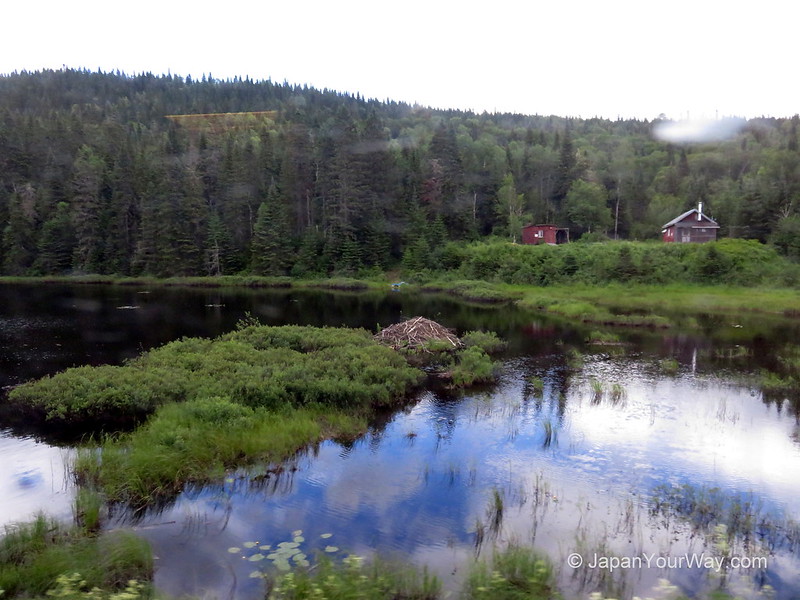
The descent into the Saguenay region provides some nice views (again, the best view are on the north side) of Lac Saint-Jean, which is huge!

The terminus station in Jonquière is conveniently located at a transit hub, providing cheap transit options throughout the region.  I stayed overnight approximately 10km away in Chicoutimi and used transit both ways.

If you are a cyclist and not familiar with Québec's Route Verte and their 5000 km network of bike paths, check out this link.  More info about taking bikes on VIA trains is on VIA's website.

Full image album on Flickr

Final Comments

I thoroughly enjoyed all of these trains.  Although it is difficult to rank them, I have to say the trip to and from Schefferville provided the most memorable experience.  This is due to the different scenery and the QNS&L railway but also because most people operating and using the train were from First Nations.  I suggest that if you take this train, try to get to know some of them (the seats in the cafeteria car provide a good place to do this).  The person who picked me up on the way to the station in Schefferville made a lasting impression as he shared his background and stories with me.  The farther north you go, the more English is spoken, so language should not be a barrier.  Note that if I did not have access to open vestibule windows, it would have diminished the experience.  You might want to bring something to clean your window!  And you should be prepared for mosquitos.

The Québec tour group I encountered on the train from Sept-Îles also offer tours using the Senneterre and Jonquière trains.  While these appear to be conducted en français, the itineraries may offer some ideas.

I'd like to ride all of these trains in winter; perhaps April or May to allow for longer daylight, before leaves on trees along the line obscure the views.

I hope you get the chance to experience these trains!

Al is a railfan based in Vancouver.  He has ridden the rails on six continents and is a guide with JapanYourWay.com offering custom tours to Japan (a great destination for railfans!) and beyond.

Saturday, October 29, 2016

Layover at Dorval


After my recent trip to Saint John, NB (see Saint John Railway Scenes and CN 406, Times Two), I hopped on a plane back to Winnipeg. Well, actually, I took two planes... a little prop plane to Montréal's Pierre Elliott Trudeau International Airport (aka "YUL") and then a jet from there to Winnipeg's James Armstrong Richardson International Airport.

I had a three-hour layover in Montréal. I decided that I wasn't going to just sit around playing with my computer or phone. I knew from a past layover that the Dorval VIA / AMT train stations were within walking distance, and since I like to walk, this could be done!

Dorval is on the CN Kingston subdivision and the CP Vaudreuil subdivision.

These Shoes Are Made For Walking

VIA 6414 at Dorval
I was fortunate that I was only a few seats back from the front of the plane, so I was able to deplane quickly and zoom out of the airport. I walked through the acres (hectares?) of parking garages and open air parking lots toward the Dorval train station.

It is a good 15-20 minute walk at a brisk pace.

I was carrying my camera bag (a Lowepro SlingShot 102 AW, if you're curious) and my laptop bag, so by the time I reached the station I was a little warm and my back was a bit sore. No worries!

The AMT and VIA stations are quite close to each other but they are separate. AMT has a pair of tracks with little one story shelters beside them, and VIA has a full train station beside their own pair of tracks. There is a tunnel that goes under all four tracks so you can go to any platform without crossing tracks.

VIA at Dorval

I looked at the AMT schedule - displayed on the station outside - and determined that nothing was coming until 13:02, so I walked over to the VIA station.

VIA 35 showed up very soon after I arrived, with VIA 6414 for power. You may remember that 6414 was the Loto Quebec unit when they were still wrapped, and was derisively labelled as "the Turd".
Spotting the consist at Dorval
In the photo above, you can see the second engineer looking back to spot the train at the right place on the platform.

There was quite a crowd on the platform but it did not take long for everyone to get on or off the train. I elected to shoot video with my iPhone as the train departed.


The consist was 6414 / 3451 / 4177 / 4118. I noted that VIA 3451 had a poppy sticker on it already.

After VIA 35 left, I went inside to check the schedule.
VIA schedule at Dorval
Nothing for an hour. Off to AMT.

Agence Métropolitaine de Transport

I knew I would have a bit of a wait for the next AMT train, but I was hoping for a freight train to come along. CP, CN and CSX all come through Dorval at different times, and on my last visit to Dorval I caught a CP freight.

I paced around by the AMT side for a while, but nothing came along until the scheduled AMT train, led by cab car 3017.
AMT 3017
They sure have a lot of horns on these cars!

I was on the wrong side of the sun but I had decided to stay here because I would have the fence in the way on the other side. Maybe wrong, maybe right, but that's the decision I made. It's important to think of these things if you have time to do so.

After a very brief stop, they continued on their way and I shot AMT 1325 pushing the consist westward.
AMT 1325 at Dorval
AMT 1325 is an F59PHI locomotive.

The End

The next VIA train was VIA 34 at 13:18 and the next AMT train was after that. My flight to Winnipeg was at 14:40 so I thought I might be pushing it a bit to wait for VIA with a long walk to the airport after that, so I set off for the airport.

In the end I was glad I didn't hang around, as the security line was pretty long and I didn't have a lot of time to wait before my flight boarded. It was the right decision.

But Wait, There's More

I neglected to mention earlier in this series that I took a few photos of NB Southern switching in Saint John that week.
GMTX 2639 in Saint John
GMTX 2639 and NBSR 911 were switching the west end of the Dever Road yard (aka "Ponderosa yard"). I took a few minutes to watch them do their thing. There is no really good angle to photograph units here without this upward look to them.

When I last saw #911 in December 2014, it was still HLCX 911. Since then, NB Southern purchased the unit and patched it to be NBSR 911. It still has the crossed out "Union Pacific" on the side, but I'm sure it will be repainted into green and yellow like the rest of the fleet eventually.
NBSR 911
For now, enjoy the patch job.

Just One More Thing

Totally not train related, but I also spotted a couple of cruise ships in the Saint John harbour.
Cruise ships in Saint John, NB
The big one was "Anthem of the Seas", a new Royal Caribbean International behemoth delivered in April 2015. This monster is just over 1/3 km long with a capacity of 4,180 - 4,905 passengers. It has a crane on board to lift a "NorthStar" observation capsule up to 300' above sea level, and an indoor skydiving simulator, as well as many other amenities.
"Anthem of the Seas" in Saint John, NB
The smaller vessel was the Disney Magic. This vessel was launched in April 1997 and can carry up to 2,700 people even though it is not much shorter than the Anthem. The Magic is definitely not as tall!
"Disney Magic" in Saint John, NB
Maybe the excursion train I saw on October 11 had been carrying cruise ship passengers?

See Also


Disclosure: This post contains one or more affiliate links to Amazon. If you purchase any item from Amazon via that link, I receive a small commission from Amazon at no additional cost to you. Just so you know.


Monday, March 09, 2015

Bailout of the Gaspe

The Quebec government has come to the rescue of the Gaspésie Railway. After serious financial troubles that threatened to shut the railway down, the Quebec provincial government has purchased the rails, assumed the debt, and will pay for repairs to the track between Matapédia and Caplan, and between Anse-à-Beaufils and Gaspé. My understanding is the government will own the rails but not operate the trains.

The existing operator, le Société de chemin de fer de la Gaspésie, or the Gaspé Railway Company, will continue for at least the next 19 months. Previously the private industries along the rails were readying a proposal to privately bail out the railway to continue service.

The section between Matapédia and Caplan is currently used for freight service, with the Temrex lumber in Nouvelle-Ouést and Gaspésie Diesel in New Richmond. The section between Anse-à-Beaufils and Gaspé is used by the l'Amiral cruise train.

Note that Caplan is short of New Carlisle, where VIA's train would typically turn when not running all the way to Gaspé. This doesn't bode well for the return of the Chaleur any time soon, as there are no facilities to turn the train between Matapédia and Caplan. At one time there was a wye at Carleton (visible on Google Maps) but it doesn't exist any more, and it wouldn't be useful anyway as the Chaleur would have to back up for 34 miles to turn on it.

I see this as a positive step and will ensure freight service for a few years. However there needs to be more customers on the line to make it sustainable. A few cars from Temrex and Gaspésie Diesel are not enough. The line has many bridges and these are expensive to maintain. There is a lot of hope with the $1 billion McInnis cement plant proposed for Port Daniel, which had good support from the government (both the previous PQ and current Liberal government).

The lack of support for the middle segment is very troubling and calls to mind the controversy over the Bathurst-Miramichi segment in New Brunswick.

Links (in French):

Tuesday, January 28, 2014

What About the Ocean?

VIA 6416 at McGivney
VIA 15 detouring through McGivney in July 2005
In the wake of the recent announcement on the fate of the CN Newcastle subdivision, many are asking what would become of the VIA Rail Ocean if the Miramichi-Bathurst section was abandoned. Well, there are three choices, one of which is highly unlikely.

Follow the Atlantic
It's possible that VIA could choose the route of the former Atlantic, running from Halifax and Moncton to Saint John and then through Maine to Sherbrooke and on to Montreal. This is highly unlikely for several reasons, including the customs clearing issues, traveling over two different shortlines (NB Southern and whatever Fortress appoints to run the former MMA), and the fact that I don't think through traffic through Lac-Mégantic has even resumed yet. I believe we can safely dismiss this option.

Through the Wilds
The most obvious choice is to run through central New Brunswick over the CN Napadogan subdivision and into Quebec over the CN Pelletier subdivision, rejoining the current Ocean route at St. Andre Junction. This is CN's main line through the Maritimes and is well maintained... despite a couple of recent derailments.

Here's a map I drew showing that route. Click on the map for an interactive version.

1977 Ocean Detour Schedule
The Ocean has detoured on this route before. Back in 1977 the Ocean was routed here for about six months due to a landslide on the northern route - the amended schedule is shown to the right. In better days a decade earlier, there was an RDC (Rail Diesel Car) that ran between Moncton and Edmundston. Heck, for a short time in the summer of 1967, the Cabot ran between Montreal and Sydney via Edmundston, and from October 29, 1967 to January 7, 1970 the Ocean ran via Edmundston while the Scotian continued on the northern route. This route would be similar today but since the Pelletier cutoff was built, the train would not go through Monk and Ste. Claire.

There are a few downsides to having the Ocean run over the Napadogan.
  • Northern New Brunswick and northern Quebec would lose their passenger service. There is an alternative, Maritime Bus in NB and Orléans Express in Quebec, although I think you'd find most people would rather take the train.
  • There are fewer available passengers over the Napadogan route, given that the Napadogan runs through virtual wilderness between Moncton and Edmundston. This would be a gain for Edmundston, Grand Falls and a few other communities, but fewer passengers = less revenue = more chance of outright cancellation.
  • A capital investment would be required for VIA to provide station facilities, as nothing really exists since passenger service ceased in this area.
One upside might be that Fredericton could get indirect passenger service via a connection at McGivney.. maybe.

Give It Up
The most serious possibility is that VIA Rail will simply stop running the Ocean altogether. The chilling headline Via Rail's Maritime-Quebec passenger service in doubt says it all.

A spokesperson for VIA Rail, Mylène Bélanger, was quoted as saying: "At this time it's still a hypothetical question, but if this section is abandoned we'll look into the commercial viability of all other alternatives, for connecting between Halifax and Montreal, before adopting any other route." (emphasis mine)

As for purchasing the section of track between Bathurst and Miramichi, Bélanger said, "Via Rail does not have the financial resources to acquire or maintain this section of the tracks. So we'll wait for any developments."

But What About The Gaspé?
One more thing - don't forget that the train serving the Gaspé peninsula (the former Chaleur) ran as part of the Ocean between Montreal and Matapedia. If the Ocean was to run a different route, or be cancelled altogether, the economics of the Gaspé train would be even worse as it would have to bear the entire cost of the Montreal-Matapedia section.

You may recall that the Gaspé train has not been running for quite some time, due to track problems. These track problems have been solved between Matapedia and New Carlisle, yet VIA has not committed to returning to the route.

The future of passenger rail east of Montreal is more and more in doubt.

EDIT: Thanks to Tom Box for a few corrections.

Wednesday, December 18, 2013

Trains Return to Lac-Mégantic Today

More than five months after the rail disaster in Lac-Mégantic, a freight train will roll through town today. The Montreal, Maine and Atlantic (MMA) railway is running a short six-car train loaded with prefabricated panels from Tafisa, a local manufacturer of particleboard and melamine panels. No dangerous goods will be on the train.

Meanwhile, a bidder has emerged for the bankrupt MMA. Railroad Acquisition Holdings, LLC, believed to be a subsidiary of Fortress Investment Group. It is expected that more bidders will emerge before the deadline of January 17, 2014.

Tuesday, August 20, 2013

Fight Over Lac-Mégantic Cleanup Costs

The Quebec provincial government has added CP Rail to its list of companies deemed responsible for the cleanup of the Lac-Mégantic disaster. The Montreal, Maine and Atlantic (MMA) is on the list, of course, as well as the Western Petroleum Company (owners of the rail cars?) and World Fuel Services (the purchaser of the fuel).

The finger-pointing is in full swing. World Fuel Services says they aren't responsible, since they dealt only with CP, and CP subcontracted to MMA. CP is appealing the decision and says they aren't responsible. At least the MMA is not denying they have some responsibility.

Let's face it - nobody is going to step up and say they are responsible if they can avoid it. The cleanup costs are going to be huge (estimated at over $200 million) and the class-action suit(s) are going to pile on too (they're already going after CP). It would be crazy for any company (except MMA) to pay now, before any official reports have come out about the accident.

Fortunately, the water quality is improving. There's no word yet on the tons of contaminated soil in the "red zone" (explosion area) and what is to be done with that.

In other Lac-Mégantic news, the MMA may get an extension to their operating permit since they have said they still have liability insurance. They can operate to October 1 provided they can prove they have liability insurance by August 23.

The CBC is reporting that J.D. Irving is considering purchasing the MMA rail lines. This makes a lot of sense, since the MMA line provides their only direct connection with CP in Quebec (see map).

Here's a few other blogs who have done some analysis of the Lac-Mégantic incident:

Aside: When did the NB Southern web site start referring to the NB&M Railways instead of NB Southern? It looks like someone did a massive search and replace. I looked at archive.org, and apparently the NB Southern web site still said NB Southern on June 21, but now it says NB&M.

Wednesday, August 14, 2013

The End Of The MM&A?

The recent railway disaster in Lac-Mégantic, Quebec has ended the lives of 47 people, changed the lives of the town's residents forever, and now it may spell the end of the Montreal, Maine and Atlantic Railway.

On Wednesday August 7, the railway filed for Chapter 11 bankruptcy protection in the USA and simultaneously filed for relief from credits in Quebec provincial court. They disclosed the following:

  • their Canadian liability insurance (through XL Insurance) does not exceed $25 million;
  • their Canadian net worth is about $18 million;
  • their gross revenues have declined from about $3 million/month to $1 million/month post-accident; and
  • expected cleanup costs are expected to exceed $200 million, much greater than the value of the insurance plus the value of the company.
Under this protection, the company can continue to operate to attempt to operate, provided the judge permits it.

However, another blow was struck on Tuesday August 13 when the Canadian Transportation Agency revoked the MMA's license to operate due to a lack of liability insurance. This is an obvious step, since their liability insurance will be fully committed to the Lac-Mégantic cleanup and they're not going to be able to get more insurance. The railway has until August 20 to wind down its Canadian operations. The Agency is going to review other federally regulated railways.

This marks the second time that rail line's owner has gone bankrupt, since Iron Road Railways went bankrupt in 2002.

Monday, July 29, 2013

Inauguration of l'Amiral Excursion Train

Saturday (July 27) marked the inaugural run of the l'Amiral excursion train in the Gaspé peninsula. The train left New Richmond and traveled to Bonaventure and back. They offer coach service with finger foods as part of the ticket price, with beverages available to be purchased on-board.

Here's their promo video:

There are two upcoming public runs (schedule):
  • August 15: New Richmond - Bonaventure
  • September 22: Gaspé - Percé
It looks like they are hoping to catch some cruise ship traffic. Gaspé had 11 cruise ship visits in 2009 and I see there are six scheduled for September and October 2013.

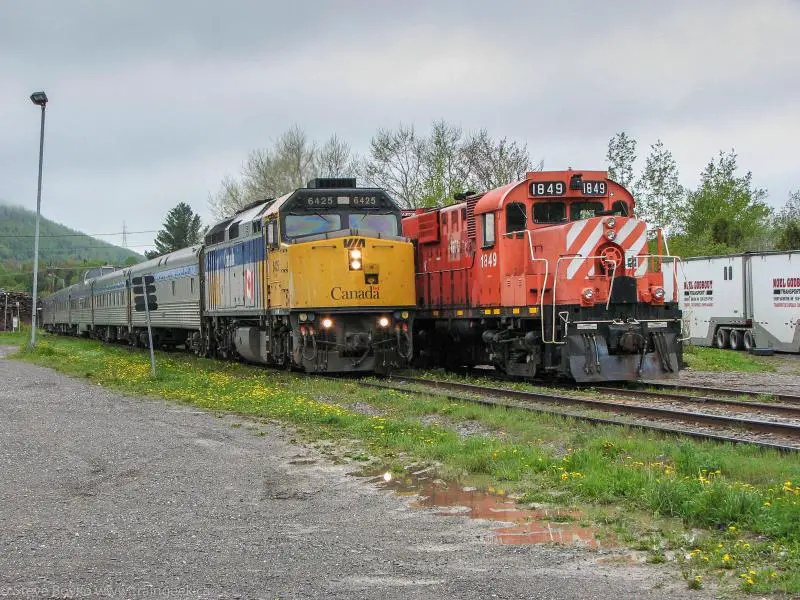
For the railfans among us, the train has ex-CP and ex-NBEC 1849 for power, followed by a former CN steam generator car SFG 602 (now with a generator to supply power for the rest of the train), and three coaches (ex-AMT cars SFG 1059, SFG 1047, among others). The coaches have been completely refurbished from their AMT days.

Of course, they have a Facebook page as well as a Twitter account.

Thanks to Bernard Babin for the information on the power car.

I wish them good fortune!

Sunday, July 28, 2013

Lac-Mégantic, Three Weeks Later

It's been 22 days since the terrible derailment and disaster at Lac-Mégantic. The community is no doubt still in shock and trying to make sense of the disaster. It is believed that 47 people died, although some have yet to be identified. The CBC says life is slowly returning to normal but I can't imagine the town will be anything like "normal" for a long time.

The federal government has promised $60 million in aid for the town, matching the province of Quebec's contribution. About 1,000 runners ran the 12 km from the Eastern Townships to Lac-Mégantic to raise money for the victims.

A lot of focus has been placed on the operation of MMA trains by a single crew person. This Eastern Railroad News article talks about the introduction of single-person crews. In theory a one-person crew can operate a train but I have questions about the operation of main line trains by single crews, mainly what might happen if the crew-person has health issues while operating the train.

The Transportation Safety Board has posted a Rail Advisory Letter after the accident, advising Transport Canada to consider reviewing its procedures on unattended trains. Transport Canada has issued an emergency directive disallowing one-man operation for trains with tank cars, as well as other directives for unattended trains. New Brunswick Southern Railway has announced changes to its operating procedures, although it never left main line trains unattended anyway.

Of course, the lawsuits have begun, with a class-action suit naming pretty much anyone with any involvement.

A fellow named Mathieu Huchette posted a photo purportedly of the lead engine (MMA 5017) on fire at Nantes, just prior to the train rolling away.

The MMA has laid off a large portion of its employees (19/80 in Canada and 79/179 in the USA) due to the continued closure of the line through Lac-Mégantic. The company is reported to be struggling financially, and its Farnham, Quebec offices were raided by police looking for information for their investigation.

Much more to come.

PS - Eastern Rail News have other related articles on their news page but they are subscription-only. Consider subscribing - it's quite inexpensive right now.

Wednesday, July 10, 2013

More on Lac-Mégantic

Many more details are emerging on the Lac-Mégantic disaster.

MMA's chairman, Edward Burkhardt, was interviewed about the accident. His position is that the railway followed generally-accepted practices. He said the practices were obviously not sufficient and they have made changes already: the train will continue on to Sherbrooke and not change in Nantes, and the trains will not be left unmanned.

Burkhardt visited the scene today, and during media interviews he basically said the engineer didn't set enough hand brakes. "It seems an adequate number of hand brakes were not set, and this is the engineer's responsibility. I don't think he'll be back working with us." Apparently the train engineer, Tom Harding, pulled nine of the tank cars out of the way after the explosions started.

Here's a good piece describing how train brakes work and how trains are parked. MMA officials said that all five locomotives had their hand brakes on, but it did not say how many cars also had their hand brakes on. The accepted rule of thumb is 10% of the cars plus 2 brakes. For a train of 5 engines and 72 cars, at least 9 hand brakes should have been set. The fact that the train was on a slope should have been considered as well.

There is speculation that the initial explosions were caused by propane cars in the downtown. This makes more sense than the crude oil exploding. Crude will burn, of course, but it is not that volatile.

The cleanup continues, and the grisly task of finding and identifying bodies is part of that. The Quebec police are currently treating this as a crime scene. Mr. Burkhardt said that MMA has not been permitted access to the locomotives.

Many towns with railway tracks nearby are now questioning the railways. Rothesay, NB is questioning CN and Harvey, NB already talked to NB Southern. So is Ste-Anne, MB. I think it's good that they are questioning, so they can update their emergency response plans and be aware of the risks. I don't think it is realistic to expect the railways to share the exact consist of every train passing through, but it would be helpful for the towns to know what kind of cargoes travel through.

Monday, July 08, 2013

First Thoughts on the Lac-Mégantic Disaster

By now I'm sure you have read the news reports about the Lac-Mégantic train accident.. but if not, here's the recap: a Montreal, Maine and Atlantic (MMA) freight train was parked a few miles outside of the town of Lac-Mégantic, Quebec. The engineer booked off and left, and sometime in the early morning the unmanned train rolled into Lac-Mégantic, derailed and a number of explosions occurred, followed by intense fires. At this point it appears that thirteen (13) people were killed but it is likely that this number will rise, as up to 40 are reported missing. The explosion and fires happened in the downtown core and the town is devastated, physically and emotionally. About 2,000 of the 6,000 people living in the town were evacuated and at least 30 buildings downtown have been destroyed.

From this press release from MMA and CBC and National Post reports, the timeline appears to be:
  • July 5, 23:15: Train stopped and tied down by engineer at Nantes. The train had 5 locomotives and 72 car loads of crude oil, destined for Irving Oil in Saint John, NB.
  • July 5, 23:30: Nearby resident calls 911 and reports a fire in the parked train. Firefighters respond and put the fire out. A track maintenance employee of MMA was present.
  • July 6, ?????: Train starts rolling downhill to Lac-Mégantic.
  • July 6, 01:15: Train derailed at Rue Frontenac crossing in downtown Lac-Mégantic
  • July 6 (later): Firefighters battle the intense blaze through the day. 13 intact carloads pulled from rear of train by MMA.
From the second press release by MMA, it appears the engine(s) were shut down after the engineer left, presumably during or after the firefighters arrived to put the fire out. What is disturbing to me is that the MMA statement says that the shutdown "may have resulted in the release of air brakes on the locomotive that was holding the train in place". I am no railroader but section 112 of the Canadian Rail Operating Rules is quite clear on this.

When equipment is left at any point a sufficient number of hand brakes must be applied to prevent it from moving. Special instructions will indicate the minimum hand brake requirements for all locations where equipment is left. If equipment is left on a siding, it must be coupled to other equipment if any on such track unless it is necessary to provide separation at a public crossing at grade or elsewhere.

(emphasis mine)  The implication is that air brakes cannot be relied upon to hold a train in place. Again, I am strictly an amateur but this did catch my eye.

The National Transportation Safety Board is investigating and they have 14 people on the scene. I understand the locomotive event recorder has been recovered. That will help fill in the timeline as to when the train started moving, and most crucially, when the air brakes were released.

In addition to the tragic loss of life, the destruction of the town, there are concerns about water quality due to the quantity of spilled crude oil.

There are some railfan reports that the runaway train may have struck a set of propane cars that were in the town and those are what caused the initial explosions.

My heart is broken at the thoughts of the people killed and injured as a result of this terrible accident.

EDIT: More information here that confirms that the firefighters shut the engine down before battling the blaze.

Thursday, October 11, 2012

Grey Cup Train Update

Grey Cup Tour
The eastern railfans have been reporting on the Grey Cup Train as it made its way to Halifax.

October 7: It is believed that the train was tacked onto the end of Sunday's VIA 2 (Canadian) as it left Winnipeg.
October 9: VIA #2 (Canadian) arrived in Toronto in the afternoon with the Grey Cup Train.
October 11: VIA #14 (Ocean) left Charny, Quebec just after midnight with the Ocean, Chaleur (VIA 16) and Grey Cup train consists. The entire Grey Cup Train was at the end of the combined VIA 14/VIA 16 consist, so the train had 3 F40PH-2 engines, 6 Budd cars (VIA 16), 13 Renaissance cars (VIA 14), VIA 6445, and the 6 Grey Cup cars. Quite a long passenger train for the Maritimes!
October 11: VIA #14 (Ocean) left Campbellton, NB at about 10 AM with the Grey Cup train on the end.
October 11: VIA #14 (Ocean) left Moncton, NB at about 3:40 PM with VIA 6436 and VIA 6432 on the head end, to meet VIA #15 at Evans.

Here are the next few public train viewing dates. Go to http://www.greycuptour.ca/stops for more details.

  • October 13: Train at Halifax VIA Rail station (1161 Hollis Street).
  • October 14: Train at Moncton VIA Rail station (1240 Main Street).
  • October 17: Train at Quebec City VIA Rail station (450 rue de la Gare du Palais).

The original plan was for the Grey Cup train to leave Halifax on Sunday, October 14th at 05:15 as VIA #3, to be at the VIA Rail station in Moncton for the 11 AM opening. It may end up departing on Saturday night instead.

Thanks to everyone in Quebec, New Brunswick and Nova Scotia for their excellent reporting.

Monday, May 03, 2010

Trans-Quebec Express

There's a new railway idea in Canada... the Trans-Quebec Express. The idea is to have a railway run from Gaspe to Nunavut through Quebec... over 9,000 km of track.

Of course, it really isn't a new idea. The author of the site says he has been dreaming of this for over ten years. There is an article in Nunatsiaq Online stating that a petition with over 4,000 signatures was presented in Quebec's "National" Assembly.

I don't think I need to say any more about this idea. Good luck!

Thursday, April 22, 2010

VIA Rail Issues Tender to Repair Cars

VIA Derailment, by Bernard Babin
VIA Rail has issued an Invitation To Tender (ITT) to repair four cars damaged in the February derailment in Saint-Charles-de-Bellechasse, Quebec.

"This train was composed of two F-40 (2) locomotives and seven (7) stainless steel HEP1 passenger cars. VIA has elected to repair four (4) cars externally. For this reason, VIA is seeking the services of an external Service Provider to perform the required repairs in order to bring the cars back to their running condition."

IRSI? :)

Saturday, March 27, 2010

CN TEST Train

CN's TEST train has been noodling around the Maritimes in the past week or so. The train had the usual two blue cars.

Here's an okay video by NBEC69 of the TEST train with CN Geep 4770 pulling the train. Nice horn.

Saturday, March 06, 2010

VIA Derailment Update

On March 2 a train (VIA 300) went up the Montmagny subdivision to the VIA derailment site at St-Charles, Quebec, to bring the damaged train back to Montreal. The cars they brought were to provide braking power for the train, as they can't trust the damaged train to have proper brake connections. The train had ex-GO 521 for power, with Chateau Closse, and coaches 8132 and 8112.

At the time, all the damaged cars were on the track, with VIA 6400 coupled onto the Skyline facing east and VIA 6457 a couple of cars further facing west.

Ron Pelletier reported that VIA 303 left Joffre at 21:30 on March 3 heading west to Montreal, with the entire train. They had to proceed at a maximum of 20 MPH and stop and inspect every hour.

Sunday, February 28, 2010

More VIA Derailment Photos

VIA 6400 damaged at derailment site. Photo by Bernard Babin
Bernard Babin took more photos at VIA derailment scene in St-Charles, Quebec (first set here) on Saturday, February 27.

I fear for VIA 6400. Maybe the damage is only to the cowl but it looks bad. In this photo you can see her trucks have been removed and she is sitting on the fuel tank and ends.
VIA 6400 without trucks at derailment site. Photo by Bernard Babin

Bernard's words: "All equipment is still present on site, the 6400 is standing in loco, cars are near the scene of the accident, in the siding. Note that two sleeping cars are there in the subdivision Levis, where the sub leaves Ultratrain Levis to get on Montmagny subdivision. The cars are very close to 0.68 MP not far from the crossing."
VIA 8507 and train at St-Charles, Quebec. Photo by Bernard Babin
It almost looks like a burn mark on the outside of the Skyline car under the "Canada".

By comparison, VIA 6457 looks pristine... but only by comparison. Still, from this photo the damage looks relatively superficial.
VIA 6457 at the accident scene. Photo by Bernard Babin

Thanks again to Bernard for the photos.

Saturday, February 27, 2010

VIA 15 Derailment Photos

Bernard Babin very kindly gave permission for me to post these photos of the VIA 15 derailment site. He and his friends went to the site a few hours after the derailment and took some photos in the falling snow.

Derailment scene. Photo by Bernard Babin
Workers at the scene of the derailment.

VIA 6400 on her side. Photo by Bernard Babin
VIA 6400 on her side. 6400 was the lead engine of the train. Note the ladder propped against the nose, probably to help the crew get out of the cab.

VIA Skyline car after derailment. Photo by Bernard Babin
The Skyline car and the coach were still upright after the derailment. Note the destruction to the house on the right, as well as the downed power lines.

VIA 8620 derailed. Photo by Bernard Babin
The junction of VIA 8620 and 8140. It's amazing that they stayed coupled together.

The train had the following consist: engines 6400 and 6457; baggage 8620; coach 8140; Skyline 8507; diner 8401 Acadian; and sleepers 8225 Chateau Rouville, 8211 Chateau Laselle, 8222 Chateau Richelieu.

The line was reopened the same day, around 6 PM local time.

Bernard and friends host the Trains en Gaspésie web site. Check it out!

Thursday, February 25, 2010

VIA 15 Derailed

The westbound Ocean derailed near St-Charles-de-Bellechasse, near Quebec City, around 4:30 AM this morning. VIA 6457 and the rest of the train left the tracks and ended up in someone's backyard, upright.

There are conflicting reports about injuries. CBC is reporting 7 injuries out of 120 passengers and 7 crew. VIA is saying four passengers were transported to hospital. The occupant(s) of the house are OK but the house is definitely damaged.

Michel Boudreau reports that he saw the train in Bathurst with VIA 6457, 6400 and the stainless steel set (1 baggage 1 coach, 1 Skyline, 1 diner and 3 sleepers). An AtlanticRails members' daughter was on the train and said the Skyline is on its side or leaning badly.

There are no reports yet on why the train derailed. This is the Google Map for the area.

CBC article, Montreal Gazette

Monday, January 18, 2010

Change of Maintenance on Chaleur Line


Former NBEC 1849 at the Temrex mill in Nouvelle Ouest, Quebec

le Soleil is reporting that RailTerm will take over maintenance and operation of the Gaspe rail line from CN in April 2010.

The Société du chemin de fer de la Gaspésie (SCFG) owns the rail lines from Matapedia to Gaspé. The SCFG subcontracted maintenance and operation of the line to the Quebec Railway Corporation, and thence to CN when the QRC was purchased in November 2008. Once RailTerm takes over, CN will continue supplying cars and billing customers, but will not be responsible for operation and maintenance of the line.

The two major sources of income for SCFG are the Temrex mill in Nouvelle Ouest, and VIA Rail. The SCFG is hoping to get some traffic from the wind farm being built near Gaspé. They expect to save hundreds of thousands of dollars per year under the new contract.