Showing posts with label 6429. Show all posts

Friday, October 21, 2011

VIA Rail's Winnipeg Maintenance Centre Part 4

Continuing on through VIA 6429 at the VIA Maintenance Centre... part 1, part 2, part 3.

The cab itself is not greatly changed in layout. There is a third folding seat mounted on the back wall of the cab, and a microwave has been added behind the "conductor's" station. I put "conductor" in quotes because there is no conductor on VIA trains. Both head end crew are qualified engineers and usually take turns in the driver's seat. The Service Manager is responsible for looking after the passengers and stays in the passenger cars.

This is the breaker panel mounted on the wall behind the right seat. I did some primitive Photoshopping to brighten the left side enough so it can be read. The big knife switch on the left is the master power for the unit.
Breaker Panel in VIA 6429

Also on the back wall is the engine control panel (see below). The "big red switch" is the kill switch for the engine. Note the four switches fixed in one position.

On the right are the headlight controls. Each unit needs to be set up as a leading or trailing unit.
Engine Control Panel in VIA 6429

Here is the bearing monitoring system panel, made by Lanka Technologies.
Bearing Monitoring System in VIA 6429

Below is the panel to set up the head-end power (HEP). It includes the genset start/stop button.

There is a left and right side HEP cable that goes from the engine(s) back to the train consist. The rule of thumb is that you need one HEP unit for every 15 cars. For trains less than 15 cars long, one engine supplies both sides. The two dials at the bottom set up the left and right side HEP. In the photo I believe this engine is set up to provide HEP to both sides of the train.

Tommy did a valiant job of trying to explain HEP to me but I don't think I completely grasp it. As I said, there is a left and right hand cable going from the engine(s) to the first car in the consist. Each side powers a portion of the car (presumably one side per cable) and normally the cables cross over between cars. This means the right hand cable from the rear engine powers the right hand side of the baggage car but the left hand side of the coach behind it, and so on. There are control panels in each car that allow VIA crew to reconfigure the HEP in each car in case of failure. For example, if HEP fails on one side, they can flip sides to keep one side of the car powered, such as the kitchen in the diner car.
HEP Control Panel in VIA 6429

"Black boxes" were added to the engine during the rebuilding. These Train Trax units from Wabtec record all engine parameters. They do not record sound in the cab.
Event Recorder in VIA 6429

The rebuilt units have the Silent Witness video camera (V60BC5060), now owned by Honeywell Video. The video camera points out the front window and also records outside ambient noise such as the bell, horn, and crossing bells. The early rebuilds did not have them but I assume they will retrofit those.

Another major item installed during the rebuild is the Wabtec QES-III unit. This upgrade brings a host of new features to the F40, including improved performance, better adhesion control, individual traction motor cut-out, and more. There is a display in front of the engineer allowing control of many of these features.

This is the QES-III control unit.
Wabtec QES-III in VIA 6429

This is the unit, opened. I had to resist the temptation to poke around, again because this is the kind of stuff I enjoy working with.You can read more detail here.
Wabtec QES-III in VIA 6429

What else, what else... I mentioned the new microwave. The hot plate is still there on the left side console. In the short hood, accessible from the cab by a couple of steps down, is some storage space and of course the toilet.
Toilet in VIA 6429

That's the end of VIA 6429.

After that, we went outside the building to take a quick glance at VIA 6443 and then walk through the train ready to become the next VIA 693. We'll do that in part 5, and then wrap things up in part 6 with a few photos of the Northern Spirit cars.

Next - part 5

Thursday, October 20, 2011

VIA Rail's Winnipeg Maintenance Centre Part 3

Diesel engine in VIA 6429

After viewing the interior of the VIA Rail Winnipeg Maintenance Centre, and looking at the changes to the exterior of VIA 6429, we went inside the unit to see its interior. I've been in a few cabs but I had never been in the engine compartment of an F40PH-2 before.

The big blue diesel engine aka "prime mover" dominates the compartment. That baby is a General Motors 16 cylinder 645E3C, delivering 3,000 horsepower to the traction motors. Most people know that the vast majority of "diesel engines" are actually diesel-electric engines, with a diesel engine driving an alternator or generator to produce electricity for the electric traction motors that drive the wheels. The F40PH-2 is no different. The 645 engine drives a generator that produces DC current to supply the traction motors powering all eight wheels.
The engine also drives a smaller alternator to provide 500 kW of Head End Power (HEP) at 480V for use by the passenger cars it is pulling. This is how the original VIA F40PH-2 engines provided power for the cars.

The rebuilds have included a separate diesel engine that provides HEP independent of the prime mover. Canadian Allied Diesel (CAD) is the prime contractor for the F40 rebuilds, and they subcontracted the HEP engine to Hewitt Equipment Ltd. Hewitt supplied a Caterpillar "genset" on a skid, basically a diesel engine combined with an alternator.  I'm told the genset is a Caterpillar C18 with a 6 cylinder engine running at 1800 RPM delivering 831 horsepower, and the genset delivers 500 kW of power.

With the Cat HEP unit, the main diesel engine can use all of its 3000 HP to move the train forward. As well, when the train is stopped, the Cat HEP can continue to run while the main engine idles, saving fuel. Previously the main engine had to be in "run 8" (full power) to provide head end power.

The HEP unit is mounted on a skid and is designed to be easily replaceable. There are doors at the rear of the engine that open, and after disconnecting a few cables and hoses, the entire unit can be slid out and replaced.

The cabinet below contains the "brains" of the genset and has local controls for the HEP power unit.
HEP control box in VIA 6429


Every engine has some kind of cooling system, and the F40 is no different. It is water cooled and below are some instructions on the cooling system. As well, there is a manual sight glass showing the level of water in the system.
Cooling System Instructions in VIA 6429


Another major part of the F40 refurbishment was the addition of a Hotstart unit. These are made by HOTSTART, Inc. formerly known as Kim Hotstart. In some sense a Hotstart unit serves the same purpose as the block heater in your car. The Hotstart unit keeps the engine coolant and lubricating oil warm and has its own pump and heaters to warm the fluids and keep them circulating. This allows the main engine to shut down during extended stops without any worry of the engine freezing up. If the Hotstart unit draws the batteries down too much, or it can't maintain the proper temperature, the main engine will be restarted.

This is a model DV3300-0904-X01 operating at 480V and 51A. It has a local Siemens TD200 control panel. This kind of stuff really interests me because this is the kind of work that my company does.
Hotstart in VIA 6429

After admiring all of this new equipment we moved into the cab... part 4.

VIA Rail's Winnipeg Maintenance Centre Part 2

VIA 6429 in Winnipeg

First off, welcome to the new followers that joined in the past week! Also, thank you for the nice comments on part 1 of this series.

In this part I will talk about VIA 6429. As I said in part 1, I had the opportunity to tour VIA Rail's Winnipeg Maintenance Centre. After walking around the inside of the building, we went inside VIA 6429 to take a look inside at the improvements made in its recent refurbishment.

VIA Rail's F40PH-2 engines are all being rebuilt to extend their life and make them more fuel-efficient. You can read VIA's statement on the rebuilds here. Their new model number is GPA-30H, replacing the three series GPA-30A through C. The engines are totally stripped and rebuilt, so there are a lot of changes and improvements. The major changes include:
We started with the outside. The most obvious change, of course, is the new paint scheme. I've featured that enough on my blog already!

The new units all have a third Xenon headlight mounted under the original two. This headlight was tested on VIA 6420 among others. Tommy told me that it really cuts through fog and mist, and also improves the train's visibility to motorists.
VIA 6429's nose

You might notice some extra stuff on the roof too. Here's a closeup of VIA 6449's roof.
VIA 6449 roof

Emergency horns have been added on both sides of the roof. These are in addition to the regular horn, which is still well back of the cab on the roof. The emergency horns are considerably louder than the regular horns and are intended to be used for... well, emergencies. I can imagine they are quite loud to the engineers sitting right underneath them.

There's a light on the roof between the two emergency horns. On many locomotives this indicates that the engine is a remote control unit, but that is not the case here. When flashing, it indicates that the engine has been manually shut down and the Hotstart unit will not monitor the unit. It is intended to warn crews and maintenance people that the Hotstart microprocessor is not going to keep the unit warm and charged.

Now let's look at the rear of the engine.
VIA 6429 roof

The HEP generator is in the very back of the engine, so there is a little "hump" at the back of the hood, with its own cooling fans. The dynamic brake grids are on the side of the engine, in the bottom right of the photo above.
Rear of VIA 6429

The original F40PH-2 engines had one rear headlight in the top centre, but the refurbished engines have one off to the side.

The speedometer used to be mounted on the lead axle of the unit, but it was found that this was the most common wheel to slip. As part of the rebuild, the sensor has been moved to the second axle. It's a small change but it shows the level of thought put into the rebuild project.

In part 3 we will go inside the engine and have a look at the new HEP generator, Hotstart unit, QES-III unit and other cab improvements.

EDIT: Corrected the meaning of the light on the roof - thanks Tommy!

Wednesday, October 19, 2011

VIA Rail's Winnipeg Maintenance Centre Part 1

VIA Rail Winnipeg Maintenance Centre

I was recently offered the chance to tour VIA Rail's Winnipeg Maintenance Centre. VIA Rail engineer Tommy Bozyk, who is also active with Operation Lifesaver, made the offer and I gladly accepted. We eventually settled on Friday, October 14th, as it is least busy there during the day with no Canadian (VIA 1/2) or Hudson Bay Winnipeg-Churchill train (VIA 693/692) departing Winnipeg.

The maintenance centre is at the end of Brandon Avenue, off Osborne Street behind the bus depot. I arrived there at 10 sharp and met Tommy at the entrance. After signing a waiver and the visitor log, I met the shop foreman and began the tour. I was given the run of the place and the only restriction was that I could not take pictures of any VIA Rail employees. Tommy had already cleared my presence with VIA management so everything was on the "up and up".

The shop building has four tracks numbered 1-4 with 4 being closest to the CN main line in Fort Rouge. Sleeper cars Chateau Brule (8203) and Chateau Viger (8229) were both on track 1. Brule is the one on the right in the photo below.
Inside the VIA Rail Winnipeg Maintenance Centre
VIA 6449 (left) and 6429 (right) were also in the building, on track 1.
VIA 6449 and 6429 in the Winnipeg VIA Rail Maintenance Centre
Track 2 has a drop table and track 3 has a selection of traction motors parked on it.

The WMC does all the servicing for the Winnipeg-Churchill train, as well as any incidental work that needs to be done on the Canadian as it passes through Winnipeg. The WMC is capable of doing any repairs and maintenance short of a rebuild.

We went to look at the passenger cars first. This is Chateau Brule (VIA 8203).
VIA 8203 - Chateau Brule
As you can see from the photo above, there was some work going on underneath. Chateau Brule was undergoing a wheel changeout. In the photo below, you can see that one end of the truck is jacked up and the supporting rails were removed to allow access to the wheels.
Chateau Brule wheel changeout
Since the cars were being worked on, we did not go inside the ones inside the building.

Here's a shot from the south end of track 4, showing VIA's Trackmobile attached to the end of Chateau Viger. The Trackmobile is used to move cars around.
Trackmobile in the VIA Rail Maintenance Centre
When the trains are brought to the centre, the VIA engineers deliver the train to one of the tracks on the east side of the building. Employees at the centre then break up the train and move cars and/or engines around on the grounds.

VIA 692 returns from Churchill and goes to Union Station in downtown Winnipeg. When they are done unloading passengers, it continues east to Beach Junction just north of CN's Symington Yard, turns on the wye there, and comes to the Winnipeg Maintenance Centre pointing "railway west". Once or twice it has been spotted turning at Portage Junction instead.

Two engines were inside the facility, VIA 6449 and 6429. As you can see from the photo below, they are pointing "railway west" or south as the rest of us call it.

VIA 6429 in the Winnipeg VIA Rail Maintenance Centre
Tommy took me into VIA 6429 and went into great detail on the locomotive systems. That'll be part 2!

Sunday, July 17, 2011

Recent VIA Trains

I wanted to post the last four Canadians I've seen, since I haven't mentioned them before the last VIA 1 I posted from June 16. Some were hum-drum, some were a bit more interesting.

For the first three I shot the Monday, Thursday and Saturday trains in sequence. I started with VIA 1 at mile 10 of the CN Rivers subdivision on July 4. It had VIA 6458 and VIA 6429 on the head end, with a normal summer consist.
VIA 6458 in Winnipeg

Next, I saw VIA 1 at Kenaston Boulevard (maybe mile 6?) on July 7. This one had VIA 6410 and non-refurbished VIA 6424.
VIA 6410 in Winnipeg

This one was interesting because it had VIA 4121 deadheading behind the engines. VIA 4121 is a coach destined for the Skeena.
VIA 4121 in Winnipeg

For the Saturday train, I got them back at mile 10. This had the Loto Quebec unit, VIA 6414, leading two other engines, 6453 and 6452, on July 9.
VIA 6414 in Winnipeg

I took a break after that and did not shoot the Monday Canadian, but I did get out on July 14 for the Thursday train. I drove up to St. James Junction, stepped out of my car, and there it was, ready to be shot. Perfect timing.
VIA 6429 in Winnipeg

I got a wave from a diner in the Acadian.
Wave from diner aboard train

Is that enough stainless steel for one post? ;)
VIA's Canadian passenger train

Tuesday, April 05, 2011

404 on 4/04

I went out at noon Monday to shoot the Canadian. After a miserable rainy Sunday it was nice to be out in the bright sun. I set up just west of mile 10 at the Perimeter and I didn't have to wait long before VIA 1 came along.
VIA 1 in Winnipeg


You may know that VIA 6429 used to be the Telus unit. Here's the only time I saw it on the Canadian, back on October 19, 2009.
VIA 6429 in Winnipeg
Now it's another refurbished unit. I think there are only two wrapped VIA engines left - Loto-Quebec 6414 and one Spiderman unit.

As you may have noticed in the video, VIA 1 called a "clear to stop" signal so they were set to stop at Diamond. I was quite surprised by this, so I jumped in the car and tried to get ahead of them. Unfortunately, due to the wet weather on Sunday the road was quite muddy and I couldn't get a decent speed on. They did stop briefly before Diamond before starting up again. I came abreast of them just west of Diamond and pulled over to get the going-away shot before they pulled away. I did notice that Strathcona Park was the trailing car.
VIA Canadian in Winnipeg
Note the mud in the foreground!

I headed back through the mud at a more sedate pace. I heard CN 404 call a clear approach signal to Diamond, so I knew they would not be long. I set up to catch them at about mile 11 and here they are.
CN 2329 on train 404 in Winnipeg
Matched GE ES44DC engines CN 2329 and 2339 provided the power.

It was nice to see CN 404 on 4/04!

Saturday, October 24, 2009

Monday's Trains

I never got around to posting the trains I saw Monday noon. I arrived near St. James Junction and I immediately saw CN 2553 and CN 5732 hauling a westbound container train past. Definitely no time for a tripod!

Sometimes you get lucky and the train is right there; sometimes you miss it by 10 seconds. :)

The Canadian could be seen right afterward. It came up to St. James Junction and stopped, presumably waiting for the freight to clear the block so it could proceed. After about 10 minutes, the Canadian started up again. From my vantage point near Kenaston I could see the lead engine was green, meaning it was the Telus engine VIA 6429.
Telus engine VIA 6429 on the Canadian in Winnipeg
It had a diner "Empress" deadheading behind the engines. On occasion you can see a car deadheading (traveling unoccupied) as VIA moves equipment around.

Full consist here in my railway sighting database.

Monday, June 23, 2008

Two Oceans, One Day

I had a quick trip up north today. I saw CFMG 6902 at rest in Miramichi with a bunch of 86' boxcars around the yard.

VIA 14

I heard VIA 614 was late, so I elected to wait a few minutes outside Bathurst for it to leave. I was rewarded by this sight of the Telus unit, even with its peeling paint.
VIA 6429 "Telus" leading VIA 14 out of Bathurst, New Brunswick
ASSINIBOINE PARK was on the tail end of the train, with a Renaissance consist.

"Assiniboine Park" on the tail end of the VIA Rail "Ocean"

Here's the video!

Ore Train

Later, I arrived in Bathurst just as the NBEC ore train returned from Belledune. NBEC 1819 and 1851 powered a short train.
NBEC 1819 in Bathurst, New Brunswick

VIA 15

I beat it to Miramichi to catch VIA 15. Fortunately they were late, so I had time to go to the river bridge to get this shot. Railpictures liked it - my first accepted photo of 2008.

Prince Albert Park was on the tail end of this Ocean.

Here's the video for VIA 6400!


PS - Sadly, VIA 6400 lasted less than two years after this photo was taken. It derailed in Quebec in February 2010 and was written off.

See Also


Thursday, March 30, 2006

Northern New Brunswick, 2006/03/29

On the 29th I went up to northern New Brunswick, and of course saw a few trains on the way. It was a beautiful day, blue sky and sunshine, so the photos turned out.

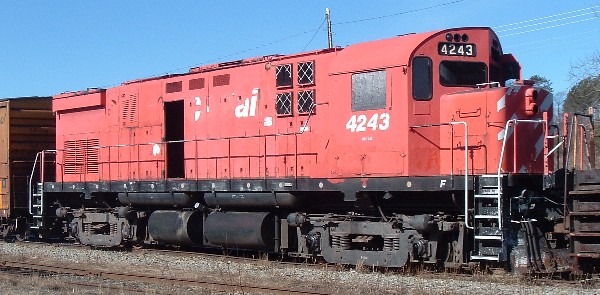
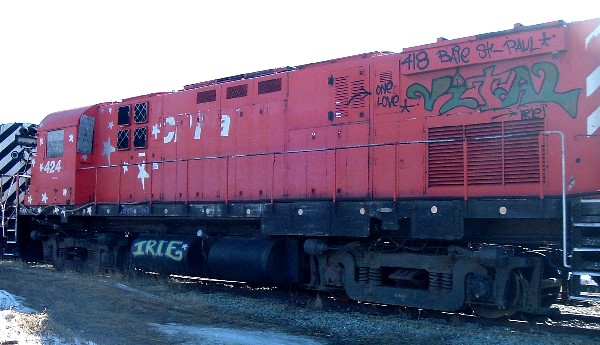
In Miramichi at 9:45, I found CFMG 6907 on the back track, idling away. The big surprise was at the end of the track, where I found NBEC 1821, 4219 and 4243 fresh from their stint at IRSI in Moncton. I believe 1821 is not operational and 4219 and 4243 are definitely not operational. They provided parts for SFEX 4203 and 4204 a while ago.
NBEC 4219
NBEC 4243
NBEC 4243
Apologies for the last shot - I had to shoot toward the bright sun

For some reason the paint on 4219 is much darker than 4243 or 1821.

A crew was doing work on the track just railway north/west of the station.

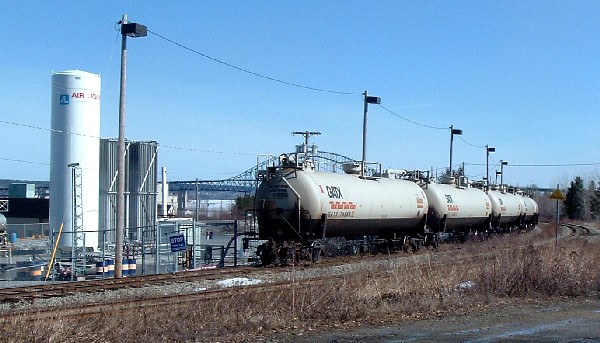
I ventured over to the Chatham side of the river and found a ram of tank cars at the Ultramar depot (GATX 75568 to 75584) at 10:00.
Tank cars at Ultramar

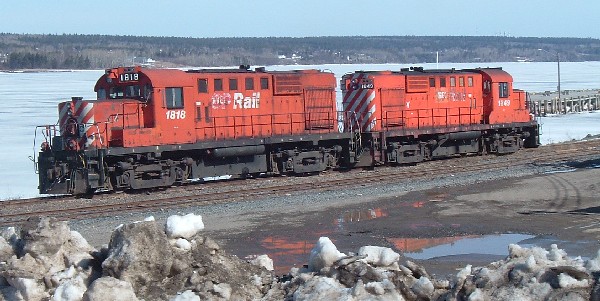
NBEC 1818 and 1849 were idling behind the mall at the end-of-track on the Loggieville spur.
NBEC 1818 and 1849 in Chatham

NBEC 587, the ore train, was working the smelter at Belledune around 11:20. I dropped by the Chaleur Lumber spur and I saw six centerbeam flat cars there (3 loads, 1 partially loaded).

I heard NBEC 587 still at Belledune at 17:10 and I saw the second unit was CFQC 3000, mainly by the flashing light on top. There was another RS18 leading but I couldn't get the number.

I dropped by the yard in Bathurst and there was no power there, but I heard NBEC 403 get a rollby inspection from someone. Right after that, I saw an MOW crane get off the tracks at Golf Road and call the dispatcher (in French) to tell them they were clear. 403 arrived at 17:35 with NBEC 6901, 6904, 6900, and 1818 from this morning in Miramichi. It was unusual to see three of the four NBEC-lettered SD40s on one train!
NBEC 403 arriving at Bathurst
Train 403 had 3 chip cars, 12 boxcars, 1 tank cars, 1 86 foot car (HLMX 86182), and the ram of 17 empty tank cars from Ultramar (GATX 75568 to 75584). 34 cars.

I arrived at the VIA station in Miramichi at about 18:45. I talked with the agent there and he said VIA 15 would arrive in about 10 minutes. I decided to try to catch him by UPM on my way out of town. I got stuck behind someone driving at 30km/h (seriously? 30???) but after they turned off I made good time. I made the left at the lights by UPM and saw the headlights on the bridge across the Miramichi river and brought the car to a screeching halt. I hopped out and started taping.. just in time. The engineer gave me a few toots on the way by.
VIA 15 at UPM-Kymmene, Miramichi
VIA 6429 (Telus) led, and they were deadheading a Skyline car behind the second engine. There were 12 cars in total.

Another great day!