While in North Dakota I took a little trip west of Grand Forks to see the grain elevator at Emerado. I was hoping to see a train too, but nothing came along. Here's the view along the tracks.
You can see there is a siding and an elevator track. The trackside signs say "ESS EMERADO" and "EMERADO". Roger Workman tells me ESS stands for "East Spring Switch". As you probably know, a spring switch is a switch that can be run through from the frog end and returns to its original position after the train has gone through. It is useful at the end of sidings so that the conductor doesn't have to reline the switch after his/her train has left the siding.
Now, on to the elevator.
It is owned by the Emerado Farmers Elevator Company. Not much is available on the Internet about them. The USDA page I just linked says they deal in "Chemicals, Fertilizer, Seed, Grain, Fertilizer Application, Trucking, Feed". Not unusual for a grain elevator these days.
Quite a few annexes with this elevator!
While I was there, I couldn't help but notice the nice crossing signs.
Emerado is probably better known for being just south of the Grand Forks Air Force base. The base is fairly young, having been formed in 1955. It hosted F-101B Voodoos and then F-106 Delta Darts for a short time, moving on to the Safeguard anti-ballistic missile system, before hosting B-52s and B-1 bombers. It also had Minuteman ballistic missiles until 2001. It used to host KC-135 tankers as part of the 319th Air Base Wing until late last year. Word is that it will host RQ-4 Global Hawks starting this year.
When I was in Grand Forks last weekend, I shot a couple of BNSF snow plows sitting in the yard. I shot caboose BN 10024 and plow BN 972510 first.
I also saw BN 97501 by itself.
I like these plows - different than we have in Canada. They resemble a Jordan spreader but I think these are dedicated plows.
Just a quickie post... I heard CN 346 was leaving the CN Symington Yard onto the Sprague subdivision, so I caught it at Deacon's Corner just south of the bridge crossing Winnipeg's all-important floodway.
CN 8883 and CN 8820 were the power on the head end.
About mid-train, CN 2684 and CN 2332 were the distributed power (DPU). I'm not sure I've ever seen two DPU units stuck together on a CN train before.
The head end of the train was grain hoppers, with a few miscellaneous cars mixed in, and a collection of empty autoracks on the tail end.
Don't forget - the next Winnipeg slide night is coming up fast - April 6 at 7 PM.
The four presenters are:
John Morris – CPR in the Rockies [35mm slides]
Fred Headon – CNR [35mm slides]
Warren Froese – Motor Cars [Digital]
Jeff Keddy - CEMR [Digital]
Next Wednesday's show is in room B126 in the north campus of the Canadian Mennonite University at the corner of Grant Avenue and Shaftesbury Boulevard - here. The H-shaped building housing the day-care is the building that B126 is in.
After that, the next slide nights are May 4 in room B132, and June 1 in room B126.
EDIT: Mark Perry is unable to attend so Jeff Keddy will be showing his CEMR photos instead.
Today's Canadian was a pretty ho-hum train, on a ho-hum day.
Two engines, nine cars, as usual (full consist). I did note that someone left a hatch open on the nose of 6419. I wonder what that is for? Gas cap? Is the SERVICE ENGINE SOON light on in the cab?
Here's the video.
They were off and running for the west.
Little did I know that VanBilly1 was just east of me filming the same train at Waverley Street. Here's his video.
Shortly after they left, BNSF 2756 pushed two gondolas and a dozen tank cars over to Fort Rouge, headed by their caboose BN 12580. Here's VanBilly1's video of it at Waverley Street.
Have you ever wondered what the heck White Balance is? Well, wonder no more. This article explains what it is, how it affects your photography, and how to use it. Recommended.
This morning I was traveling along Wilkes Avenue and heard that CN 115 was coming, and CN 111 was going to overtake her before Diamond. I stopped around mile 8 and saw the headlights of 115 in the distance on the north track. CN 115 poked along at a jogging pace...
Note the piles of new ties by the tracks. The Herzog machine has been busy distributing the tie bundles for the upcoming work season.
Here we see the problem with shooting westbound trains in the morning.
Beautiful light on the sides, but the nose is totally in darkness.
The going-away shot is much better lit.
The paint is falling off poor CN 2501. Even the SD60 CN 5533 is in better shape.
CN 115 continued trundling on and on, probably frustrating many morning commuters as it blocked crossings all along Wilkes. I didn't count the cars but there were well over a hundred.
Eventually the end of CN 115 came into view, and beyond that I could see the headlights of CN 111 in the distance.
111 covered the distance at a much quicker pace. CN 2274 and 8898 were the sole power on a short CN 111.
I had thought I would have video of train 111, since I just let the Canon S3 continue recording all the way through CN 115. Unfortunately, it stopped recording before 111 was done... because it hit the maximum video size of 1 GB. Who knew there was a limit? I was too busy clicking away with my T1i to notice that the video had stopped. Dang it.
I'll spare you the highly-backlit shot of lead engine 2274 and just show the going-away shot.
PS - Apparently there is a CHDK hack that removes the 1 GB video limit, and provides other goodies like RAW files, motion detection and scripting. I haven't tried it and of course I do not warrant it will do anything good or bad for your camera!
The Canada Geese have arrived in Winnipeg for their yearly honkfest. Witness these two geese frantically flying out of the way of the Hudson Bay.
VIA had just finished crossing over from the south to the north track, and would accelerate up to track speed (40 MPH) after crossing the St. James diamond.
Just prior to that, BNSF Manitoba brought their engine, BNSF 2756, and one gondola back from the CN Fort Rouge yard. They did the same maneuver, crossing from the south track to the north track, then taking the switch to their yard.
Continued from part 1. We stayed in Grand Forks until noon on Monday. I woke up before sunrise and headed out to see what I could shoot in the few hours allotted to me. Railfanning involves a lot of negotiation at times!
BNSF 2271 and 2327 were sitting at the west end of the yard with a mixed train in tow. Soon a train headed by BNSF 9147 and BNSF 9138 pulled up beside them. I think they were arriving from the east, because I saw those two units later by the roundhouse.
At the time I thought 9147 was going to head out, so I relocated to the wye just west of US 29. I didn't know whether they would take the wye track to go south or go straight west. I had a lot of indecision, but eventually parked at Amtrak and resolved to wait and see. Soon I heard a horn blowing for crossings, and ran over to see that the train was taking the wye. I hastily planted my tripod (with the Canon S3 on it for video) and grabbed a few shots with my T1i. The problem was that I still had the long lens on it so I couldn't get any wide angle shots.
BNSF 2086 (GP38-2) and BNSF 3207 (GP50) took a train south to Fargo.
I soon heard more horns, and BNSF 9840 (SD70MAC), BNSF 6396 (ES44AC), and BNSF 6065 (ES44AC) took a long empty coal train south to Fargo. I didn't get any video of this, alas.
I went to the east end of the yard and found quite a few units parked near the roundhouse. BNSF 3126 was still parked in the same place I saw it the day before, but this time it was joined by BNSF 2256 (GP38-2).
BNSF 8178 and 8154, both SD60M engines in Burlington Northern green, were visible in the back.
BNSF 4106 and 4191, also seen the day before, were parked but looking like they were getting ready to go.
Other units visible were BNSF 5639 (AC4400CW), BNSF 6205 (SD39), BNSF 5256 (Dash 9-44CW) and BNSF 8225 (SD75M). Off in the distance I saw two small switcher units switching, BNSF 3703 and xx34. 3703 is an MP15, definitely the first of that type I've seen.
After cataloging the units visible, I headed north on Washington Street to see if I could find some grain elevators. I did... and a few industrial units too!
I was driving around the north end of Grand Forks today (Monday) when I spotted this caboose. It is painted as a Great Northern caboose, although I have no idea if it really was a GN caboose. It is at the headquarters of R&R Contracting, a full service rail construction, maintenance and removal company. The caboose is well-maintained and looks quite sharp.
I'm back in Winnipeg now but I have more to write about Grand Forks.
We were in Grand Forks, North Dakota for a quick shopping trip to the good ol' USA. I managed to finagle a bit of train-watching time and spent it around the BNSF yard in town. When I first arrived, little switcher BNSF 3429 (SW1500) was working the west end of the yard but I was unable to get a photo of it.
I went to the east end of the yard where the turntable is. I parked my van and walked across Demers Avenue to get some shots from the sidewalk. BNSF 1745 (SD9) was working the east end but wasn't really in a good photo spot. BNSF 3126 was posed quite prettily, though.
BNSF 3126 is a GP50, built in August 1985 for the Burlington Northern. I found a photo of 3126 with BNSF 2886. You may recall that 2886 was a resident of Winnipeg for less than a month from late September to mid October 2009. This might be the first time I've seen a GP50.
Also parked in the yard were BNSF 4191 and 4106, both Dash-9s, unfortunately not in a great position to be photographed.
BNSF 2327 and 2271 (both GP38-2s) were also parked near the "roundhouse", and 2327 was in a nice spot for a photo.
After taking all the roster photos I could, I went for a drive west to see if I could find any trains there. No luck, but I did find a BNSF truck getting off the rails at Emerado, so that pretty much guaranteed no trains for a while. On my return to Grand Forks, as I approached the Amtrak station on the west side of town, I saw a coal train coming north from Fargo. I parked just east of the wye and shot BNSF 8880 and 9354 coming into Grand Forks with a loaded coal train.
BNSF 8880 is an SD70MAC and BNSF 9354 is an SD70ACe, both quite modern engines.
That was the end of my railfanning for Sunday. Not a bad haul!
Remember you can click on most photos for a larger version, and the complete list of units shot can be found in my railway sightings database.
Here are a few recent YouTube videos I saw and wanted to share with you.
Kevin Gaudet posted this video of CN 120 at Memramcook. The train had CN 8949 (shiny new SD70M-2), IC 1036, and CN 2666.
I can't get used to CN 120 having all this non-container junk in the train. CN 120/121 used to be pure container trains, but with the loss of most of the freight trains in the Maritimes, 120 and 121 get to carry the junk. Some of this would have gone on CN 148 and 149 but they do not run any more.
RailFanJon shot an empty coal train growling by on the CP Shuswap subdivision in British Columbia. Lots of good noise from the engines as they throttle up.
VanBilly1 caught two CEMR engines going into the BNSF yard here in Winnipeg. This was a great catch. On Monday, March 14, BNSF had put their engine on the ground (or, as we say it, derailed) around 14:00 and the CEMR engines were coming to help out while BNSF tried to get their engines back on the rails.
I was browsing through old photo albums when I came across some photos I took of the Prairie Dog Central railway back on August 18, 2001.
I was surprised to see engine 8454 front and center. 8454 is an MLW S-3, built in 1952 for CN. I saw it in Moose Jaw last summer at the Parrish and Heimbecker elevator.
I remember that my father-in-law, my son and I all took the train from Inkster Junction to Warren and back. It was fun. Here's the engine running around the train at Warren.
I was out running errands at noon and figured I'd try to get the Canadian at Portage Junction today. When I arrived there, the sun was shining, the sky was blue, and BNSF 2756 was ready to head back to their yard "running light" (with no cars).
I positioned myself to look straight down the mainline track. The nice thing about Portage Junction is that you can get fairly close to the tracks without trespassing. Soon I saw a headlight in the distance as the Canadian ran past Fort Rouge.
Here they are, passing under the signal tower.
Notice the big hump behind the engine? It was Rocky Mountaineer car RMRX 9527.
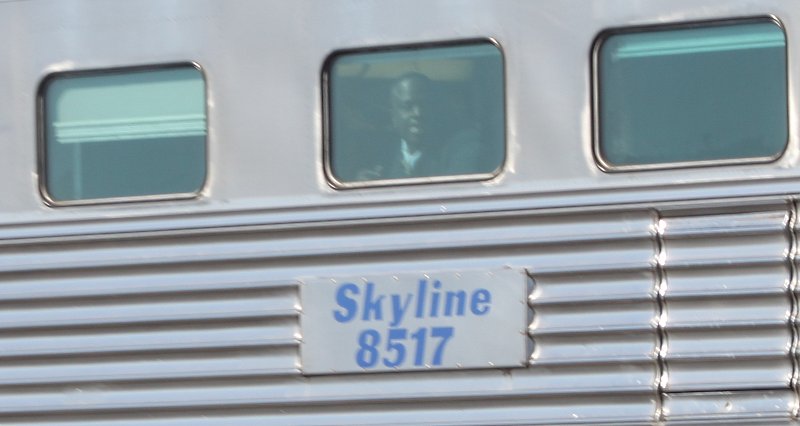
I shot each car as it went by, to record the car numbers. A gentleman in Skyline 8517 was chuckling at this idiot standing on a snowbank with a camera.
They rounded the corner at Portage Junction and headed toward Waverley Street and points west.
Part of a movie entitled "The Railway Children" will be filmed at the John Street Roundhouse in Toronto, Ontario. A steam engine will be imported into Canada for use in this production. It is scheduled to arrive in Halifax on March 28 and be brought to Toronto.
IRSI in Moncton has been refurbishing VIA LRC (Light, Rapid, Comfortable) cars. The first car, coach VIA 3315, was released recently. Matt Soknacki caught it as part of a corridor train VIA 64.
Externally there are not many changes. The bottom is coloured Renaissance green instead of blue, the VIA logo is smaller, it has a thin yellow stripe above the windows, and it currently does not have a Canadian flag on it.
Here's a video showing the car in the middle of this train.
Matt has a few more photos of the car exterior in his photo album. For members of the Yahoo! group CanPassRail, there are some interior LRC photos in the group's photo album.
The LRC car left Moncton on March 4 on the tail end of the Ocean.
The contract with VIA was announced in May 2009. IRSI is refurbishing the cars to bring them up to date, but mainly to make them more accessible to people with disabilities.
The export train, CN 316, arrived in Halifax early Friday afternoon. The train had CN 5524 leading, five export locomotives, and a flatcar on either side of the export locos.
09:00: Through Moncton
13:05: Sandy Cove
13:30: Arrived in Halifax
David Othen posted a great video of CN train 316, among other trains.
Skip ahead to 3:26 to see the export train. They took the siding to allow one-engined VIA 15 to roll on by - also in the video. CN 120 was first on the video.
The GM export engines were parked near the Halifax Ocean Terminal (HOT), waiting for their ship to come in.
CN is running an export train to Halifax as I write this. CN X316 was ordered out of Toronto at 21:30 on March 16, due in Joffre PQ at 14:30 on March 17 and 22:30 in Edmundston.
CN X316 actually left Joffre at 12:30 on March 17, so it was ahead of schedule. The train consisted of CN 5524 and 5 export locomotives, presumably on their own wheels.
It appears that X316 spent the night in Edmundston waiting for a crew, then proceeded to Moncton last night / early this morning. It is currently following CN 120 into Halifax and should arrive shortly after noon.
All of this information comes from the excellent AtlanticRails mailing list, a great resource for railfans in the east.
In other news, VIA's Ocean had an engine problem and set off VIA 6453 somewhere west of Campbellton. The Chaleur split off at Matapedia as usual and proceeded with VIA 6402, and the Ocean kept going with one engine, VIA 6456. Presumably Friday's Ocean will depart with that engine only.
I was driving around with my young son this evening and happened to come across VIA 2 coming into Winnipeg.
I rarely see the eastbound Canadian because it comes in at night. I used my 50mm prime lens for its light sensitivity, and I think it turned out OK in the dim light.
The Canadian was a bit longer than usual, 13 cars including two deadhead Manor cars behind the engines and ahead of the baggage car. Full details.
I certainly had a mixed day Sunday when visiting Portage.
I set out from Winnipeg around 7:30 AM and headed west on the Trans-Canada Highway. CN was quiet and there was nothing to hear or see on the way. I reached Portage and went in to see the downtown. The signal lights were all showing red, indicating no traffic on CN nor CP, so I took some photographs for my model train layout. I was particularly interested in the West Tower area where the CP Carberry, CN Rivers, and CN Gladstone subdivisions meet. I was amused to see that some pigeons were warming themselves on the switch heaters on the CN Rivers sub.
Finally I heard some discussions on the CN RTC channel that seemed to indicate that a train was switching at Bloom, west of Portage. I headed out of Portage that way, only to encounter CN train 304 heading east into Portage. Drat! I knew I wasn't able to catch up to it inside Portage, so I drove around the city intending to catch it on the other side as it left East Tower. However, there is no place to exit the highway on that side, so I kept on driving.. and driving.. until I reached Newton. CN calls this Nattress, mile 50.4. I set up at the crossing of highway 331, and I didn't have to wait long until CN 304 blew through.
CN 8922 was leading and ex-UP unit CN 2100 was trailing.
I should have turned the video camera a bit to the left.
After they passed, I drove back into Portage. I decided to go shoot the grain elevator at CP Tucker just east of Portage. While there, I heard CP 8877 West tell the RTC that they set off the WILD* and had to set off a car. Since I could hear them, they were nearby... but where? My handy dandy Trackside Guide told me that the WILD is at mile 44.8, east of Portage, so they were coming my way! I set up and waited only a few minutes before their headlight came in view.
I figured I could easily beat them to the other side of Portage, so I drove around Portage (again) and turned south on highway 305 to the CP crossing. They soon came into view.
They pulled up to the switch, and the conductor dismounted to get things ready to set off the bad order car. As there were already cars in the siding, they had to get them ready to move so they could shove them back. Of course, the derail and the switch had to be taken care of too.
The train pulled ahead over the crossing.
I believe the bad car was about the 65th car, so they would have had to pull until that car was next to the conductor. He would then cut off the rest of the train and leave it there, then the train would pull ahead until they were clear of the switch. The conductor would line the switch for the siding (having taken care of the derail already and released the handbrakes on the cars already in the siding), then the train would shove into the siding until the bad car was fully in the siding. Then, cut off the bad car, pull ahead, reline the switch, and join the train back together again.
That solved the mystery of what was just west of Simplot - a siding.
Anyway, I didn't stick around for that operation. I went across the highway to CN Bloom and took some photos there, while CN 314 was still switching. I noticed that the tail end of 314's consist had this car.
Then I headed north on highway 16 to see the elevator near Macdonald. I took a quick peek in the town of Macdonald itself, and found a little MOW** train there. It had a gondola, CP caboose 420991, and some kind of MOW contraption that looked like it would be used to help lay welded rail.
Time was running short for me, so I zipped up to the elevator north of Macdonald. It's a Pioneer elevator at "Dundonald". The leased GP15 was there and I snapped a bunch of pictures.
On my way back down highway 16, I saw CN 302 was passing 314 at Bloom, so I set up for video and took some more shots.
I was out of time, so I wasn't able to shoot the Simplot facility. Next time.
I headed toward Winnipeg, gradually getting ahead of CN 302 as they had to stop at Nattress for CN 115 to go by. I saw 302 a bit behind me as I approached Elie, and suddenly I noticed VIA's Hudson Bay coming the other way. A track speed meet! I pulled over to the side of the road and took a series of photos as they passed each other. Fantastic.
As I crossed over the CN mainline at Wilkes Avenue, I saw the lights of CN 302 in the far distance.
But...
You'll notice I haven't included any pictures of the elevator, the GP15, CN 302, or the meet at Elie. Unfortunately, sometime at Macdonald, I bumped the selector wheel on my camera and changed it from Tv (Shutter speed priority) to Av (aperture priority). This meant that all my photos were tremendously overexposed and ended up pure white. Imagine my disappointment when I looked at them at home!
Moral of the story: LOOK at the photos you've just taken. I reallly dislike chimping, but I guess there has to be a happy medium between looking at every shot and doing what I did. Sigh.
Enjoy the shots I did get! :)
* WILD = Wheel Impact Load Detector. It measures the force that the wheels put on the rails, and is basically looking for flat or damaged wheels.
** MOW = Maintenance Of Way.